Showing posts with label Saguaro National Park. Show all posts

Wednesday, July 28, 2010

The Good-bye Chronicles Chapter 5: A Return to the Beginning

1. Saguaro NP east Saguaro National Park Rincon Mt. Unit 7-18-10

July 18, 2010

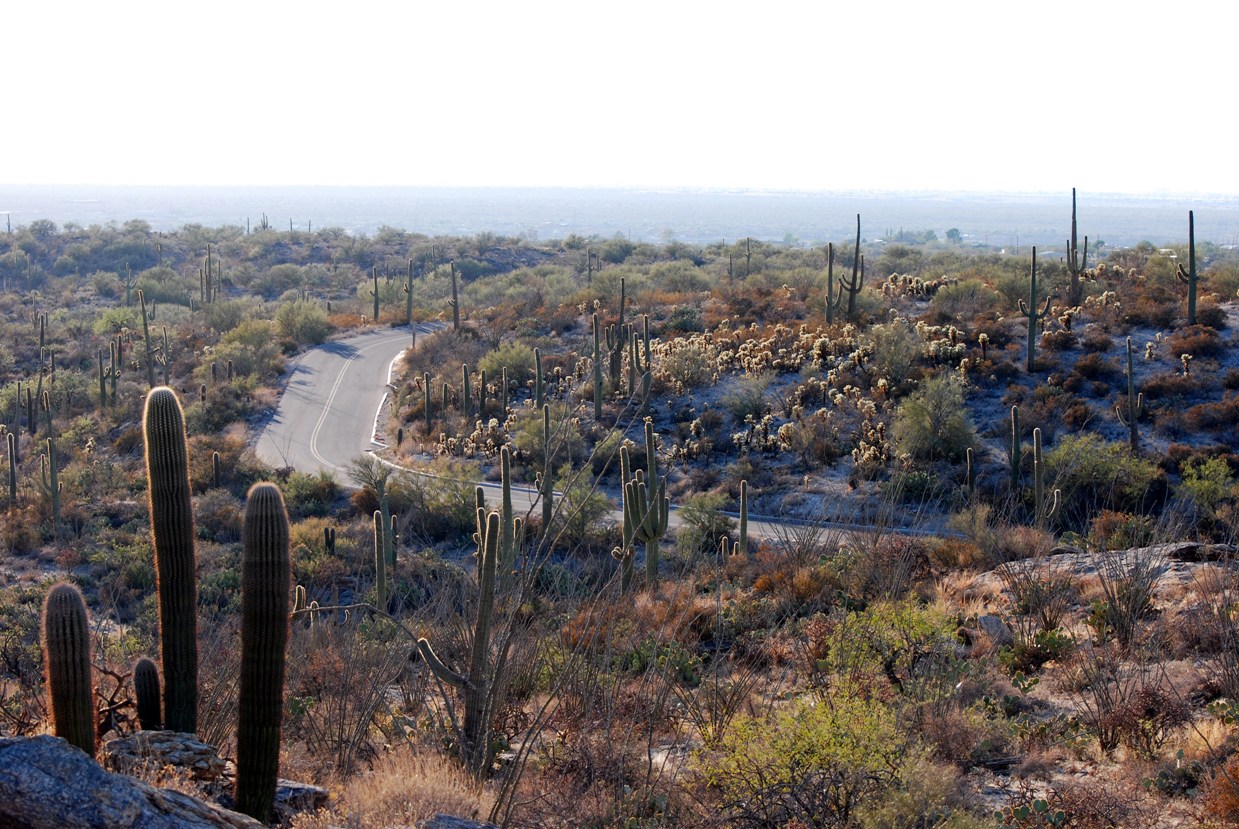
Sunday morning. It’s hot. It’s humid, but we decide to take a drive anyways. I want to drive through Saguaro National Park’s Rincon unit, for it is where it all began. When we first moved here 3 years ago I used to come here all the time. We were staying in the studio apartment then waiting to find someplace to live. One day while Gus was at work I drove over to Saguaro National Park and bought a National Parks pass. This allowed me to go in as often as I wanted to without paying each and every time.

2. Road Saguaro NP 7-18-10

Saguaro National Park is divided into two separate units. The Tucson Mountain Unit sits on the west side of town and it was the first part of the park we visited before we even moved down here. It was while we were visiting our kids for Thanksgiving in 2006 that Gus decided he wanted to live where he can wear shorts in the wintertime. We went home to Utah from that trip and Gus started applying for jobs. Within three months we were living here. The eastern portion of Saguaro National Park is actually the largest, but very few people make it into the back country. I must say that I never have. However, the park is still quite enjoyable from the 7 mile loop road and the few trails I have accessed from below. Now, as we drive through the gate this Sunday morning memories of those other visits come rushing back and as we drive I am well aware that this might be the last time I get to do this.

3. Saguaro n OcotilloSaguaro and Ocotillo 7-18-10 

We have both cameras with us, but I am using my binoculars and counting birds as we go. For once Gus is stopping without me having to ask him. He is taking pictures of everything. I can tell that he is well aware of the fact that it could be a very long time before we see any of this again. Whenever he stops to take pictures I count birds. Suddenly we are like tourists once again and every cactus seems amazing to us.

4. Cactus close up

5. Saguro blossomSaguaro Blossom 7-18-10

6. Prickly pear fruit Prickly Pears 7-18-10

7. cholla surprise Cholla Cactus 7-18-10

8. Prickly pear Prickly pears 7-18-10

9. prickly pear Prickly pear cactus 7-18-10

10. Pincushion cactus Flowering Pincushion Cactus 7-18-10

Though it is only around 9:30 a.m. the temperature has started to rise. Accompanied by the humidity, it’s quite uncomfortable out there. Thankfully we are in an air-conditioned car, though the sound of the motor running drowns out the birds. At our next stop I shut the car off and Gus wants to know why. I tell him I cannot hear the birds. He goes back to photographing a cactus and I listen and watch. White-winged doves are everywhere, but I have seen a few purple martins, a couple of flycatchers and some Gila woodpeckers. Turkey vultures circle above in the clear blue sky. Will they find anything that has died on this hot day? I suspect they will.

11. Sagauro The road winds up through a cactus forest. The Rincon Mountains loom before us. We stop at a favorite overlook, then get back in the car and drive as the road bends back toward the city. Soon all of Tucson is spread before us. In the distance the Tucson Mountains punctuate the skyline. It’s almost noontime now and the heat makes it impossible to drive with windows open. We view the world from within this steel and glass air-conditioned cage. It is not quite how I would choose to experience the park, but I am not in favor of passing out from the heat and humidity.


12. death and lifeGus seems obsessed with dead and dying saguaros on this day. I wonder if he is making the connection between his subject matter and the end of our life here in Tucson. I certainly do.

13. Bones 14. more cactus bones 15. dead arms Old man cactus with arms 7-18-10

After an hour and 40 minutes and 6.5 miles of driving I counted 18 species of birds on this day. The most numerous species were white-winged doves. I counted at least 40 of them. Our days here are probably limited. I am torn between wanting to visit old haunts to say good-bye and trying to see other places that I never got to. How will I choose what to do? Will I have time to do any of it? I will not have any answers until later on this week. How does one say good-bye to the land and the place they love?

16. rincon mts Saguaro NP Rincon Mountains 7-18-10

(All of today’s photos were taken by Gusto! with the Nikon D90)

Birds Seen Today In Saguaro National Park Rincon Mt Unit

Location: Saguaro NP--Rincon Mt Unit
Observation date: 7/18/10
Notes: Drove through the park slowly with Gus. Stopped a few places along the way.
Number of species: 18
Gambel's Quail 4
Turkey Vulture 6
White-winged Dove 40
Mourning Dove 2
Gila Woodpecker 12
Gilded Flicker 4
Ash-throated Flycatcher 2
Brown-crested Flycatcher 3
Purple Martin (Desert) 2
Verdin 2
Cactus Wren 3
Northern Mockingbird 2
Curve-billed Thrasher (Western) 4
Rufous-crowned Sparrow 2
Black-throated Sparrow 4
Pyrrhuloxia 2
Brown-headed Cowbird 2
House Finch 2
This report was generated automatically by eBird v2(http://ebird.org)

17. 3 saguaros DSC_0090 DSC_0094

The Good-bye Chronicles

Kathie’s Poet Tree 

Sycamore Canyon Birds

Tuesday, November 24, 2009

My World: Saguaro National Park East

Catalina Mountains as seen from the Javalina Picnic area 11-15-09

Driving away from Agua Caliente Park the warm autumn sun bathes my car in sunlight. I drive into town to purchase my lunch then head east to Saguaro National Park’s Rincon unit. Saguaro National Park is divided into 2 separate sections with the Tucson Mountain region on the west and the Rincon Mountain unit on the east. Tucson lies in the great bowl between these two mountain ranges, a hub of activity surrounded by quiet nature.

Though the western section of Saguaro National Park is the most visited the eastern park is larger and more peaceful to me. I drive here now with my lunch and take the turn to the Javalina Picnic Area which is located to the south and west of the 8 mile loop road. I have spent all morning with Celeste and her husband in Agua Caliente Park in Northeast Tucson. It is such a beautiful day that I am not ready yet to go inside. With Gus at home watching football I have his blessing to stay out and enjoy myself.

Antelope ground squirrel 11-15-09


I am no sooner seated at a picnic table before the little creatures start to emerge. First an antelope ground squirrel scurries up. It looks at me inquisitively testing to see if I will offer it a bite to eat, but I do not. Not only is it against park rules, but I do not want this little creature to come to depend on humans for its existence. Shortly after the ground squirrel makes its appearance a cactus wren hops by. It twists and turns and investigates before moving off into the brush once again. Hmmn, I think perhaps these little guys have been fed by someone before me!


Black-throated sparrow 11-15-09


Soon I hear the chatter and calls of some Gambel's quail. They walk so close to me that I can almost reach out and touch them. No one harms the critters here and you can tell they have pretty much lost their fear of man. Oh that the world could always be like this! As golden sunlight bathes the desert in its warm light I hear the silvery sound of a black-throated sparrow as it flits up onto a nearby rock. I love these pretty little birds with their black caps and white eye stripes. I love their bell-like voices that flutter over the desert. This little bird seems to be alone today as it flies to a nearby bush, then disappears into its habitat.


Rufous-winged sparrow 11-15-09

All around me is warmth and sunshine and peaceful solitude. With my lunch finished I pack away the remnants, then wander the hillside searching for birds. Two little rufous-winged sparrows hop out of the brush searching the packed earth for food. I watch their little hops in the dirt. I see their small bodies casting long shadows over gravel. Everything is a bit distorted and over dramatized in this late autumn light.


Before me the rocks glow with autumn-colored lichen forming beadwork on its surface.


Even the sharp spines of teddy bear cholla glisten in this dazzling light.

Western view from the rocks above the Javalina Picnic Area 11-15-09


A gentle breeze riffles my hair blowing stands into my eyes. I search the cliffs and mountains ridges around me. I search the sky for motion, but all is still and quiet. So quiet!


The Javalina Picnic Area sits down in a bit of its own bowl. I find it is a good place to bird because usually you can just sit here and the birds will come to you. It is in this location that I saw my first and only black-chinned sparrow. Here I have seen rocks wrens and kestrels, cardinals and hawks. I am walking the rocky rim of the bowl when I see a flash of red down the slope below me and on the other side of the picnic area. I do not even guess that it is a bird. The patch of red is too large. Since I am walking, I catch the glimpse between bushes and cactus. I stop and look through an opening and I see a woman sitting in a chair facing west. The sinking sun has flooded her face with light and she seems so peaceful there. I do not want to stop and stare. I assume she does not want company, so I change directions and walk on. I feel like I have found some bird in its nest. Her location is a secret that I will not divulge. I leave her to her solitude and walk on.

I have spent the whole day outside by now and it is getting late. From the high rocks on the south I stand and gaze to the western horizon which blazes with a cool white light. Deep shadows fall long and dark across the picnic area. I find my way to the car and drive out of the park. My day in the sun and fresh air has left me feeling so mellow. I do not want to hurry home. I do not want this feeling to fade just yet. I decide to take the long road home and so I turn south on Old Spanish Trail and drive the black asphalt ribbon before me. I can’t help but wonder as I drive if this is the way that other people feel when they are high or they have a buzz on from drinking. I have never understood the need for drinking or for drugs. I have always found that nature alone gives me the only “high” I need. But this high has one benefit beyond the artificially induced state of alcohol or drugs, there are no bad side effects, and no hangover the next day. As I turn south on Pistol Hill road the sun sinks below the horizon and I point my car towards home. It has been a very good day in MY World.

To see more amazing places in the world click on the link above.

On a personal note: I am so sorry I have been absent for so long. As many of you know, I have a son in the military who recently moved to a new base. He and his wife are expecting a new baby any day and I just found out yesterday that they absolutley NOthing for the new baby. Nothing! and I mean Nothing! Diane was able to go to a thrift shop and buy some used baby clothes yesterday. They have a crib on order, but they are so new to this base. They have no friends and no family and no one to do a baby shower for them. I spent the last 2 days shopping and sending off boxes. The baby will be here soon. I will let you know when she arrives. It is very hard to be this far away right now. I would go there, but I have my other son and grandchildren flying in from Maine for 3 weeks. Much as I would like to, I cannot be everywhere at once. So send up a small prayer for a soilder and his wife and a new baby about to enter this troubled world. And in case you haven't noticed, I am not very good at keeping up on Facebook! I am not shunning anyone, I just would rather blog first and Facebook later if I have time!

Monday, October 12, 2009

My World: Birding With TR Ryan

Lark Bunting in Sycamore Canyon 10-8-09 by Kathiesbirds

T. R. Ryan's visit with me begins in Sycamore Canyon. It is Tuesday afternoon and I am writing last week's MY World post and waiting for him. Finally he arrives and before long we are out the door. We have just enough time to visit Saguaro National Park's Rincon Unit before darkness falls. On our way out of the Canyon, I decide to drive him up the foothills to see the view from here.

Yellow Warbler in Sycamore Canyon 10-6-09

Our birding expedition begins as soon as TR arrives when he sees his first Anna's and Costa's hummingbirds in my back yard. Then, as I pull the car over to show him the view of the canyon we find this little yellow warbler and its mate hopping about among the cholla cactus and mesquite trees that dot the hillsides around us.

American Kestrel in Saguaro National Park's Rincon Mountain Unit

It is a quick 20 minute drive from my house to the eastern section of Saguaro National Park. Saguaro is divided into the Tucson Mountain Unit on the west and the Rincon Mountain Unit on the east with the city of Tucson sprawling inbetween the two. Though the Rincon Mountain Unit is the largest, it is the least visited of the two. However, it is the closest to me, and I am eager to show it to TR. The park is fairly quiet as we drive in and park at the visitor's center. As soon as we exit the car, TR gets another life bird when a Black-throated sparrow jumps up on a nearby bush. We see cactus wrens and hear Curve-billed thrashers before we leave the parking lot, but soon after that the desert falls silent in the late autumn day. We drive the 5 mile loop raod without seeing many birds, but before we leave I drive TR down to the Javalina Picnic Area which has historically been a rich birding area for me. Sure enough we find an American Kestrel, along with a cardinal, another black-throated sparrow, and others. The sun is low in the sky now, casting a golden glow on what remains of the day. Our bird list is not large, but almost all of them are life birds for TR.

TR walking the Proctor Trail in Madera Canyon 10-7-09

Tomorrow we are up early and soon we are driving south. We arrive in Madera Canyon by 9 a.m. and hike on down the trail. The morning sun is warming, but a brisk wind blows. Still, we manage to find quite a few birds on this short paved loop. I am quite surprised to find the creek dry as we head on down the trail.


We find this ball of resin clinging to the side of a mesquite tree. I have never seen anything like this.


Resin ball 10-7-09

It looks like some confection made crackling hard and translucent by nature's own candy maker.

Bridled titmouse 10-7-09

We hear a faint twittering and a call that reminds us of chickadees, but higher pitched and different somehow. Soon we spot the bridled titmice working their way among the twigs and branches gleaning food. Bridled Titmice are one of TR's target birds and here they are, right before our eyes. T. R. is mesmerized.


Green-tailed Towhee 10-7-09 Proctor Trail

I saw a green-tailed towhee on our way into the trail, but TR was a bit ahead of me and didn't get such a good look. However, on the way back out this little bird hopped right up into some dead brush and let us get a really good view. Yet another life bird for TR.


From here we head farther up into the Canyon to another favorite birding spot: Madera Picnic Area. As soon as we park the car TR gets to see yet another target bird, the Acorn woodpecker. While he jumps out for a better look, I gather my gear and the food and we head down to find a picnic table for a rest and a snack. However, just as soon as I lay my books, bags, and cooler on the table I see something in the shadows of a nearby bush. It is barely 10 feet away from me and my jaw drops open and I start to shake. Can I be seeing what I think I am seeing?
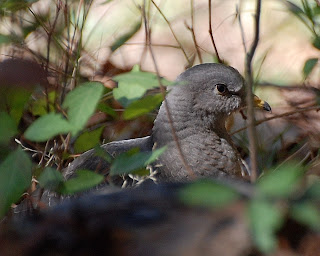

Juvenile Band-tailed Pigeon 10-7-09


T.R. is wondering what I am so excited about but I can barely answer him. I have been in pursuit of this species for almost a year, and now here it is, right before my eyes. I see the pigeon's body, but this is no Rock Pigeon or Mourning Dove. "How do you know," asks T.R.? "See the yellow feet and the yellow beak," I say, but something is not right. Where is the banded tail and the white crescent and green iridescence that should be on the back of the neck. Yet it has a yellow beak and yellow feet. Rock pigeons have pink feet and a gray beak. Mourning doves have the same with a pointed tail and speckled wings. As my mind races, all I can think is that this must be a juvenile.

Juvenile Band-tailed pigeon 10-7-09 Madera picnic area.

TR and I both snap several photos. The bird doesn't seem to mind a bit. It settles beneath the bush for a nap, and stays there the rest of the time we are here. After I finally sit down, I pull out my bird guides to check. Sure enough, it is a juvenile band-tailed pigeon. Unlike the street pigeons, this one favors oak woods and pines and is a summer resident here in Southeast Arizona. Though I know it has been seen here in Madera Canyon, this is my first time ever seeing one here, or anywhere! I brought TR here because this was at the top of his list of places to visit. We came here seeking lifers for him, but this soft young bird is my reward. Life Bird 363 for me!

We hike up along the creek and emerge near the Santa Rita Lodge. There we find wild turkeys and Mexican jays eating greedily from the feeders. I search the nearby trees for Arizona woodpeckers, but no luck. Arizona woodpeckers are our only brown woodpecker here in the USA, and many people come to SE Arizona to see them. No luck today, but reason enough for TR to come back and visit me again!

We finally drive all the way to the top of Madera Canyon and start to hike up the Carrie Nation trail, but we are tired and hungry. After a few minutes of hiking we are seeing no birds at all. Not a one! So we head back to the car and drive out of the canyon. We take I-19 south to Rio Rico, where I show TR hawk hill and the Swainson's hawk field. The bales of hay and the Swainson's hawks are all gone, but we do find a female vermilion flycatcher, a western kingbird and a kettle of Chihuahuan ravens swirling overhead! We leave Rio Rico shortly after 4 and meet up with Gus in Tucson at a local Mexican Restaurant called Macayo's. It is the perfect way to end the day, since I have neither the time nor the energy to cook and clean up!

Queen Butterfly in Sycamore Canyon Wash 10-8-09

(Thanks Doug!)

Thursday morning dawns bright and clear. The wind has died down so all is calm as T.R. and I head out into the wash. This will be our last hike before he has to leave. We saved Sycamore Canyon for last since we do not have to drive to get there. It is right out my front door. I do not know what we will see, since we have not seen large numbers of species at all in the places we have birded so far, but Sycamore Canyon does not disappoint and soon we are seeing birds everywhere! So many, in fact, that it is hard to keep track of them all. I get on one bird and TR finds another. "What is this," he ask. "Wait a minute, I am not sure what this one is!" I reply. And we spin, and snap and look and list and hike and look some more. We are finding phainopeplas, Gambels' Quail, Gila Woodpeckers, Gilded flickers, Black-tailed gnatcatchers, black-throated sparrows, Costa's hummingbirds, curve-billed thrashers, cactus wrens, turkey vultures and more. Birds are all around us. Birds are everywhere. T.R. wants to see a pyrrhuloxia, and finally we find one when we near the bridge over the wash. We also find a ladder-backed woodpecker, and a lark bunting eating grass seed heads by the side of the road. The lark bunting is in the same area where I had the Unexpected Encounter with the peregrine falcon and I point it all out to him. We are in no hurry and we go at our own pace. T.R. is enjoying the beauty around him. I think the magic of this place has wrapped around his heart.

Verdin in hackberry bush in Sycamore Canyon Wash 10-8-09

We have been up on the canyon's rim but now decide to hike home up the floor of the wash. Here TR gets his best view of a verdin yet. while we are hiking we discuss where he is going to next and it is then that we hatch a plan for me to meet him in Patagonia tomorrow and go birding at the Patagonia -Sonoita creek preserve together. So, after entering all our bird counts into eBird, TR packs his vehicle and I hug him good-bye. I wave as he drives down the road and a smile spreads across my face. I'm ready for more birding adventures, but I am glad for an afternoon of rest!

And that's MY WORLD Tuesday (and Wednesday and Thursday...)

also, visit Kathie's Poet Tree to read my new poem: Brown Creeper

Wednesday, February 20, 2008

GBBC: Monday's Finale


I slept late Monday still trying to recuperate from this darn cold. I wore myself out yesterday but I don’t want today to slip away. I have high ambitions but time, distance and health will probably limit the extent of my birding today. I count the birds in my yard and at my feeders while I wake up and fix my breakfast. Then, I check the bird counts and results on the GBBC web site. I notice that no one has counted birds in Saguaro National Park yet, so I make up my mind to make that my destination for the day. But first, I decide to check out two of the other sites I birded at yesterday.

I head to the park first, which is really close by. I decide I can walk the dog and count birds at the same time, killing two birds with one stone so to speak, but when I get to the park there are few birds in sight. The workers are driving their bulldozers through the desert ripping open a brown wound on the surface of the earth. Construction of the Community Center has begun. I hear a few birds off on the opposite side of the park, but all I count are 2 mourning doves, a Gila woodpecker and a couple of house finches. All the little sparrows I saw yesterday are gone for now. I will have to wait to see if they ever come back.

I bring the dog home and head to the Vacant Lot again. This time it is so quiet when I get here. It’s only 15 minutes later in the day than when I was here yesterday, but still, there should be some birds. Then, I see the red-tail soaring across the gold course with nesting material in its beak. I watch as it flies into a tall pine on the golf course. Perhaps I will get to see Red-tail chicks this spring. (Are they called chicks? I will have to look this up!) Then the smaller birds start to emerge. First I see an Anna’s Hummingbird, and then the sparrows start to move about. After awhile I see the Lark bunting again, and in the tall trees at the edge of the field I find Yellow-rumped warblers, a Ruby-crowned kinglet, an Orange- crowned warbler and a Hutton’s vireo! The warmth of the sun is making me very thirsty with this cold, so I finally pack it in and head down the mountain to town. I stop at a local park where I count a vermillion flycatcher along with 50 Brewer’s Blackbirds and 50 American Widgeons in the manmade lake, but I don’t stay here long. I soon head out for Saguaro National Park, east.

Saguaro National park is divided into two sections, one on the west side of Tucson and this other on the east near the Rincon Mountains. The western side has a larger visitor center and more easily accessible trails, but the east side is much closer to me and has a nice 8 mile loop drive. However, today I head to the Javalina Picnic area to eat the fast food I bought in desperation. Plus, I have found that by sitting quietly that often the wildlife will come to me. Not long after I sit down a little ground squirrel comes out looking at me with inquiring eyes. I know it wants me to drop it a tidbit, but I resist the urge. Human food is not good for these creatures and I do not want to contribute to the delinquency of a ground squirrel. Instead, I raise my camera to take a picture, but the squirrel scampers off. Soon however, the birds start to show up.


I’ve been listening to thrashers sing since I got here. Now I hear a covey of Gambel's quail calling to each other across the desert. Then, a little black-throated sparrow lands on a twig right near the picnic table. This time I am able to snap off quite a few pictures before it leaves. Then, I see a flash of feathers cross the road. I leave my belongings on the table and follow. Looking through my binoculars I see a bird that looks like a cross between a junco and a sparrow. While it has a gray head and a junco-like beak, it’s back has the coloring of a chipping sparrow. I know I’ve seen its picture before, but I can’t think of the name. I try to take a picture of it myself but this little guy is secretive and elusive. Every time I think I have clear shot it drops back into the brush again. It always manages to keep a flower, or stick between us. Finally it flies off into even deeper cover, but I’m sure of what I saw and when I get to consult my bird guides afterwards I discover it is a black-chinned sparrow, a life bird for me!

I put away the remnants from lunch and climb around on the hillside. The Javalina Picnic Area is in a bit of a hollow with rocky outcroppings and cactus covered hillside all around. Beyond this natural bowl the Rincon mountains rise in the east and with the recent rains and snow I can hear water trickling down the cliffs in a gentle cascade. Walking up the hillside I come upon the covey of Quail. They are rather tame here and don’t dart for cover as quickly as the ones in my neighborhood, so I am able to take a decent picture of some of them before they dash for cover again. I estimate their number at about 14, which is the most I have seen at one time.

While I am standing there photographing quail, a little rock wren hops up on a picnic table as if to inquire about what I am finding so interesting. Well, you of course, I think as I snap off some pictures of it. The sun is beating down on my feverish body but I don’t want o give up yet. I climb even farther up and start to circle the picnic area, but it seems all the birds like the bottom of the bowl better, for there are few up here, save for a red-tail lazily circling the sky.

I continue on my way and climb one final outcropping. The effort and the heat make me dizzy and I sit down. It’s then I realize I’d better cash it in and go home. If I passed out up here no one would see me and I’d lie here in the sun and fry to a red crisp! I’m so thirsty but my water is down in the car. I have to at least make it that far, so, I slowly make my way down trying to avoid other people’s picnic tables. I don’t want to intrude on their privacy. Back at the car I gulp what is left of my water and decide I should head home, even though it is only about 3 pm. If I was feeling better I would go do a couple of other counts before the day ended, but I must go home. As I drive south on Houghton Rd I briefly pull off to head to another park, but then reprimand myself and get back on track. I make one final count of the evening birds in my yard and call it a day. The GBBC has ended until next year.

Saturday, January 5, 2008

Don't Fence Me In


A warm gray day awaits me this morning. “The warm before the storm” as the saying goes. While the yard is full of birds, the burrowing owl is nowhere to be seen. We hurry through our morning preparations and head for Saguaro National Park East; I with my new binoculars and Gus with his new Nikon D80 SLR. We soon discover we are beset by what I’ve decided to call the three W’s: Warm Winter Weekend. That means the parks are full of winter weekenders drawn out by the warm weather. The parking lots are full, the streets are full, the trails are full, and the birds are all hiding! We only saw 12 species at Saguaro East, so we left and decided to try Agua Caliente Park.

Agua Caliente is a true desert Oasis on the northeast side of Tucson. Due to the year-round spring, palm trees grow in profusion and the birds there are a mixture of the typical desert species and various waterfowl. We were able to see Gila woodpeckers, cactus wrens and a roadrunner in the same place as a blue heron, American Widgeons, ring-necked ducks and Northern pintails. But Agua Caliente is full of people, kids, and dogs. We take a few shots but decide to leave. I’ve recorded 19 species here.

We spend the afternoon at home, then take a walk just before sunset. There is still no sign of the owl. Perhaps he has moved on. Still, I was hoping I would see him for more than just a day, and I was really hoping that Gus would be able to take a photograph of him. Instead, I convince Gus to come to the desert and see the wash with me. We cross the street and pass between the houses. I am getting excited, for Gus has never come out to the wash with me. I am eager to show it to him. This is where Liz and I picked all the prickly pears for our jelly last summer. This is where I saw the Gila monster I tell him. And then I stop dumbfounded. Stretching across the trail that leads to the wash is a brand new barbed wire fence!


I don’t know what to think. My heart fills with many emotions. I’m disappointed and angry. “NO!” I cry. “NO! They can’t do this! When did they do this!” My mind races as if this is incomprehensible. How can there be a fence here?

I know I don’t own this land, but easy access to the desert and the wash is one of the reasons I like living here. It never occurred to me that I would be fenced out of it. I felt like this was my special place where I could flee civilization and be alone with the birds, the bugs and the lizards. Now what will I do?

Gus and I head for the upper trail along the backs of the houses. Here we can see into everyone’s backyards and they can see us. Some yards have dogs that bark furiously at us—not a peaceful walk by any means and certainly not conducive to wildlife watching. Finally we are past the houses at the end of the cul-de-sac and I am pleased to see that so far there is not a fence here. But I fear it will come one day. For now I will have to access the wash from this location and it will require some scrambling down the steep bank.

Gus and I head up a trail along the top of the wash. By now the sun is setting and the sky is aflame with color. The thin blanket of clouds reflects the sinking fire. It seems every 10 seconds the colors change. In the west it is as if the Golden Fleece has been hung in the sky. Then, as the sun sinks lower, it throws color and light across the sky till we are surrounded with shades of pink, lavender, gold, and blue. Mt. Fagan catches a bit of the rosy hue and blushes with warmth. Saguaros appear as sentinels silhouetted against the sky. Looking through the branches of a creosote bush towards the west looks like a black filigree screen in front of a blazing fire. It is a burning bush in the desert and God is speaking in the wind.

All around us the soft voice of the desert whispers. Here we are past the fences and human habitation. Here the desert is open and inviting. Here it is calling us to wildness and freedom. I need this wildness, this open space, not only for my feet, but for my heart and mind also. I don’t like barriers. I can’t be contained. I must fling my soul into the sky and see where it lands. Perhaps that is one reason why I like birds so much. To a bird, a fence is but another thing to fly over or perch on. A bird is not contained by a fence or a block wall and I want to plead with the universe, “Don’t fence me in! Give my heart wings and let my spirit soar.”

Sunday, July 29, 2007

A Place Called Home

It was spring when we arrived in Tucson. We spent the first 2 months in a one bedroom apartment looking for a home. While my husband started his new job, I set off to explore this strange new place I had come to. My first trek was to Saguaro National Park East. I drove the Sunset loop, stopping here and there to observe birds and take in the scenery. On my first visit to the park I saw cactus wrens, Gambel's quail, a gilded flicker, and Gila woodpeckers. A white-winged dove perched atop a saguaro with its waxy blossoms. In the mesquite trees tiny verdin chattered and twittered in their hurry to goble up as many insects as possible. Turkey vultures soared in the rising thermals, searching for something dead to dine on. One of the biggest ravens I have ever seen crossed overhead, a black shadow over the sunny landscape. Curved-billed thrashers hid in the brush. Ocassionally one would perch on a branch and sing. One of the prettiest birds I saw was a black-throated sparrow with its beautifuly striped head and black bib. On a subsequent visit I discovered a great-horned owl and her chicks nesting in a cave high up in a sand bank!

Since it was spring, the hedgehog cactus were in bloom. Like cucumbers with spines, the hedgehog's magenta flowers sprouted from their top ends like ruffled Easter bonnets. Soon after they blossomed the ocatillo with their flaming orange candles blossomed, along with prickly pears and barrel cacti.

Besides Saguaro east we visited the Tucson Botanical Gardens. A pyrrhuloxia flashed across our path as we walked to the entrance. Inside the gardens wildlife and birds populated this protected area inside the city. Desert cottontails hopped among the agave. Mourning doves walked peacefully among the flowers and along the paths. A Gila woodpecker peeked out at us from its nest in a Saguaro hole. Between Saguaro National Park and the Botanical Gardens I learned much about the Sonoran desert and the plants and animals that now inhabited my world.

Out home sits in the Sonoran desert at the foot of the Santa Rita Mountains. Sycamore Canyon is a wildlife preserve which is being developed to preserve the desert and wildlife around us. There are 8 miles of hiking trails here. The trails are mapped and marked. Small plaques point out the names of plants or habitats of animals. The philosophy is one where people and nature can coexist. Any habitat destroyed in the building process is supposed to be restored and native plants are suppose to be saved whenever possible. I am not sure that this is happening. Still, much open space and green space is being preserved, which makes life here much more enjoyable.

From my windows I can see giant saguaros towering over the desert. Behind me the Santa Ritas rise strong and solid. On the side of one mountain is a white stone projection that I have been told is a former limestone mine. Whenever I leave the house to drive to town I can see this mountain and this mine. I look at them and think, "That is where I live. That is my home." To get to town involves a 15 mile jaunt downhill all the way. To get home is 15 miles all uphill. There are no alternative routes. What goes down must go up! Still, it is this isolation that for the moment gives us peace. The nights are quiet here, with the occasional howl of coyotes. From my yard I can see the milky way, something I missed dearly living near Salt Lake City.

I don't know the name of the mountain behind me yet, but I am determined to find out. It is important to me to know the place I live in. Places are like people; they have personalities and emotions. They have their own characteristics and feelings. Places have moods along with their vegetation, their topography, and climate. I want to know the plants, the paths, the inhabitants of this place. I want to know the contours of the land and where the washes run. Where do the lizards live, where do the rabbits hide? I want to know if I will love it and if it will like me. When you know a place, when you love it, then it becomes a part of you and a part of who you are. It is like knowing your mother or your lover. It is like knowing your self. It is connected to your heart.