Showing posts with label Verdin. Show all posts

Monday, December 21, 2009

Winter Birds in Sycamore Canyon

Bewick's Wren climbs the block wall searching for insects 12-5-09

Ever since discovering Sycamore Canyon almost 3 years ago I have been counting birds. Even before we moved in I started my Sycamore Canyon Bird List, which you can see in the side bar. Since that time I have kept constant track of all the bird species seen in this area. In 2 1/2 years I have seen 90 species of birds right here in Sycamore Canyon. Many of them I have seen right from my own yard! Our yard was nothing but bare dirt in the back while small scrubby trees and bushes grew in the front. In less than a month after we moved in we bought and planted a native velvet mesquite tree in the backyard. By the following spring we added a Desert Museum Palo Verde and a patio with sitting walls. This year we added more plants and an irrigation system to the backyard. Meanwhile, the front yard trees have grown taller, the bushes have filled out, and the manmade wash beside my house has filled in with pioneering species like creosote bush and brittle bush. And, as mine and other neighbor's landscaping matures I have recently noticed an increase in the bird population in my yard!


A verdin at my window hummingbird feeder 12-5-09

Suddenly I am getting Bewick's Wrens and verdins. The verdins even come to my nectar feeders, something I have never observed before, but I have this sweet pair hanging out in my yard on an almost daily basis. While typically insect eaters, I guess these little gray birds know a sweet thing when they find it! I have no complaints. I love their merry chatter and cute little faces. Though hardly much bigger than the hummingbirds, they are quite gregarious. Still, the hummingbirds have no trouble taunting them or chasing them away. With cactus wrens and Gila woodpeckers all vying for nectar, it is all out war in my backyard right now!

Here is a list of MY 2009 December Yard Birds:
  1. Gambel's Quail
  2. Sharp-shinned hawk
  3. Cooper's hawk
  4. White-winged dove
  5. Mourning dove
  6. Greater Roadrunner
  7. Anna's Hummingbird
  8. Costa's Hummingbird
  9. Gila woodpecker
  10. Gilded Flicker
  11. Say's Phoebe
  12. Loggerhead shrike
  13. Common raven
  14. Verdin
  15. Cactus Wren
  16. Bewick's Wren
  17. Rock Wren
  18. Curve-billed thrasher
  19. Canyon towhee
  20. Black-throated sparrow
  21. White-crowned sparrow
  22. Northern Cardinal
  23. Pyrrhuloxia
  24. House finch
  25. Lesser-goldfinch
  26. House sparrow
Have a Very Birdy Christmas!

and that's...

Monday, October 12, 2009

My World: Birding With TR Ryan

Lark Bunting in Sycamore Canyon 10-8-09 by Kathiesbirds

T. R. Ryan's visit with me begins in Sycamore Canyon. It is Tuesday afternoon and I am writing last week's MY World post and waiting for him. Finally he arrives and before long we are out the door. We have just enough time to visit Saguaro National Park's Rincon Unit before darkness falls. On our way out of the Canyon, I decide to drive him up the foothills to see the view from here.

Yellow Warbler in Sycamore Canyon 10-6-09

Our birding expedition begins as soon as TR arrives when he sees his first Anna's and Costa's hummingbirds in my back yard. Then, as I pull the car over to show him the view of the canyon we find this little yellow warbler and its mate hopping about among the cholla cactus and mesquite trees that dot the hillsides around us.

American Kestrel in Saguaro National Park's Rincon Mountain Unit

It is a quick 20 minute drive from my house to the eastern section of Saguaro National Park. Saguaro is divided into the Tucson Mountain Unit on the west and the Rincon Mountain Unit on the east with the city of Tucson sprawling inbetween the two. Though the Rincon Mountain Unit is the largest, it is the least visited of the two. However, it is the closest to me, and I am eager to show it to TR. The park is fairly quiet as we drive in and park at the visitor's center. As soon as we exit the car, TR gets another life bird when a Black-throated sparrow jumps up on a nearby bush. We see cactus wrens and hear Curve-billed thrashers before we leave the parking lot, but soon after that the desert falls silent in the late autumn day. We drive the 5 mile loop raod without seeing many birds, but before we leave I drive TR down to the Javalina Picnic Area which has historically been a rich birding area for me. Sure enough we find an American Kestrel, along with a cardinal, another black-throated sparrow, and others. The sun is low in the sky now, casting a golden glow on what remains of the day. Our bird list is not large, but almost all of them are life birds for TR.

TR walking the Proctor Trail in Madera Canyon 10-7-09

Tomorrow we are up early and soon we are driving south. We arrive in Madera Canyon by 9 a.m. and hike on down the trail. The morning sun is warming, but a brisk wind blows. Still, we manage to find quite a few birds on this short paved loop. I am quite surprised to find the creek dry as we head on down the trail.


We find this ball of resin clinging to the side of a mesquite tree. I have never seen anything like this.


Resin ball 10-7-09

It looks like some confection made crackling hard and translucent by nature's own candy maker.

Bridled titmouse 10-7-09

We hear a faint twittering and a call that reminds us of chickadees, but higher pitched and different somehow. Soon we spot the bridled titmice working their way among the twigs and branches gleaning food. Bridled Titmice are one of TR's target birds and here they are, right before our eyes. T. R. is mesmerized.


Green-tailed Towhee 10-7-09 Proctor Trail

I saw a green-tailed towhee on our way into the trail, but TR was a bit ahead of me and didn't get such a good look. However, on the way back out this little bird hopped right up into some dead brush and let us get a really good view. Yet another life bird for TR.


From here we head farther up into the Canyon to another favorite birding spot: Madera Picnic Area. As soon as we park the car TR gets to see yet another target bird, the Acorn woodpecker. While he jumps out for a better look, I gather my gear and the food and we head down to find a picnic table for a rest and a snack. However, just as soon as I lay my books, bags, and cooler on the table I see something in the shadows of a nearby bush. It is barely 10 feet away from me and my jaw drops open and I start to shake. Can I be seeing what I think I am seeing?
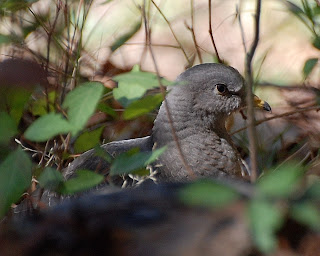

Juvenile Band-tailed Pigeon 10-7-09


T.R. is wondering what I am so excited about but I can barely answer him. I have been in pursuit of this species for almost a year, and now here it is, right before my eyes. I see the pigeon's body, but this is no Rock Pigeon or Mourning Dove. "How do you know," asks T.R.? "See the yellow feet and the yellow beak," I say, but something is not right. Where is the banded tail and the white crescent and green iridescence that should be on the back of the neck. Yet it has a yellow beak and yellow feet. Rock pigeons have pink feet and a gray beak. Mourning doves have the same with a pointed tail and speckled wings. As my mind races, all I can think is that this must be a juvenile.

Juvenile Band-tailed pigeon 10-7-09 Madera picnic area.

TR and I both snap several photos. The bird doesn't seem to mind a bit. It settles beneath the bush for a nap, and stays there the rest of the time we are here. After I finally sit down, I pull out my bird guides to check. Sure enough, it is a juvenile band-tailed pigeon. Unlike the street pigeons, this one favors oak woods and pines and is a summer resident here in Southeast Arizona. Though I know it has been seen here in Madera Canyon, this is my first time ever seeing one here, or anywhere! I brought TR here because this was at the top of his list of places to visit. We came here seeking lifers for him, but this soft young bird is my reward. Life Bird 363 for me!

We hike up along the creek and emerge near the Santa Rita Lodge. There we find wild turkeys and Mexican jays eating greedily from the feeders. I search the nearby trees for Arizona woodpeckers, but no luck. Arizona woodpeckers are our only brown woodpecker here in the USA, and many people come to SE Arizona to see them. No luck today, but reason enough for TR to come back and visit me again!

We finally drive all the way to the top of Madera Canyon and start to hike up the Carrie Nation trail, but we are tired and hungry. After a few minutes of hiking we are seeing no birds at all. Not a one! So we head back to the car and drive out of the canyon. We take I-19 south to Rio Rico, where I show TR hawk hill and the Swainson's hawk field. The bales of hay and the Swainson's hawks are all gone, but we do find a female vermilion flycatcher, a western kingbird and a kettle of Chihuahuan ravens swirling overhead! We leave Rio Rico shortly after 4 and meet up with Gus in Tucson at a local Mexican Restaurant called Macayo's. It is the perfect way to end the day, since I have neither the time nor the energy to cook and clean up!

Queen Butterfly in Sycamore Canyon Wash 10-8-09

(Thanks Doug!)

Thursday morning dawns bright and clear. The wind has died down so all is calm as T.R. and I head out into the wash. This will be our last hike before he has to leave. We saved Sycamore Canyon for last since we do not have to drive to get there. It is right out my front door. I do not know what we will see, since we have not seen large numbers of species at all in the places we have birded so far, but Sycamore Canyon does not disappoint and soon we are seeing birds everywhere! So many, in fact, that it is hard to keep track of them all. I get on one bird and TR finds another. "What is this," he ask. "Wait a minute, I am not sure what this one is!" I reply. And we spin, and snap and look and list and hike and look some more. We are finding phainopeplas, Gambels' Quail, Gila Woodpeckers, Gilded flickers, Black-tailed gnatcatchers, black-throated sparrows, Costa's hummingbirds, curve-billed thrashers, cactus wrens, turkey vultures and more. Birds are all around us. Birds are everywhere. T.R. wants to see a pyrrhuloxia, and finally we find one when we near the bridge over the wash. We also find a ladder-backed woodpecker, and a lark bunting eating grass seed heads by the side of the road. The lark bunting is in the same area where I had the Unexpected Encounter with the peregrine falcon and I point it all out to him. We are in no hurry and we go at our own pace. T.R. is enjoying the beauty around him. I think the magic of this place has wrapped around his heart.

Verdin in hackberry bush in Sycamore Canyon Wash 10-8-09

We have been up on the canyon's rim but now decide to hike home up the floor of the wash. Here TR gets his best view of a verdin yet. while we are hiking we discuss where he is going to next and it is then that we hatch a plan for me to meet him in Patagonia tomorrow and go birding at the Patagonia -Sonoita creek preserve together. So, after entering all our bird counts into eBird, TR packs his vehicle and I hug him good-bye. I wave as he drives down the road and a smile spreads across my face. I'm ready for more birding adventures, but I am glad for an afternoon of rest!

And that's MY WORLD Tuesday (and Wednesday and Thursday...)

also, visit Kathie's Poet Tree to read my new poem: Brown Creeper

Thursday, June 19, 2008

An Early Walk and a Mystery Bird

Long shadows lay across the desert on Saturday morning, June 14, when Gus and I entered the big wash across the street. We got up early to beat the heat and were out the door by 6:30 a.m. Gus carries the camera and I have my binoculars harnessed to my chest. We both have hats and bottles of water hooked to our belt loops. While there air is still cool in the shadows, one only has to step into the sun to feel the coming heat of the day.


To the south the jagged peaks of the Santa Rita Mountains loom against the pale blue skies. A few wispy clouds float above the mountains, hinting of the monsoon just south of the border. A cactus wren flies up cackling to a nearby rooftop as we pass through the block walls that define our neighborhood. The tall saguaro condo greets us on the left—a home to woodpeckers and martins. A small flock of rufous-winged sparrows seeks shelter in the desert scrub beneath the saguaro. The song of a curved-billed thrasher follows us as we pass through the barbed wire gate into the wash.


Here we head north so the sun will be at our backs, better for identifying birds and taking photos. We keep to the wide sandy bottom of the wash but scan the Palo Verde, mesquite, acacia and creosote bush along the edges for signs of life. The wild cotton is blooming again, while the dried bolls from the last season still cling to leafless twigs. A lesser nighthawk flutters overhead searching for breakfast in the ever warming day. Gila woodpeckers chatter as they cling to nearby saguaros. White-winged doves call out, “who cooks for you, who cooks for you?” over and over again. The air is full of bird sounds.


The Santa Rita Mountains look so lovely in this morning light. They have a bluish cast as the sunlight plays along the gentle slopes casting purple shadows. Nestled along the canyon rim the saguaro sentinels reach for the sky with purple martins circling like satellites around their desert homes.


As we progress farther downhill the side of the canyon becomes narrow and steep. Soon tall red banks loom over us and we can see the layers upon layer of gravel and rock that have been laid down and then carved through by the force of water. It’s always hard for me to imagine water rushing down this dry bed with crunching sand beneath my feet. I have yet to see this wash flowing fast and deep enough to have carved this canyon out. I wonder as I’m walking if millions of years ago the Grand Canyon started as something like this.


Most of the vegetation is up on the canyon rim now, or growing along the edges of the wash. Huge roots lie exposed in the steep bank in their search for water.


Their twisted shapes look muscular and thick as they grab onto the eroding soil of the red caliche walls. The wash curves left, then right, then flattens out again before it reaches the newly constructed bridge that will bring people and cars to the new neighborhood on the west side of the wash. At this point they are only putting in roads, but someday the pounding of hammers will be heard as more human homes invade the desert. For now, the birds and wildlife are the only residents here.


High on the east bank we spot a female hummingbird gathering nectar from a saguaro blossom. Her tiny size is emphasized by the large green cactus. With her tiny feet extended, she looks like a helicopter coming in for a landing on a frilly helipad.


An ash-throated flycatcher hunts from a nearby mesquite tree. Then a Gila woodpecker decides the flycatcher is too close to home, and chases the intruder away in a blur of black and white wings and chestnut tail feathers. We watch a canyon towhee fly to the center of the wash, then skulk along the bottom as it proceeds to walk to the opposite side. Once there it alights in a tree before turning and flying into deeper cover.


We listen as a male Gamble’s quail calls from the west bank.


He walks out into the center with his questioning “whoop? whoop?” When he is halfway across we spot the female at the edge of the bank.


She looks out, gauges the danger, and decides to head back into cover. The male turns around and crosses the wide expanse of gravel, then disappears into the brush with her. I guess we know who’s in charge in that family!


So far I have been able to keep to the shadows of the eastern bank where it is cooler. Now the cliffs have flattened into low banks and Gus and I pass through the large cement openings of the new bridge. It is the gateway to a different world.


A deep basin filled with riprap is on the north side of the bridge. I can only guess that it is to hold the water and debris before it overflows and continues on its way downhill. We skirt the edge of the basin and re-enter the wash again.


I have never been north of the bridge before. This is all new territory for me. Gone are the step banks and cliff edges we have just walked past. Now it feels more like an alluvial fan as the gravel spreads out into various channels before us. There is more vegetation here and suddenly we hear the whirr of cicadas in the brush around us. One insect starts to whine on the left, then another picks up the chorus on the right. The insects sing us down the dry gravel bed while the sun beats down and cooks us. I am vigilant in my lookout for snakes, but all we are seeing are lizards. I glance back towards the mountains and see the bridge we have just walked under set against the beautiful Santa Ritas.


I don’t find this flat place quite so interesting. We aren’t seeing many birds anymore. The heat is making us tired and we are both hungry since we haven’t eaten breakfast. So, we decide to head for the big saguaro to our right which we know is at the edge of Sycamore Canyon Park. As we walk cautiously through cholla and prickly pear we see birds all over this old man cactus.


A Gila Woodpecker and Gilded Flicker cling to separate arms of this green monster. The spiny flesh is pocked with holes. Still, this ancient giant produces blossoms in an ever hopeful attempt to reproduce.
We step out of the desert and onto the pavement of the track that encircles the park. After the dry sand and gravel and sparse vegetation of the desert the large expanse of lush green grass is a cool feast to our eyes.


Along the edges of the park a few scrubby shrubs and trees still grow, though many have been removed to make way for the community center and neighborhood swimming pool that is under construction. A little gray birds flits among the twigs of an acacia tree. I have seen several of these birds in the canyon today but I have not been able to identify them.


They are a plain gray with no wing bars or eye rings, but they have this distinctive yellow base to their lower mandible. Gus snaps off a few photos for me in hopes that I will be able to identify the bird at home.


Just as we are about to leave the park area and head home I spot a kestrel atop a distant saguaro. Gus walks back to get a photo as purple martins dive bomb the bird. Irritated, the kestrel flies off with a lizard in its talons in search of a more peaceful place to consume its breakfast. Speaking of breakfast, it’s 8:15 now and our stomachs have been growling for at least an hour. We stride home in the heat and cook up a feast to consume in our air conditioned home.


As for the mystery bird, well, I searched three bird guides and numerous web pages without success. While I hoped it might have been a gray flycatcher, it didn’t have that silhouette or behavior. Also, a gray flycatcher is about 6 inches and this bird seemed smaller. I considered the blue-gray gnatcatcher but that wasn’t it. No eye ring, no black tail, not the right profile or behavior. Was it a vireo? I checked those out also, but still the shape of the beak was not vireo like, nor did it have the eye lines or spectacles of the gray vireo. On Tuesday one landed in the Palo Verde tree in my backyard. I quickly grabbed the camera and stepped out the door. The bird didn’t seem to mind my presence but as soon as it heard the camera click, it flew off. On Wednesday it came around again at about the same time. This time I stayed inside and clicked off about 100 shots through the glass windows and doors. I off-loaded the pictures, enlarged them and examined each one. Its shape and behavior suggested a Verdin, but there was no yellow head, no red shoulder patches. Could it be a juvenile? Perhaps, but none of my bird guides had a good picture of one. Off to the internet again where finally I found a photo and a description on the 10,000 Birds Clinic page. Apparently I was not the only one stumped by trying to identify this bird, for it stumped these guys too. But in the end it was confirmed: Juvenile Verdin!

(Note: All of today's photography is by Gus except for the 2nd photo of the juvenile Verdin which was taken by Kathie on June 18th.)


I counted 22 species of birds in the canyon today:


  1. Kestrel (1)
  2. Turkey vulture (3)
  3. White-winged dove (4)
  4. Mourning Dove (4)
  5. Gambel's Quail (6)
  6. Gila woodpecker (5)
  7. Gilded Flicker (4)
  8. Ash-throated Flycatcher (2)
  9. Canyon towhee (1)
  10. Lesser nighthawk (2)
  11. Purple martin (19)
  12. Barn Swallow (1)
  13. Cactus wren (4)
  14. Curve-billed Thrasher (7)
  15. Verdin (6)
  16. Black-tailed Gnatcatcher (3)
  17. Pyrrhuloxia (1)
  18. Rufous-winged Sparrow (6)
  19. Great-tailed grackle (2)
  20. House Finch (7)
  21. Common raven (1)
  22. Hummingbird species, female (1)

Thursday, April 3, 2008

5 Days of Birding: Day 2, Saguaro National Park East

We told ourselves we would take it easy the next day, but we were both up at sunrise and out the door by 8:30. I drove Kathryn to Saguaro National Park East where we decided to hike the Freeman Homestead Trail instead of driving the 8 mile loop road. I had seen a great horned owl nesting in a hole in the cliff when I first hiked here at this time last year and hoped to find it again. Blacked-throated sparrows tinkled a welcome as we stepped from our cars and started down the trail. In the distance a cactus wren cackled noisily from atop a cholla cactus. Ahead of us we spied some birds, all in the same general area. In the foreground a curved-billed thrasher sat atop the bare branches of a dying tree. Nearby a loggerhead shrike clung to an ocotillo in bud, while in the distance a gilded flicker perched atop a saguaro. Later on I would discover there were actually two flickers on the saguaro when I enlarged the photo I took at home. One was hiding on the backside of the saguaro with only the edge of its head showing. Perhaps a nesting pair? They do nest in holes excavated in the tall saguaros. The saguaro soon heals the wound created by this excavation forming a woody “boot” inside that lingers even after the saguaro has died. It is possible to find these “boots” on the desert floor or for sale in garden shops and at farmer’s markets by those fortunate enough to find them.


We descended the dirt trail down to the level of the wash where the former Freeman adobe cabin had stood on a little rise above the wash. A large Palo Verde now shades the empty foundation of a former life. In this tree a Gila woodpecker laughed at the morning while we walked calmly past. Here the path is hard packed caliche, but down in the wash the shifting sands slid beneath our feet. A flash of red caught my eye as I saw a cardinal fly from a bush into even thicker cover and out of sight. I scanned the walls of the sand cliff above us for the owl, but all the holes were empty, save for some busy bees that have made a hive in one hole. I wondered if they could be Africanized bees, which are quite prevalent around here. However, they were far above our heads and we had no intention of molesting them. We padded onward.


Up the dry wash we walked looking for all the birds we were hearing. A ladder-backed woodpecker flew to the Palo Verde the Gila was in. The buzzy call of a gnatcatcher caught our ears and then its form caught our eyes. I was surprised to see a blue-gray gnatcatcher as black-tailed are the more common variety around here. Along the wash we found a canyon towhee hiding in the scrub. Bell’s vireo and Hutton’s sang and hopped among the new leaves emerging from mesquite and other trees. A small flycatcher sat on a branch before us and I was at a loss to identify it. I took a photo to examine at home and decided it was a gray flycatcher due to its shape, colors, habit and habitat. So many of the flycatchers are so difficult to distinguish unless you hear them call and know their voices.


We’d been down on the trail for a couple of hours with the sun growing stronger by the minute. We hiked back up to the street level and drove to the Javalina Picnic Area to have a cool drink of water and eat our snacks in the shade of a covered picnic table. While we sat there chatting and discussing what birds we had seen and what to do next, a canyon towhee hopped out of the bushes and towards our picnic table totally at ease with us sitting there. Gambles quail darted across the path from one side and then back to the other. Then, a rock squirrel came creeping out of the brush and rippled across the dirt with a mouth full of something bulging its cheeks out to the max. I have seen this elusive species of squirrel twice before but was unable to snap a photo. This time I was close enough and quick enough to get a good shot of this unusual animal.
We relaxed in the shade of the covered picnic table for about twenty minutes, then decided to head for Aqua Caliente Park, where we could bird from the shade of the palm trees looking out on cool waters. When I was there in January I counted 30 species of birds. Since it was the middle of the day on a Friday, I thought it would be relatively quiet, but I was mistaken. As we drove into the parking lot I saw 4 or 5 buses parked around the lot. Several loads of school children, families and others roamed the paths and filled the picnic tables. My vision of a shady and quiet birding experience at a desert oasis was quickly shattered. We took a quick walk around the park and counted only 13 species with the highlight being Kathryn’s first Phainopepla near the parking lot and a Verdin pair going in and out of their nest in a 200 year old mesquite tree which is walled off to protect it. This particular mesquite is rumored to be the oldest living mesquite in “The Old Pueblo” as Tucson is called. Its many weighty arms are held up by steel poles and brick supports. It makes a perfect private area for nesting birds and we watched them from outside the wall without disturbing them. The Verdin make a ball shaped nest lashed between twigs with an entrance hole at the bottom. If they don't like this particular nest they will just build a new one until they have constructed one that is suitable. Verdin are a small gray bushtit with a yellow wash on their heads. Their shoulders sport tiny red epaulettes that are not always visible. Verdin eat insects, drink nectar and sometimes visit hummingbird feeders. Other than when they are nesting, they are a solitary bird and never seen in flocks like other bushtits.


We headed home for a late lunch with a total of 23 bird spotted at the Freeman Homestead Trail, 6 at the Javalina Picnic Area, and 13 at Agua Caliente Park.