 Lark Bunting in Sycamore Canyon 10-8-09 by Kathiesbirds
T. R. Ryan's visit with me begins in Sycamore Canyon. It is Tuesday afternoon and I am writing last week's MY World post and waiting for him. Finally he arrives and before long we are out the door. We have just enough time to visit Saguaro National Park's Rincon Unit before darkness falls. On our way out of the Canyon, I decide to drive him up the foothills to see the view from here.
 Yellow Warbler in Sycamore Canyon 10-6-09
Our birding expedition begins as soon as TR arrives when he sees his first Anna's and Costa's hummingbirds in my back yard. Then, as I pull the car over to show him the view of the canyon we find this little yellow warbler and its mate hopping about among the cholla cactus and mesquite trees that dot the hillsides around us.
 American Kestrel in Saguaro National Park's Rincon Mountain Unit
It is a quick 20 minute drive from my house to the eastern section of Saguaro National Park. Saguaro is divided into the Tucson Mountain Unit on the west and the Rincon Mountain Unit on the east with the city of Tucson sprawling inbetween the two. Though the Rincon Mountain Unit is the largest, it is the least visited of the two. However, it is the closest to me, and I am eager to show it to TR. The park is fairly quiet as we drive in and park at the visitor's center. As soon as we exit the car, TR gets another life bird when a Black-throated sparrow jumps up on a nearby bush. We see cactus wrens and hear Curve-billed thrashers before we leave the parking lot, but soon after that the desert falls silent in the late autumn day. We drive the 5 mile loop raod without seeing many birds, but before we leave I drive TR down to the Javalina Picnic Area which has historically been a rich birding area for me. Sure enough we find an American Kestrel, along with a cardinal, another black-throated sparrow, and others. The sun is low in the sky now, casting a golden glow on what remains of the day. Our bird list is not large, but almost all of them are life birds for TR.
 TR walking the Proctor Trail in Madera Canyon 10-7-09
Tomorrow we are up early and soon we are driving south. We arrive in Madera Canyon by 9 a.m. and hike on down the trail. The morning sun is warming, but a brisk wind blows. Still, we manage to find quite a few birds on this short paved loop. I am quite surprised to find the creek dry as we head on down the trail.  We find this ball of resin clinging to the side of a mesquite tree. I have never seen anything like this.
 Resin ball 10-7-09
It looks like some confection made crackling hard and translucent by nature's own candy maker.
 Bridled titmouse 10-7-09
We hear a faint twittering and a call that reminds us of chickadees, but higher pitched and different somehow. Soon we spot the bridled titmice working their way among the twigs and branches gleaning food. Bridled Titmice are one of TR's target birds and here they are, right before our eyes. T. R. is mesmerized.
 Green-tailed Towhee 10-7-09 Proctor Trail
I saw a green-tailed towhee on our way into the trail, but TR was a bit ahead of me and didn't get such a good look. However, on the way back out this little bird hopped right up into some dead brush and let us get a really good view. Yet another life bird for TR.
 From here we head farther up into the Canyon to another favorite birding spot: Madera Picnic Area. As soon as we park the car TR gets to see yet another target bird, the Acorn woodpecker. While he jumps out for a better look, I gather my gear and the food and we head down to find a picnic table for a rest and a snack. However, just as soon as I lay my books, bags, and cooler on the table I see something in the shadows of a nearby bush. It is barely 10 feet away from me and my jaw drops open and I start to shake. Can I be seeing what I think I am seeing?
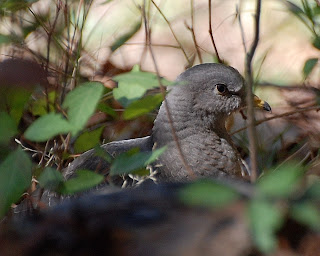 Juvenile Band-tailed Pigeon 10-7-09
T.R. is wondering what I am so excited about but I can barely answer him. I have been in pursuit of this species for almost a year, and now here it is, right before my eyes. I see the pigeon's body, but this is no Rock Pigeon or Mourning Dove. "How do you know," asks T.R.? "See the yellow feet and the yellow beak," I say, but something is not right. Where is the banded tail and the white crescent and green iridescence that should be on the back of the neck. Yet it has a yellow beak and yellow feet. Rock pigeons have pink feet and a gray beak. Mourning doves have the same with a pointed tail and speckled wings. As my mind races, all I can think is that this must be a juvenile.
 Juvenile Band-tailed pigeon 10-7-09 Madera picnic area.
TR and I both snap several photos. The bird doesn't seem to mind a bit. It settles beneath the bush for a nap, and stays there the rest of the time we are here. After I finally sit down, I pull out my bird guides to check. Sure enough, it is a juvenile band-tailed pigeon. Unlike the street pigeons, this one favors oak woods and pines and is a summer resident here in Southeast Arizona. Though I know it has been seen here in Madera Canyon, this is my first time ever seeing one here, or anywhere! I brought TR here because this was at the top of his list of places to visit. We came here seeking lifers for him, but this soft young bird is my reward. Life Bird 363 for me!
We hike up along the creek and emerge near the Santa Rita Lodge. There we find wild turkeys and Mexican jays eating greedily from the feeders. I search the nearby trees for Arizona woodpeckers, but no luck. Arizona woodpeckers are our only brown woodpecker here in the USA, and many people come to SE Arizona to see them. No luck today, but reason enough for TR to come back and visit me again!
We finally drive all the way to the top of Madera Canyon and start to hike up the Carrie Nation trail, but we are tired and hungry. After a few minutes of hiking we are seeing no birds at all. Not a one! So we head back to the car and drive out of the canyon. We take I-19 south to Rio Rico, where I show TR hawk hill and the Swainson's hawk field. The bales of hay and the Swainson's hawks are all gone, but we do find a female vermilion flycatcher, a western kingbird and a kettle of Chihuahuan ravens swirling overhead! We leave Rio Rico shortly after 4 and meet up with Gus in Tucson at a local Mexican Restaurant called Macayo's. It is the perfect way to end the day, since I have neither the time nor the energy to cook and clean up!
 Queen Butterfly in Sycamore Canyon Wash 10-8-09
(Thanks Doug!)
Thursday morning dawns bright and clear. The wind has died down so all is calm as T.R. and I head out into the wash. This will be our last hike before he has to leave. We saved Sycamore Canyon for last since we do not have to drive to get there. It is right out my front door. I do not know what we will see, since we have not seen large numbers of species at all in the places we have birded so far, but Sycamore Canyon does not disappoint and soon we are seeing birds everywhere! So many, in fact, that it is hard to keep track of them all. I get on one bird and TR finds another. "What is this," he ask. "Wait a minute, I am not sure what this one is!" I reply. And we spin, and snap and look and list and hike and look some more. We are finding phainopeplas, Gambels' Quail, Gila Woodpeckers, Gilded flickers, Black-tailed gnatcatchers, black-throated sparrows, Costa's hummingbirds, curve-billed thrashers, cactus wrens, turkey vultures and more. Birds are all around us. Birds are everywhere. T.R. wants to see a pyrrhuloxia, and finally we find one when we near the bridge over the wash. We also find a ladder-backed woodpecker, and a lark bunting eating grass seed heads by the side of the road. The lark bunting is in the same area where I had the Unexpected Encounter with the peregrine falcon and I point it all out to him. We are in no hurry and we go at our own pace. T.R. is enjoying the beauty around him. I think the magic of this place has wrapped around his heart.
 Verdin in hackberry bush in Sycamore Canyon Wash 10-8-09
We have been up on the canyon's rim but now decide to hike home up the floor of the wash. Here TR gets his best view of a verdin yet. while we are hiking we discuss where he is going to next and it is then that we hatch a plan for me to meet him in Patagonia tomorrow and go birding at the Patagonia -Sonoita creek preserve together. So, after entering all our bird counts into eBird, TR packs his vehicle and I hug him good-bye. I wave as he drives down the road and a smile spreads across my face. I'm ready for more birding adventures, but I am glad for an afternoon of rest!
 Lark Bunting in Sycamore Canyon 10-8-09 by Kathiesbirds
 Yellow Warbler in Sycamore Canyon 10-6-09
 American Kestrel in Saguaro National Park's Rincon Mountain Unit
 TR walking the Proctor Trail in Madera Canyon 10-7-09
 Resin ball 10-7-09
 Bridled titmouse 10-7-09
 Green-tailed Towhee 10-7-09 Proctor Trail
 Juvenile Band-tailed Pigeon 10-7-09
 Juvenile Band-tailed pigeon 10-7-09 Madera picnic area.
 Queen Butterfly in Sycamore Canyon Wash 10-8-09
 Verdin in hackberry bush in Sycamore Canyon Wash 10-8-09


 Their twisted shapes look muscular and thick as they grab onto the eroding soil of the red caliche walls. The wash curves left, then right, then flattens out again before it reaches the newly constructed bridge that will bring people and cars to the new neighborhood on the west side of the wash. At this point they are only putting in roads, but someday the pounding of hammers will be heard as more human homes invade the desert. For now, the birds and wildlife are the only residents here.


 He walks out into the center with his questioning “whoop? whoop?” When he is halfway across we spot the female at the edge of the bank.

 A deep basin filled with riprap is on the north side of the bridge. I can only guess that it is to hold the water and debris before it overflows and continues on its way downhill. We skirt the edge of the basin and re-enter the wash again.

 A Gila Woodpecker and Gilded Flicker cling to separate arms of this green monster. The spiny flesh is pocked with holes. Still, this ancient giant produces blossoms in an ever hopeful attempt to reproduce.

 They are a plain gray with no wing bars or eye rings, but they have this distinctive yellow base to their lower mandible. Gus snaps off a few photos for me in hopes that I will be able to identify the bird at home.


