Thursday, February 5, 2009
Skywatch Friday: Egg Case
Wednesday, February 4, 2009
Big January: Two "Common" Birds
At the beginning of the month adding new birds to your count is always easier as even the familiar backyard birds are your first time for this year, but as the days and weeks pass the same species start showing up on your bird counts and the challenge becomes finding species that you haven’t already counted. I went at breakneck speed towards the beginning, but I have to confess, I sort of petered out near the end.
The weekend of January 24th and 25th I only went to Saguaro National Park West on Sunday. Though I counted birds there, they were all species I had already counted someplace else. I didn’t count any new birds the rest of the last week until Saturday, January 31st when Gus and I headed out for One Last Hurrah. I read on the Southeast Arizona Rare Bird Alert that the Elegant Trogon has been hanging out at Patagonia Lake State Park. I have never seen the Trogon, and so it would be a triumph to add it to my Life List as well as my Big January Count. We packed up our gear and headed down there to try to find the bird. What a great way to end the game, I thought, if only I could find it. Well, we not only did not find the trogon, but I did not count any new species of birds on the Birding Trail at the east end of the lake. However, just before we left, I asked Gus to stop at the beach area. I wanted to see if there was anything new or different there.
As I stood on the grassy beach with the blue lake reflecting sunlight like fractured glass a flock of Common Mergansers flew past in a line. There were 12 of them heading towards the west end of the lake. Then, two more flew back to the east. They were quite far out for a photo, but I attempted one anyway. Then, a lone duck came flying low and slow. This time I was ready with my camera. I focused and panned as it flew by. When it landed in the water I peered through my bins at a black and white duck with that unmistakable white cheek patch of a Common Golden Eye.
So, the Common Merganser and the Common Golden Eye make 108 and 109, Right? Not so fast she says.
First of all, when I counted the Pyrrhuloxia as number 107 the other day I was wrong. I kept wondering why it was not recording on my eBird list at the end when I lined up the data according to the dates. So, yesterday I arranged the data alphabetically and found out I HAD recorded this species of bird at the beginning of the month in Arivaca. So, that makes the count 108.
Now, for another adjustment: In recording the Black-throated Green Warbler I saw at Madera Canyon I have been corresponding with Rich Hoyer from eBird. Because this is my first sighting and because I don’t have any photos and I did not see the markings on its back and because a Hermit Warbler was also seen in the area around the same time, my Black-throated Green sighting is noted but not validated. Therefore I am removing it from my Big January list and putting it as unconfirmed on my life list. This is okay. I do not want to count a species of bird that I have not positively identified. I am sure I will get my chance again one day. As for eBird, they have to do this to maintain their quality of information. It is not a slight towards me or any other birder. In fact, it can make you feel more confident in the data they release.
So, with these two adjustments and the two new species my Big January count stands at 107 species!
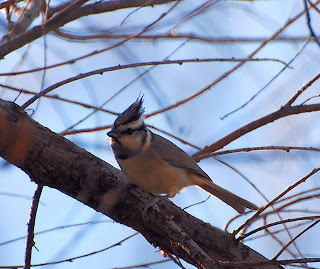
Now, I have two weeks to rest up before the Great Backyard Bird Count starts on Presidents Day weekend, February 13 through the 16th.
Big January Bloggers Final count:
Larry, Brownstone Birding Blog: 100*
Ruth, Body, Soul and Spirit: 61*
Mike, 10,000 Birds: 55*
Mary, Mary's View: 30ish* (she thinks) :)
The Strobels, Bird Couple: 87*
KAllen305, Kitchen Window Birder: 37*
Anyone Else? Let me know and I will add you to the list!
*Congratulations Everyone!
Tuesday, February 3, 2009
Notice: Pima County Residents
The Pima County Board of Supervisors would like your comments on Pima County’s most recent Multi-Species Conservation Plan (MSCP: go to the main website to access the PDF file.) If approved, the plan would provide a comprehensive way for Pima County and the regulated community to achieve compliance with the Endangered Species Act in unincorporated Pima County. In the past, this has been done project-by-project, species-by-species.
Various efforts to avoid, minimize and mitigate the impacts of urbanization on various plant and animal species and their habitats have already been implemented through the Sonoran Desert Conservation Plan. We are proposing to formalize those existing programs and institute new measures in this document.
We invite your comments!
Attend an informational meeting to learn more. Use this comment form (in Excell format) for handwritten comments. Or, you can complete an online survey. Your input will help us draft the community’s final proposal, which will be sent to U. S. Fish and Wildlife Service for formal review later this year.
Public Meetings at
Green Valley Branch Library
Wednesday, February 4, 5-7 PM
Tucson Estates Community Center
February 9, 5-7 PM
South Tucson Branch Library
Tuesday, February 10, 4-6 PM
Ellie Towne Community Center
Tuesday, February 17, 5-7 PM
More information at http://www.pima.gov/cmo/sdcp
Monday, February 2, 2009
My World: Sycamore Canyon

I am amazed how tree-like some cactus seem. This prickly pear is so old and heavy its trunk looks like it has bark.
Farther down the wash the remnants of last summers Monsoon are piled up against the base of this small tree. How it withstood the onslaught of water and debris I'll never know. It stands here now a silent witness to the nature's former fury.
As we near the end of our hike a Black-throated sparrow finally flies up to sing in the sunlight atop yet another Teddybear cholla. I have never figured out how they can stand on one of these cacti and not come away with bleeding feet, but many of the birds do it and many use this species of cactus as a safe nesting place. For now the desert waits as I do, for the healing warmth and renewing rains of spring.
Friday, January 30, 2009
Big January: Pyrrhuloxia No. 107
While most people can identify a male Northern Cardinal with his bright red plumage, black mask, and red crest, the female of the species can be more difficult to identify, especially when in Pyrruloixa territory. So, how do you tell them apart? Well, as seen above, the male Pyrrhuloxia is not red all over. The red is confined to certain areas of the body. The Phyrruloxia, whether male or female, does not have a black mask. Pyrrhuloxias have a short, stubby yellow beak. Cardinals have a red conical shaped beak, though the female cardinal's can appear reddish-orange.
If you look at the photos above, you can see the difference between a male Pyrrhuloxia and a female cardinal. Though it isn't very dark the female cardinal still has a hint of the black mask around her beak. Notice how her beak is also longer, reddish, and more cone shaped. You can clearly see the yellow stubby beak of the male Pyrrhuloxia here. As an interesting point, the Cardinal Symbol used by the Superbowl challengers Arizona Cardinals have it all wrong. If you look at the Symbol they use, their Cardinal is depicted with a Yellow beak. Another case of Art trumps reality!
I had not seen a phyrrhuloxia yet this year but I knew they were resident here in Sycamore Canyon. On Thursday I went hiking in the wash with some new birders I met. (Come back for My World Tuesday to read about this hike) We did see one out in the wash, but it flew down behind some brush before I could capture a photo of it. I was sorely disappointed but we enjoyed ourselves anyway. Later, when I was back at home uploading my bird count into eBird I looked up to see a Pyrrhuloxia right outside my window in the bird feeder. I quickly grabbed the camera off the desk and starting snapping, but the bird was in the shadow and inside the bird feeder. Those shots aren't worth publishing here, but then, to my surprise and delight, this gorgeous male hopped out onto the fence in the sunlight and I was able to snap off several shots before he flew away.
Big January Update: 107: Pyrrhuloxia
Wikipedia's Pyrruloxia entry says: Its name comes from Greek terms describing its coloration (πυρρος = pyrrhos = reddish or orange) and the shape of its bill (λοξος = loxos = oblique, hence crossbill).
Thursday, January 29, 2009
Wednesday, January 28, 2009
Big January: Chestnut-sided Warbler Surprise
Down here by the creek the ruby-crowned kinglet flitter about. We hear their high-pitched voices before we finally spot one in the thick underbrush. Around us giant reed grows tall above us, transforming the creek banks to a jungle. These invasive plants are in the process of being removed by the forest service and a group of trained volunteers. We duck under their towering heights and wander among the willows by the dam. It has been reported that a rare chestnut-sided warbler has been spotted in the area. We crane our necks combing the treetops looking for the little bird.
Even when it completely lacks any Chestnut on the sides, non-breeding Chestnut-sided Warbler is a distinctive bright yellow-green above and unstreaked grayish-white below. It also has wingbars and an eyering. No other warbler has this combination of features.
We continue past the dam and along the creek. Though our list is small today, this one bird is worth it all. Over the dam the swift water tumbles roaring a song in our ears. The boulder strewn creek bed is evidence of its power. Gray sky above becomes life-giving water below.
Big January Update:
105. Chestnut-sided Warbler
106. Anna's Hummingbird
Blogger's Note Update 1-29-09: I submitted my Chestnut-sided warbler photo to the AZFO Webpage where it was accepted and posted. This is a first for me.