Friday, January 16, 2009

Big January: In Praise of Vacant Lots


Some of my best times birding are spent looking for the hidden spots of the world. I find the most unusual birds and sometimes the most peace in vacant lots. They are undiscovered and abandoned places, full of mystery, trash and treasure, and if undisturbed for a long time, they are often the happy habitats of birds.

We have driven to Coolidge for the afternoon to spend some time with my son. It is football playoffs time and as the men settle in for their football game I wander out into the warm afternoon sun. As I pad across the pavement a Eurasian collared-dove eyes me from the overhead wires.


I glance across the flat expanse of desert before me. I use to find so many birds in this vacant lot, but today only jackrabbits scuttle up from the brush as I hike across the dusty earth. A lone Say’s Phoebe bobs its tail from the top of some desert broom. It has a vast terrain to hunt in, but it looks like slim pickin’s to me! In the distance I see the crumbling walls of the Casa Grande Monument. I head in that direction, but take a meandering path.

For the next half mile I see nothing other than mourning doves and grackles flying overhead but as I cross the road I start to hear the sounds of birds. In the two years that I have lived in Arizona I have watched the open land disappear as new neighborhoods and houses go in. Along with the neighborhoods come the new schools, and more land is lost to wildlife. Out here the west seems so big that the loss of a few acres doesn’t seem like it could matter much, but it does. Each little piece of earth is home to wildlife and as the habitat is fragmented and the humans become more numerous the wildlife moves on, moves out, or dies off all together. My son says he has not seen the little owl in the vacant lot I just crossed in a very long time.


But I am here now, here in this wild and discarded place. A neighborhood is growing to the west of it. The curbs and roadways are already in. To the East a new school has risen since the last time I was here. How do they build them so fast? And right here where old trees tower, and remnants of another day lie discarded and rotting the trees and bushes are full of evening birds.


I walk soft as I can on the dried grasses. Leaves and sticks crumble and crack beneath my feet. Mourning doves make heavy silhouettes as they roost on utility wires and on the tangled branches of the trees. I stop to admire the scraggly branches that loom above my head.


Why do I find the bare leaved trees so beautiful and sculptural? In this evening light their bark looks gilt with gold.

A silver silo rises up from the golden land, a monument to man’s discarded past.


Farther down through the vacant lot I wander with yellow-rumped warblers singing me along my path. They don’t seem to mind the garbage strewn about their domain, but I start to wonder if I am safe back here. I’m quite a ways off the road. Would anyone hear me if I needed help?


A flock of White crowned sparrows flutters by and lands in a thicket. Their thin voices call a soft “zeet zeet!” in the waning light.


Then a flock of Gambel’s quail scurries across an opening. Everything about them says, “Hurry! Hurry!” but they have nothing to fear from me. How I wish I could communicate that to them.


With the sun below the horizon the full moon rises in the eastern sky. It is a round balloon in a lavender sea.


I know my time here is short now but I see a lone dark shape high atop a utility pole in the distance. I walk closer hoping for a better view but as I do clouds of mourning doves rise from the tree lined canal that borders the vacant lot and separates it from the Casa Grande monument. Wave after wave of birds rise alerting the hawk to my presence. It lifts on dark wings into the sky and vanishes into the night.


In the pale light that remains I gaze across the canal as if gazing across time to an ancient day when native peoples roamed this land and grew crops that they irrigated with water from the Gila River. The adobe walls of the Casa Grande Ruins are all that remains of those times and those days. I wonder what birds and wildlife lived here then?

As I head back out to the road the mourning doves settle down again to their nighttime roosts. There had to be at least 200 hundred of them, maybe more. As the darkness deepens I grow colder and a bit more concerned about my location. I call my son who comes and picks me up in the moonlit night. If the vacant lot is still here next time I return, I will come back again. The birds are waiting for me.


Big January Update:

70. Brewer’s Blackbird; Rita Ranch Fry’s Parking lot 1-10-09
71. Green winged Teal; Santa Cruz River at Ina Road, Marana 1-10-09
72. Road Runner; Picacho resevour dirt road. 1-10-09
73. Eurasian collared Dove; Coolidge, AZ 1-10-09
74. Great-horned Owl; Sycamore Canyon 1-12-09

Big January Participants:

Larry: The Brownstone Birding Blog
Mary: Mary’s View
Mike: 10,000 Birds
Ruth: Body, Soul and Spirit
The Strobels: Bird Couple

If you are participating in Big January just let me know and I will add your link to this list!

Good Birding Everyone!

Scroll down to see Skywatch Friday: Coolidge Sunset/Moonrise

Thursday, January 15, 2009

Skywatch Friday: Coolidge Sunset/Moonrise

Sunset in a Vacant Lot 5:21 P.M. MST 1-10-09
Coolidge, AZ by Kathie Brown


Perigean Moonrise @ 5:29 P.M. MST 1-10-09
Coolidge, AZ by Kathie Brown


To view more awesome skies from around the globe click on the button!

Click on any picture to enlarge for the best view.

Come back tomorrow to read the post: In Praise of Vacant Lots!

Tuesday, January 13, 2009

MY World: Madera Canyon


Wild turkeys in Madera Canyon 1-9-09 by Kathie Brown

Madera Canyon is a world class birding destination just east of Green Valley in the Santa Rita Mountains. People come from all over to see the numerous species of birds that make this canyon their home. At every season you can find birds in Madera Canyon. For some species this is one of the only location in the United States to see those birds. The Canyon is also a migrant trap and many unusual bird species have been spotted here. I first saw Madera Canyon when Gus and I came here on his job interview 2 years ago. At that time when we were looking at houses in Green Valley and when people found out that I was an avid birder they all asked me, "Have you been to Madera Canyon yet?" At that time I had never heard of it, but before we left the area we drove the 13 miles out of Green Valley up the long desert bajada on Whitehouse Canyon Road and into the tree covered cleft of Madera Canyon. We didn't get out of our car that day, but only drove to the top and came back down. It was January 28th and there was snow on the ground at the top parking lot. But today as I drive through the Sonoran Desert the sun is bright and the air is warm. I came to Green Valley to return some books to the library, but I brought along my birding gear, just in case!

Acorn Woodpecker by Kathie Brown 1-9-09


I bought a sandwich at Subway before leaving town and I ate my lunch at the Whitehouse Picnic area. Though I heard a few birds in the forest, none came close enough for me to photograph or identify, so as soon as I am done, I head up the road a short distance to the Madera Picnic area, which is the most reliable place to see Acorn Woodpeckers. It isn't long before I am rewarded with a view of this clown faced bird. I hear a rustle in the underbrush and find a Hermit Thrush, it's soft brown plumage blending perfectly with the dried brown leaves on the woodland floor. A twittering in the nearby juniper tree reveals a Ruby-crowned Kinglet, and overhead the Mexican Jays raise a ruckus as they fly through the tree tops on wings of blue sky.

Wild Turkey eyes in Madera Canyon 1-9-09 by Kathie Brown


Though it is late afternoon the sun is still slanting down into the deep canyon. Madera Creek bubbles merrily down the rocky slopes. I head on up the trail across the creek where I usually see Bridled titmice, but this time all is quiet as the sun sinks lower and the shadows deepen. I cross the creek again to climb the bank behind the Madera Cabins. Here the Cabin owners maintain bird feeders for their guests and I can sometimes find nuthatches. Imagine my surprise when instead of nuthatches at the feeders I see a flock of Wild Turkeys! I stand silent in the tree line as other people up on the road stop to watch the birds. The Wild Turkeys are wary and start to slip back into the forest away from the gathering crowd. With their concentration focused behind them they don't see me standing there. A few of the bronze beauties come straight towards me. When one large bird is within a foot or two of me it stops, takes inventory and decides to melt into the forest in the opposite direction. I stand still and all is quiet except for the clicking of my camera. While I have seen Wild Turkeys before in other states, this is my first time seeing them in Arizona. This bumps my Arizona Life List up to 200 species of birds. Though I have only lived in Arizona for just under two years, this is no great feat. Arizona is a birdwatchers dreamland and Madera Canyon is one of the many reasons why. Arizona's unique location and terrain provide one with so many diverse habitats, and diverse habitats draw diverse species of birds.


Bridled titmouse 1-9-09 by Kathie Brown

I follow the wild turkeys across the creek and watch as they pick their way up the mountainside before disappearing into the shadows. This side of the road seems to have gotten quiet, so I decide to try the other side of the road where I have seen Painted Redstarts and Arizona woodpeckers before. The Mexican Jays follow me across the pavement and squawk away from the tops of Live Oaks, Junipers and Sycamores. Sometimes they land on the picnic tables or even on the ground, searching for acorns in the forest detritus. At the far end of the parking lot I finally find my Bridled Titmice moving busily about amongst the leaves. These little acrobats are never still as they climb up and down and all around on the leaves and twigs searching for food. And there on the tree trunks I also find the White-breasted nuthatches I've been searching for. Then, to my surprise, I find a small flock of dark-eyes juncos hiding in the brush.


Mexican Jay 1-9-09 by Kathie Brown

The whole mixed flock of birds is moving down the mountain trough the treetops. I find a couple of Ruby-crowned Kinglets in the mix and then, a different bird with a white-breast, black chest and throat and a yellow head. I know it is a warbler and at first I think of Townsend's, but this is not a Townsend's, the face is too yellow and their is no striping. I try to get a picture but the birds are moving so fast and I am torn between looking through my binoculars and trying to get a photograph. Before I know it, they are gone and I am left with the impression of this white, black and yellow warbler. I only saw it from below and after consulting my bird guides I am at a loss. Part of bird watching is knowing field marks, but it is also knowing bird ranges and knowing what a bird is not. I know this bird is not a Townsend's. I have seen them before and I am familiar with them. This one is different and from the information in the bird guides it is either a Hermit Warbler, or a Black-throated Green Warbler-all of which should not be here at this time of year. Kaufman's Guide and the National Geographic don't put the Black-throated Green here at all. Sibleys says they can be here during migration. Well, this bird hasn't read the field guides and just seems to go where it wants! I only know I saw a clean white breast, black throat and bright yellow head. That seems to suggest the Hermit Warbler except the black seemed to wrap around the sides more like the Black-throated Green. What I don't remember is if I saw an eyeline and I never saw the bird's back. Drats! If I could positively identify this bird, I would have a new species for my Life List, never mind Big January! (Note: after consulting all the links I've put into this post I now feel confident that what I saw was a Black-throated Green Warbler.)

For now, the shadows are deepening and the temperature is dropping. As I head back towards my vehicle a little brown birds flies past me and disappears into a yucca at the edge of the parking lot. I don't know if I will ever get over this blending of forest and desert. It surprises me every time.


House Wren 1-9-09 by Kathie Brown

I stop and wait by the yucca and finally the tiny bird hops out cautiously where I can see it. Well, I may not get to add the warbler to my list, but this little house wren is the first I've seen this year. So, with a smile and a warm heart I climb back into my car with the cold shadows of the snow-covered peaks of Madera Canyon falling dark and silent around me.

Snow on the Santa Ritas 1-9-09 by Kathie Brown

As I emerge from the violet shadows I am blinded by the brightness of the sunlight in the open desert once again. As I drive down Whitehouse Canyon road I keep glancing at the utility wires overhead. After almost two years of living here, I know what I am looking for and soon I am rewarded. I pull off onto the shoulder to photograph a Loggerhead Shrike. He is backlit by the setting sun and so the photo isn't very good, but I add him to my Big January count and head on down the road.

Big January Update: My visit to Madera Canyon added 11 more species to the list.

59. Wild Turkey-Arizona Life List

60. Hermit Trush

61. Dark-eyed Junco

62. Ruby-crowned Kinglet

63. Acorn Woodpecker

64. Bridled Titmouse

65. White-breasted Nuthatch

66. House Wren

67. Mexican Jay

68. Black-throated Green Warbler-Lifer!

69. Loggerhead shrike-Seen on Whitehouse Canyon Rd.

Friday, January 9, 2009

What Was That: Hawk or Falcon?

Sharp-shinned hawk 12-9-08 by Kathie Brown


It is Wednesday afternoon and I am sitting outside in the sun on the patio. I’ve been blogging and birding for days on end and I need a break. The warm sunlight falls across my cheek and I close my eyes and melt into the seat. Ahh, this is what I need!

In the mesquite tree behind me a couple of Lesser Goldfinches cheep. The tiny leaves and stems of the native Velvet Mesquite tree have all but fallen off. The naked branches offer little in the way of cover for the birds now. Still, they come to the thistle seed feeder hanging from a sturdy branch and I love to see them there, thick as feathers. I turn to see a female house finch fly in. She lands on a top branch trying to decide if it’s safe, if I am safe. I settle back down into the chair as a soft breeze caresses my face.

Suddenly there is an explosion of wings behind me. I turn just in time to see a small dark bird flying through the middle of the mesquite tree’s maze of branches. The tiny birds scatter in all direction. The hawk or falcon flies straight towards me, tail tilting and turning like a rudder in the air. It flies less than two feet over my head in dashing and darting flight in pursuit of prey.
I try to gather my wits about me and realize what I am seeing. This bird is small, swift and dark. Its tail seems shorter than the hawks I usually see. My mind races…could it be a Merlin? One time before I thought I had seen a Merlin here, but this is such open country, I do not expect them. I don’t even know what field marks to look for to distinguish them from a Sharpie. I only know it’s not a Cooper’s Hawk. This bird is about the size of a Mourning Dove.

I watch as the small falcon flies swiftly over the yards and road only to disappear beyond a rooftop. I do not have my binoculars outside with me and to go in the house even a couple of steps would be to miss seeing what I am seeing. I wait to be sure the bird will not circle around again, and then I relax and breathe. I did not know I was holding my breath. My heart is pounding and I feel the adrenalin coursing through my veins. It is as if I was part of the hunt, though I don’t know who I was rooting for. It was a magnificent sight to see, but I love my little yellow goldfinches and I’m not sure I want to see one end up as dinner right before my eyes. I wish there was a way to serve up House Sparrows only, but even this would not be fair. Nature has its own ways and I am part of that also.

I finally go inside and pull out my bird guides and here is what I learned today, so I will be prepared for the next time. Merlins are small dark falcons with pointed wings. A Sharp-shinned hawk has rounded wings. Merlins have a whisker mark that runs down the side of their face, just like a kestrel does. They have vertical striping on their breast, whether they are mature or immature, but the males are blue-gray above and the females and immature brown. There is also a black northwestern variety and a pale prairie form. A Merlin has a long, dark tail with whitish bands and according to the range maps, this is its winter territory. I will have to pay more attention next time a small hawk flies by and make sure it is not a falcon instead. From all I have read, I believe the possibility is strong that this is what I saw today, but until I am sure, I will not add the Merlin to the Sycamore Canyon Bird List or my Big January count.

I welcome anyone's opinion and input on the identity of this little raptor.


(I have no pictures of a Merlin. The sharp-shinned photo is of a bird that showed up here last December and is shown for contrast only. It was taken using the Nikon D80 with the 70-300mm lens set in sports mode.)

Wednesday, January 7, 2009

Reid Park Serenity

Northern Pintail Duck by Kathie Brown 1-5-09

If I am going to town to get my hair cut, why am I taking my camera, binoculars, and birding paraphernalia (which for me consists of bird guides, notebooks, and hat)? But I am, because if I have time…


Reid Park Reflections, Tucson, AZ 1-5-09 by Kathie Brown

…and I do. Though I have other errands to run, I think I will just stop by Reid Park for a few minutes. I can get a few new species here and it won’t take long. Reid Park is 73 acres in size and is located between Broadway and 22nd Street at 900 S. Randolph Way. I park on the west side of the Zoo and get out. To my surprise, the park is virtually empty of humans. Whenever I have been here before there were as many people as birds, but today is the first day back to school and work for most people. This day started out rainy, gray and cold, though now the sun has burst forth once again and all is bright in the world.


Pond Full of Ducks 1-5-09 by Kathie Brown

I immediately head over to the large pond where I can hear the high-pitched wheet-woo of American Widgeons. The pond is full of ducks and as I start to scan the crowd someone at the east end of the pond brings out some bread and the flock flies up in a low rush to the far side away from me. No matter. A short walk along the pond’s edge brings me to this concentrated collection of waterfowl and I happily count and snap away.


Rock pigeons are as numerous as the ducks and a flock of over 100 birds parades proudly on the ground nearby. When I was young I use to help a man who raised racing pigeons. These birds are the wild escapees of the same species. Though they have a bad reputation and I don’t want them at my bird feeders at home, I still admire them from time to time. Today their flight as they rush by me seems almost magical. I am caught in a whirlwind of feathers and flight and I stand joyous and jealous as they wing past.


Pied Beauty by Kathie Brown 1-5-09

On the ground this one fancy fellow puffs up his chest and starts cooing. He has to be one of the prettiest males I have ever seen in his pied black and white beauty.


Great Egret by Kathie Brown 1-5-09

As I wander the grounds of Reid Park I can hear the distance hum of traffic racing by, but here in this green fortress I am lost in a world of birds. They seem to be everywhere I look. I find a Common Egret fishing in a shallow pool surrounded by a carpet of golden leaves.

Orange-crowned Warbler eating an olive 1-5-09 by Kathie


Beyond the egret I find a tree full of birds. It is an olive tree ripe with fruit. House Finches, House Sparrows, and Verdin weave busily in and out of the thick foliage. Then a flash of yellow flits by and I find an Orange-crowned warbler feeding greedily.

Overhead a winter starling watches and waits.


Reid Park Blue Bridge 1-5-09 by Kathie Brown

Reid Park is wonderfully designed with hills and creeks, treed areas and open space. Little bridges cross the creeks and creek beds. Paths wander here and there. Pine trees tower alongside eucalyptus trees. Palm, Olive, and mesquite trees dot the landscape along with Palo Verdes.

Palm Trees and Roses 1-5-09 by Kathie Brown

On the eastern edge a rose garden grows, with roses in bloom even now, in winter. Most of the blooms are edged in brown from the recent cold, and some of the buds are frozen in time. Will they open still, or fade and fall unfulfilled? Do the sparrows huddled beneath their branches care if these blossoms fade and fall? I walk the circular path in search of that perfect bud or blossom. I lean over tenderly to see if they have any fragrance, but the perfume is faint or nonexistent at the moment. Perhaps a few days of warmth will bring it forth again.

Rose name: Solitude and Artistry


I am amazed at how empty the park is. It’s almost like I have it all to myself.


I wander to the northwest corner, where I have found a Lewis’s Woodpecker before. Today it does not show up, but I find a lovely Red-naped Sapsucker...


Vermillion Flycatcher by Kathie Brown 1-5-09

...and a Vermillion Flycatcher to boot. I stroll the northern perimeter in hopes of finding some juncos, which I have seen in this area before, but all is quiet. Then, I pause in my steps as I realize why.

Cooper's Hawk with Prey 1-5-09 by Kathie Brown

There on the ground ahead of me, beneath a tree a Cooper’s Hawk is standing on its feathered prey. I do not want to disturb the bird. After watching them attempt to catch birds in my yard, I know how hard it is for them to get a meal. I stand where I am and raise my camera to get a distant shot, but after a couple of snaps of the lens the bird sees me. It grabs its meal in its talons and flies to the nearby trees. Once it is gone I walk over to the downy feathers scattered on the green earth. Dappled sunlight highlights a few remnants of the life that was. It’s always a hard thing to accept that one life must end for another to continue, but that is the way of things on this earth. Perhaps in a distant future, this will not be necessary, but for now this is the way. I suspect the prey was a mourning dove. A glance at the nearby fence surrounding the baseball fields reveals a number of them perching in the slanting sun. Do they have any consciousness of the loss of one of their own? It seems to me they go on as usual, now that the danger has passed.

Feathers by Kathie Brown 1-5-09

With these solemn thoughts I head back to my car. I have been here for two hours! It’s time to go home. It will take me 25 minutes to reach the grocery store in Rita Ranch, and another 15 to 20 minutes to get home from there. The sun is setting as I drive up the road to my neighborhood, but inside I carry the serenity of this day, spent in a city park, virtually alone doing what I like best.

Peaceful Dove in Reid Park 1-5-09 by Kathie


Click on any photo to enlarge for the best view and please visit...


Thanks T.R.!


Photographer's Notes: All of today's photgraphy is by Kathie Brown with the Nikon D80 and the 70-300mm lens set in sports mode for bird shots, close-up mode for flowers and Programed Auto for landscape shots. All photos are copyrighted by the blog author. Please do not use without permission.

Big January List Update:

I saw 24 species of birds today at Reid Park in Tucson. This added 11 more birds to my Big January List.
48. Pied-billed grebe
49. American widgeon
50. Northern Pintail
51. Great Egret
52.American Coot
53.Vermillion flycatcher
54.Orange-Crowned Warbler
55.Great-tailed Grackle
56. Redhead
57. Red-naped Sapsucker
58. Mallard

Tuesday, January 6, 2009

My World: Arivaca Cienega


Amado Sewage Pond with clouds streaming off the Santa Rita Mountains 1-3-09 by Gus


In pursuit of my Big January Count Gus and I headed to Arivaca Cienega on Saturday morning. Our route takes us south on I-19 to the Amado exit south of Green Valley. As we exit the highway we take a left and cross beneath the underpass to the frontage road and the Amado Sewage Pond. I have never stopped here before but I have been seeing the pond full of winter ducks when w pass by on the highway. It’s early morning and the sun is still low in the sky as we pull up on the western edge of the pond. We pull off on the frontage road, which I assume will have little traffic, and try to see the birds. The pond is fenced all around with “No Trespassing” signs attached, but you are allowed to view the duck from beyond the fence. I count 6 species of duck here before we head on our way.

We continue our way west-southwest on Arivaca Rd. Here the terrain is hilly and the road winding. We greet the border patrol as we pass by, telling them to look for us on the way back, we are going birding! Soon the pinnacle of Baboquivari Peak looms ahead before disappearing beyond the horizon as the road dips once again. Finally we pull into the parking lot of Arivaca Cienega at 10 a.m. MST. Arivaca Cienega is part of the Buenos Aries National Wildlife Refuge and an Audubon Important Bird Area.

As soon as I open the car door a huge white and brown raptor flies low overhead. It looks just like a photo I saw on someone else’s blog of a Rough- legged Hawk, but I see the dark leading edge to the wings that indicates a red-tail. This puts me off and I am unsure of which bird I am seeing. Gus hasn’t gotten the camera out yet, so we don’t get a photo. Soon the bird disappears beyond the tree line and I don’t add it to my count.


Red-tailed Hawk soars over tree top by Gus 1-3-09

Though the sun is shining brightly, a stiff wind is blowing cold. I bundle up with three layers of shirts and we head down the path. Last year I found sparrows, woodpeckers, and wrens along this paved walkway, but today all is silent. There is no bird movement around as we walk through the Mesquite Bosque. Soon the trail opens up to the grassland and marshes of the Cienega. Towering cottonwoods stand as sentinels along the creek bed. At the point where the path diverges left and right a huge old cottonwood is often a great place to find Great-horned Owls, but today it is void of birds, except for raptors. A red-tail sits on a high limb and the sky is full of them. Red-tails circle endlessly above us. I search their numbers for harriers, but so far this common raptor is missing from the fray.

Arivaca Cienega by Gus 1-3-08

We decide to head east on the loop trail, hoping to find the Green Kingfisher in the pool where we found him last year. Nope. The pond is empty except for a lone Black Phoebe. This is also the area where I usually see Abert’s Towhees. Nothing. As the wind gusts past us I hold onto my hat. I am starting to think the wind is keeping all the small birds down. We continue around the trail under wind scoured skies. A red-tail lands in a nearby willow trailing bronze limbs like strands of hair blowing in the wind, but no other birds are found. No song sparrows by the creek in the forest, no great blue herons in the marsh. No towhees anywhere.

Searching for Birds by Gus 1-3-09
Then, at the far eastern point of the boardwalk, where the path becomes dirt again, I see movement low in the brush at the edge of forest and field. The initial shape looks like a flycatcher, but this bird is bobbing its tail like a phoebe. However, its shape is like an Eastern phoebe and not our more common Say’s Phoebe. What am I seeing? It disappears farther into the trees and I take the camera from Gus and try to follow it, hoping for a photograph, but the bird is gone. Later on I look it up in my bird guides and discover that the Gray Flycatcher is our most numerous winter flycatcher and is noted for its habit of bobbing its tail like a phoebe! ID confirmed: 1 Gray Flycatcher!

Cottonwood Giant by Gus 1-3-09
We wander past the hilly eastern edge of the loop trail with the marshland off to our right. Where the trail takes its turn back towards the west I see some motion and a slight patch of red in the thicket. A look though the bins reveals first one Pyrrhuloxia, then another. Deep in the thicket they hide from us, and we continue down the trail. In this open area we can see across the marsh to the cottonwood tree beyond where all is tan and blue.

The wind is starting to die down a bit as we enter another wooded section of the path. I usually like this section, for it reminds me of the eastern forest I prowled as a child with dappled sunlight speckling the trail before me. We are so close to the marshland now that the cattails and rushes are seen through the trees and red-winged blackbirds call from deep within. Today I hear the call of one, simply one red-winged blackbird. I feel lucky to have heard that one, for this is not the usual time of day for them to give voice. But other than that, this path through the woods is void of birds, whereas last year I saw towhees, cardinals, juncos and sparrows all on this section of the trail.


Red-shafted Flicker 1-3-09 by Kathiesbirds

As we emerge into the sunlight again I spot more red-tails soaring overhead, and another darker bird. Its black silhouette is different. Its long flat wings are totally black, except for the white wingtips. Could this be a Black Vulture? I thought they had all flown farther south for the winter, but as I continue to watch, I have no doubts about what I am seeing. I did not expect to see this bird on this trip, and many others I did expect to see are not here. So, I add a black vulture to my list and continue on the trail as it crosses a bridge over the meandering creek. Another Black Phoebe chirps from the rushes and nervously flits about the reeds. Then a yellow-rumped warbler makes an appearance. Things are starting to look up. Now the Marsh Hawks are up and soaring, white rumps flashing as they fly low over the marsh. Marsh hawks were recently renamed Northern harriers, but their old name is more descriptive to me, and I use the names interchangeably. Gus isn’t feeling well and heads back to the parking lot, giving me the camera as I continue on the trail. At this point the trail turns back across the marsh over a board walk, or you can take a little spur up a hill that overlooks the big marsh and a smaller marsh and pond. I go this way and am rewarded by finding Red-shafted flickers, white-crowned sparrows and a Wilson’s snipe.


Northern Harrier (Marsh Hawk) by Kathie 1-3-09

What I love about Arivaca Cienega is the way the trail wanders in and out of sunlight and crosses various terrains. It loops up hilltops and down to marshland. Golden grasses wave in this pale winter’s light. A single lesser goldfinch peeps at me from a treetop and deep in the wooded area of the marsh I find a Northern Harrier perched on a snag looking over the creeks, its owl-like face focused and searching.


Sunflower Jungle by Kathiesbirds 1-3-09

Once past the creek and pond the land becomes quite marshy once again. In my search for birds I try to follow the path I have before where I have seen meadowlarks, plovers and snipe, but what a difference a year makes. Apparently the wild sunflowers took over this part year and now their dry canes tower overhead like a bamboo forest. Still, someone has broken a crude trail through this jungle of weeds and I follow the damp path searching, searching, searching. But, despite sunshine and what looks like it should be good birdy habitat, all I see are weeds. After a few meters of this I finally decide to turn back as the only motion or sound comes from the wind and the rustling grass and weeds.


I have surrendered. I give up. There will not be a large bird list for me here today. As I emerge from the sunflower jungle I meet a wonderful older couple on the path. Their names are Hank and Dot, short for Dorothy and Harold. I am pleasantly surprised as I tell them those were my grandparents’ names. Hank and Dot are from Green Valley and they are newlyweds of 4 years. They tell me that they dated in high school, then married other people. When their respective spouses passed away, they reconnected after all these years, fell in love and married each other. Together the three of us walk back towards the parking lot.


Red-tailed Hawk in Tree by Kathiesbirds 1-3-09
We continue to see Harriers and Red-tails. As we cross the boardwalk some Eastern Meadowlarks fly up and drop into the marshland once again. Then, a kestrel races by us and we turn to watch its rapid flight. We find Gus sitting in the sunlight on a bench where the loop begins by the old cottonwood tree and I introduce him to my new found friends. Dot and Hank are staying to have a picnic, but Gus and I both aren’t feeling well.
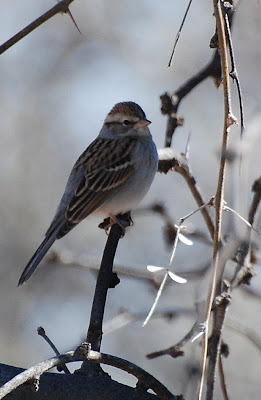
Chipping Sparrow 1-3-09 by Gus

We decide to leave, but before we do, I hit the restroom once again, since it is an hour’s drive through a rural landscape to get back home. By now I assume my birding is over, but as we draw near the car I finally spot a chipping sparrow in the ticket. First one, and then another, then a small flock. Gus takes some photos for me. Then, when I emerge from the restroom I hear the chipping of wood in the nearby mesquite trees.


Female Ladder-backed Woodpecker by Kathiesbirds 1-3-09

I still have my bins with me and I finally spot a female Ladder-backed Woodpecker working vigorously on a fallen limb. She pecks and pounds away, undeterred by my presence. I hurry to the car to get the camera, since Gus is already in the vehicle waiting for me. As I start snapping photos I catch some motion from the corner of my eyes.


There in another tree is a vireo. When I turn to focus on it, it disappears in the thick tangle of branches but I find a Verdin, then a Bewick’s Wren and more chipping sparrows, all in the same tree! In my last five minutes at Arivaca Cienega I find five more species of birds!


In the end I counted 23 species of birds at Arivaca Cienega. A little over a year ago, on December 30, 2007, I counted 26 species of birds. We didn’t have the D80 at the time, and though it was ordered, it hadn’t arrived in the mail yet. It was our Christmas present to ourselves last year, and now we are putting it to good use this year. Arivaca Cienega continues to be one of my favorite birding areas in Arizona and today’s visit goes to show that you just never know what you are going to see. This is part of the charm of birding, or bird watching. It is an adventure. It is full of surprise and delight. It gets you outdoors and into nature, and for me, it renews my spirit. As an added bonus, you never know when you are going to meet some really interesting and kind people. I can only hope I will bump into Dot and Hank again someday. Since they are bird watchers like me, this is entirely possible! (Dang! I wish I had taken their photograph!)


Verdin 1-3-09 @Arivaca Cienega by Kathiesbirds
(click on any photo to enlarge for the best view)


Arivaca Cienega (site profile) is desingnated as an Important Bird Area by Tucson Audubon.


Birds Seen January 3, 2009 (Big January Count Continued)

23. Red-tail hawk: Sycamore Canyon
24. Chihuahuan Raven: Sahuarita
25. Northern shoveler: Amado Sewege Pond
26. Canvasback: Amado
27. Lesser Scaup: Amado
28. Bufflehead: Amado
29. Ring-necked duck: Amado
30. Ruddy duck: Amado
31. Black Vulture: Arivaca Cienega
32. Red-winged blackbird
33. Pyrrhuloxia
34. Chipping sparrow
35. Yellow-rumped warbler
36. European Starling
37. Bewick’s wren
38. Verdin
39. Plumbeous Vireo
40. Black Phoebe
41. Gray Flycatcher
42. Northern Flicker
43. Ladder-backed woodpecker
44. Wilson’s Snipe
45. American kestrel
46. Northern Harrier; Arivaca Cienega
47. Rock Pigeon; Arivaca Junction