
Costa's Hummingbird (male) at feeder outside my kitchen window 9-30-08
Click on photos to enlarge for best view
I didn't want to fall in love with hummingbirds. After all, that's what everyone else does and I don't want to be like everyone else. I resisted as hard as I could, but I did put out feeders and these tiny feathered jewels showed up. They came in such an array of colors; so many varieties, so much energy, so much fighting, so much laughter, that I couldn't resist. I've fallen and I don't want to get up. I kind of like it here in the winter world of flying gems.
I am not a hummingbird expert by anyone's stretch of the imagination, but I've taken lots of photographs and I am trying to learn. I pour over bird guides and study field marks. When they didn't provide enough data, I borrowed Hummingbird guides from the library. I look and look and look. Some things I have figured out and others have left me totally confused. Females and immatures are especially difficult, but I am doing my best. So, enjoy the hummingbird feast. These are just a few of the beauties who have passed through my yard since August, when the little birds started showing up once again.
Anna's Hummingbird

Male Anna's in mesquite tree 10-13-08
Anna's are one of the two helmeted hummingbirds we have here in Arizona. That means their reflective feathers go up from the throat and over the head. This bright male has been hanging around since September. His gorget flashes rose-red in the sunlight.
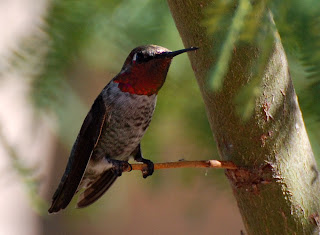
Male Anna's Hummingbird 9-23-08
At about 4 inches in length, the Anna's is a chunky bird with a pot-bellied silhouette. It is common around neighborhood gardens in the southwest. I usually see them after it has warmed up for the day. They tend to chase away the more timid Costa's.

Anna's Hummingbird 9-23-08
Unlike the Costa's, the Anna's tends to hold it's tail still and in line with it's body when hovering. This guy is defending his territory and his tail is a little more cocked for a fight. Look at those ferocious feet!
Black-Chinned Hummingbird

Black-chinned hummingbird 8-31-08
The male black-chinned hummingbird has a mostly black chin with a thin slice of purple that flashes in the sunlight. The black wraps around its head to the green neck with no white stripe of any kind. A long slender hummingbird, it constantly pumps its tail while hovering. While Costa's do this also, the black-chin's tail is longer and the motion is more pronounced.

Black-chinned female 9-13-08
Archilochus alexandri is the western version of the Eastern Ruby-throat, though the Ruby-throat does not pump its tail in flight. Notice the flat headed appearance of this female with the long straight bill. The forehead is grayer than a Costa's and the neck slimmer. Notice that the tail extends well past the wingtips.

Black-chinned male 8-31-08
The male Black-chinned characteristically shows a white collar beneath his black chin separating it from the scaly gray vest it wears.

Black-chinned female at the feeder 8-31-08 The black-chins do not nest around here. These were just passing through on their way to their winter home in Mexico. They showed up mid-August and were gone by mid-September.
Broad-billed Hummingbird
 Broad-billed hummingbird 8-30-08
The broad-billed hummingbird is strikingly beautiful to me with its broad red bill tipped in black, it long blue forked tail, iridescent green body and blue throat and crown.
 Broad-billed hummingbird at the new feeder 8-31-08
Stokes Beginner's Guide to Hummingbirds says they breed in remote dry canyons below 6000'. I saw my first one in Sycamore Canyon last spring. This fall they have been much more numerous, but I do not know if they will stay the winter here. I have counted them numerous times on our IBA survey of Sabino Canyon where they do nest for the summer. I will find out if they hang around there for the winter this year as we continue our survey.

Immature Broad-billed 9-30-08
I was so excited to see the above hummingbird, hoping it was a white-eared hummingbird, which would have been a new record for Sycamore Canyon and a life bird for me, but after consulting my bird guides I learned it was an immature male. He is still pretty and a delight to look at. He stayed around for a day or two and them was gone.
 This is a close-up of the same bird at a closer feeder. Notice the feathers just coming in on its throat and breast.

Just when I thought the broad-bills were gone, this pretty boy showed up on 10-7-08. In this light his head almost looks purple and his chest blue. Could it be a hybrid of some sort, or is it just the play of light on its feathers?
Female Broad-tailed Hummingbird
Female Broad-tailed hummingbird 8-30-08
So, I am going out on a limb here, tell me what you think. After consulting bird guides I have decided this is a female broad-tailed due to the slender body, the speckled throat, the long, straight bill, and the limited rufous/peach to the flanks and tail. The female broad-tailed and the female and immature Rufous are similarly colored but the Rufous has more extensive rufous in the body and tail. The Rufous also frequently has a orange throat patch but the female or immature broad-tail lacks this throat patch. Male broad-tails have a rose-colored gorget and their wings make a high-pitched whistle when they fly. I heard and saw some males but they did not hang around for long and I was not able to photograph one.
Calliope Hummingbird

Calliope female or immature 8-30-08
The Calliope Hummingbird is the smallest hummingbird in North America. While the male has a very distinctive frayed looking red-colored gorget, the female and immature look alot like a female broad-tailed. Short billed and short tailed, this little hummer is very compact at 3.25 inches. The short tail is square and mostly black. The wingtips just barely reach the tail.
 I have found this bird to be wary and shy, only coming to the feeder in the early morning or late afternoon and usually to the less frequently visited side feeder where there is less competition.
 While a male would be an easy call, I was not sure if I could really call this a Calliope, but the bird was so obviously smaller than any other hummingbird, and all the other characteristics fit. So, this is a new bird for Sycamore Canyon and a life bird for me.
Costa's Hummingbird

Costa's Hummingbird in Palo Verde tree 8-17-08
When this Costa's showed up I had no trouble identifying it with that long, flared, purple gorget. After last winter and spring I was quite familiar with this little hummer, which nests in this high desert and was the most common and sometimes the only hummingbird I saw here last year. I fed them through April and early May, then they were gone. I took my hummingbird feeders down after that, and only put them back up when these guys started visiting my yard in August.

Costa's Hummingbird male 9-30-08

Costa's Hummingbird female 9-30-08
The Costa's female can be a challenge to differentiate between it and the female black-chinned. Both are similarly colored and both pump their tails while hovering, but notice the short-necked and short tailed appearance to this little girl. Also, her forehead is more of a greenish tinge while the female black-chin's is flatter and grayer. Still, I sometimes have trouble when there are immatures and females about.
Rufous Hummingbird
 Rufous Hummingbird female 9-7-08
While I have not seen a Rufous male hummingbird around here yet, I have frequently seen these female hanging about. Notice the orange throat patch and the extensive rufous in the body and tail. When the tail is spread the rufous extends to all the bird's retices, or tail feathers. The female broad-tail only has rufous at the base of her outermost tail feathers if my bird guides are correct.

Rufous female 9-3-08
She doesn't seem to hang around for long but I have seen them more than once. Each time I am drawn to the rufous coloration in the body and tail. I usually see it in the house as I walk by the windows. Then, I grab my binoculars and sometimes my camera, but this bird is also shy and wary and not quite so easy to photograph.

Rufous female 10-13-08
The bird guides say this hummer is short and stocky with rufous flanks, a medium length straight bill and a central spot of orange-red on the throat.
These hummingbirds truly are a feast for the eyes and I hope you have enjoyed watching them with me!

An unknown female hummingbird flares her tail at a male broad-billed hummingbird 8-31-08.
Photographer's note: All of today's photography is by Kathie, taken with the Nikon D80 and the 70 to 300mm lens set in sports mode. All photographs are copyrighted 2008 by Kathiesbirds. Please do not use without my permission.


