
Saturday night I went to bed with thoughts of a drive across the Greaterville Road. The Greaterville Road stretches 14 miles from Rt. 83 near Sonoita on the East, to Whitehouse Canyon Rd, near Madera Canyon on the west. I read about it in my Finding Birds in Arizona guide which recounted what a scenic drive it is. However, parts of ht road are gravel and unpopulated as it passes through Box Canyon and the Coronado National Forest. Around here I am always aware of the possibility of encountering illegal aliens or worse, drug smugglers and bandoleros, the Mexican Bandits who prey on drug smugglers and coyotes-guides who lead illegal aliens across the border. I fell asleep that night with hope, but woke up with nightmares of being chased by bandoleros. I almost asked Gus if we could cancel the trip, but with the light of day reason returned and my fears dissipated.


 In the top of a tree I spot a prairie falcon on the lookout for breakfast. We watch the bird quietly and Gus tries to get a photo, but it is too far away. The falcon flies to a nearby agave flower and perches on one of the arms. The agave stalk is over 15 feet tall and dry as it is last year’s bloom. These dry stalks decorate the horizon throughout the desert and many birds use them like trees to perch on and scan their domain. I've included this photo so you can see the relative size of the agave stalk to the nearby trees. Can you see the falcon perched near the top?
The buzz of bees draws my attention to a nearby mesquite tree in bloom. The tassel-like flowers shimmer invitingly in the morning sun.
 There are enough blooms for bees and butterflies alike.


Alongside the road these beautiful ruffled white flowers are blooming like brides in June.

A small herd of black cattle gathers around a watering trough. Here I find 2 red-winged blackbirds singing from a dead tree. We’ve already seen several Cassin’s and Western Kingbirds. While the Cassin's prefer a more wooded habitat, the Western like the more open range. since there is a combination of open range lands and oak woods, I am seeing both today. While they look very similar, the Cassin's has a darker grey head and breast, a white throat patch, and a pale tip to its tail. The Western Kingbird has white edges to its tail and is paler gray on the head and breast. Both have a yellow belly.
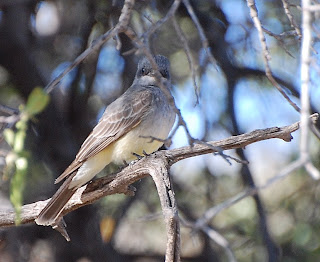

In light of these descriptions, can you tell which bird is which?
A Common Raven flies overhead croaking at the day. The rolling grass covered hills are dotted with live oaks. It gives us both the slight feel of a drive through the back roads of New England, but of course, the trees and vegetation are all wrong. Still, we both comment on how peaceful it is, and how we would like to live here. We drive up around a bend where the pavement ends and the road forks. The left fork dead ends in Greaterville but the right fork leads us through to Box Canyon and Green Valley. The gravel road is well graded and we drive on. We pull over as the first vehicle of the day passes us. I see some action in the nearby trees and find a pair of nesting Bewick’s wrens flitting in and out of a hole in a dead tree. I observe one after the other bringing insects to the hole but when Gus tries to creep up and catch a shot the wrens fly off to keep their secret from us. We quickly leave the area so the parents will return.

A short distance down the road we pullover once again. On the north side of the road there is a lot of activity with turkey vultures and ravens. They are flying over the crest of a hill and swooping back into view on our side again. But, there in a tree at the edge of a small wooded area I spy a large dark shape. I point it out to Gus and he starts snapping shots of the hulking body of a Turkey Vulture. I know they are so common, but this is the closest we have ever been to one that wasn’t flying.

While Gus concentrates on the vulture, I scan the roadside scrub for smaller bird life. I find two rufous-crowned sparrows flitting about near a gully and two canyon towhees hiding out at the base of a large tree. As I step closer to get a better view of the towhees, I’m startled by the sudden flapping of wings. I turn to see a chunky quail flying up from its hiding place in the grass. Its chestnut rump is to me as it flees farther up the slope where it disappears into the vegetation near an oak. I am looking quickly with my binoculars for I read there are elusive Montezuma Quail in this area. The short chunky body and heavy flight lead me to believe it is one for it doesn’t fly anything like the more common Gambel’s quail, nor is the shape the same. I only wish I could have seen the head which, on the male, has a distinctive clownish pattern. The female is more subtly colored and I believe it was a female I saw.
The temperature is rising as the day grows longer, I stamp my feet to keep the flies from landing on my legs. Gus is still absorbed in photographing the vulture as well as the numerous ravens that are flying about. My active imagination wonders if there is a dead body over the crest of the hill, but I am in no mood to investigate and find out! We finally get in the car and drive on. A short distance up the road we find the red jeep-like vehicle that passed us earlier parked by a trailhead leading up into the National Forest. I spot yet another bird on an agave stalk and since it is on my side of the vehicle, I jump out to photograph it for later identification as a mocking bird.

We are on National Forest land now and the hills beside us are becoming cliffs. On our left side the small wash has deepened to a canyon. The road has narrowed to a single lane with many twists and turns. It would be precarious if we encountered another vehicle, but there are none. We stop in the middle of the road and take photos wherever we want to. When we are at the highest point we stop near some rocky ledges to photograph this amazing red flower that is growing alongside the road. I have never seen such a plant and the bloom is fascinating with scarlet pipes radiating from the leafless stem. Apparently this black insect thinks so also as it hovers near the red blossoms.


 We see the bridge over the canyon that we will soon cross. It’s getting late and our stomachs are starting to growl. The sun has gotten so hot that we’ve rolled up the windows once again. We saw the most birds in the first 3 miles of the journey, but I think that is due to the time. As the sun rises the birds go down into the cool places of the canyon. We stop on the bridge to see what we can see and Gus spots a white-tailed deer as it moves from the cover of one bush to another.
 Santa Rita Experimental Range. This area stretches along 53, 159 acres of the western slope of the Santa Rita Mountains and from what I understand is a research area for the University of Arizona. This is open range around here and it isn’t long before we see cattle in the road. The terrain has changed from grassland and oaks to mesquite and cactus once again. I hear the cackle of cactus wrens now, and the whit wheet! of a curved-billed thrasher.
 In the end, we saw 33 species of birds that I identified, with a few more that I didn’t. I am always intrigued by the smaller birds now, but Gus likes the big ones that he can photograph easier. For those of you who are interested, here’s the final count:
1. Say’s phoebe 3 
2. Prairie falcon 1
3. Western tanager 1
4. Black-throated sparrow 2
5. Western kingbird 2
6. Barn swallow 3
7. White-winged dove 7
8. Red-tailed hawk 6
9. Kestrel 2
10. Lillian’s meadowlark 3
11. Cassin’s kingbird 5
12. Common raven 10
13. Red-winged blackbird 2
14. Lark sparrow 1
15. Mourning dove 5
16. Bewick’s wren 2
17. Western wood pewee 1
18. Montezuma Quail 1
19. Turkey vulture 8
20. Canyon towhee 2
21. Rufous –crowned sparrow 2
22. Chihuahuan raven 8
23. Brown-headed cowbird 2
24. Ash-throated flycatcher 2
25. Canyon Wren 1
26. Golden eagle 2 
27. Curve-billed thrasher 2
28. Cactus wren 1
29. Vermilion flycatcher 1
30. Verdin 1
31. Loggerhead shrike 1
32. House finch 3
33. Mockingbird 1
Note: Today's photography is by Gus and Kathie, with Gus taking the majority of the pictures and Kathie editing the ones used in this blog. Hopefully Gus will be editing and adding photos to his own Blog tonight. Then you will be able to see more pictures by clicking here: Gusto!


