For me, part of the fun of birding is finding someone to go birding with. In July I travelled to Maine where I met my new blogging and birding friend, Beth of Beth's Stories.
 We met at the Boiler Room restaurant in Wilton, ME, which is near Wilson Lake. The Boiler Room is housed in an old mill which still has the mill creek running alongside.
 Beth and I sit inside the brick lined boiler room dining area which still has the remnants of its past hanging about on the walls and ceiling. It was the first time we met but we felt like old friends. It is an easy meeting. Her red hair catches my eye. I always wanted to be a redhead. Her bright eyes sparkle behind her new glasses. We order our meals and chat, but we are eager to finish so we can go out birding together.
  After our meal we head out to find birds. A few clouds overhead threaten rain as we stop by the smooth blue lake to take a few photos and see if there were any birds on the water. Wilson Lake, also called Wilson pond, is just one of many with that name in Maine. My grandfather use to camp and fish at another Wilson pond up by Moosehead Lake far to the north. I was born on his birthday and it is because of him that I feel such a connection to this state. However, there are no birds on this lake today, so we drive over to a nearby cemetery I know of to see what we can see.
  We park our car in a quiet corner where large eastern white pines ring the edge of the graveyard. We glance up to see the evidence of woodpeckers, but no birds. Then, we hear a ruckus in the trees and watch as a family of blue jays flies into the pines.
The young jays screech and squawk at the parents to feed them. The parents are frantic to oblige. We laugh and enjoy the show. Then, I see some movement across the street. The black and white barring of a hairy woodpecker hanging about flahses by and lands clinging to a tree trunk. Perhaps he is the one who made at least some of the holes we observed earlier. After spotting a red-winged blackbird in a wet meadow beyond the trees, a chickadee and a few mourning doves we head back to the car and decide to try someplace else.
 I suddenly remember a place I had seen on the back side of the lake from when I lived here before. We drive west along the lake until we reach Rt. 2. I take a right, which is west, and just a bit further we turn off Rt. 2 onto Pond Rd. We follow the road around a bend to where it opens into farmland and meadows. There on the left I see the gravel parking area just as I remembered it. We pull in and grab our binoculars and cameras. Even before we cross the road to the trail I spot an Eastern Kingbird sitting on the gate. I am thrilled, for Beth and I had been discussing this very species earlier and she had mentioned that she had not seen it. Our first bird at the Foothills Land Conservancy site is not only a Kingbird, but a life bird for Beth!
Then, as we cross the street to the meadow we see a Savannah Sparrow catching insects in the meadow grass. A warm sun shines down on us filtered by the threatening clouds. The air is muggy but a light breeze ruffles our hair now and again. I did not remember to bring bug spray and neither did Beth. I know I will pay for this foray into the meadow, but I will not be deterred by mosquitoes. This is the only day and time that Beth and I have. We forge on.

Soon I hear this strange whistling buzz in the trees overhead. A quick look up reveals a flock of cedar waxwings silhouetted against the patchy blue sky. All my senses are on alert as we walk onward. Someone has mowed a path around the meadow, which is thick with tall grasses and wildflowers.
 Beth is much better than I am at tuning into the wildflowers we walk amongst. She points them out to me and I stop to photograph them, all the while listening for birds and watching for winged motion in the trees. Suddenly I grab her arm as my mouth drops open, for I cannot believe what I am seeing in the nearby trees. A bird with a curved bill is clinging almost sideways to a branch. I see it's clear white breast and long chestnut tail. It looks at me through wary eyes rimmed with red and freezes. I'm torn between trying to show the bird to Beth and trying to get a photograph. Beth hears the excitement in my voice as I try to point the bird out to her. I raise my camera to get a shot of the cuckoo and it spooks. Beth watches as the bird flies across the meadow to the trees beyond. I never expected to see a cuckoo. It wasn't even on my radar screen. I know it only as a bird in a book until now. Later, I scour my bird guides for clues as to which cuckoo it was, for there is a yellow-billed and a black-billed cuckoo. I was hoping they had different ranges, but their ranges do overlap. But, since I clearly remember seeing the red skin around the eyes I decide it must have been a black-billed cuckoo. This, too, is one of the pleasures of birding, for birding is a puzzle to be solved.
We continue on our way, but poor Beth endures me repeatedly remarking, "I can't believe I saw a cuckoo. I can't believe I saw a cuckoo" for the rest of our hike. As the trail leads from one meadow to another I'm struck by the beauty of these milkweed blossoms. Though I have grown up with milkweed I am more used to the dry seed pods and the fluffy down that floats on the wind. This is my first time really noticing the blossoms that create the seeds in the first place. The unopened buds appears like tiny purple fruits, but when they open the berries become pink petticoats on a green stem flanked by large shady green leaves. No wonder butterflies like them. What a pretty place to rest and feed.
 As we walk along we spot this huge beetle crawling in the grass. I have no idea what it is, but Beth is not afraid to pick it up for better viewing. I'm content to take a picture and let it crawl away. Birding not only provides the opportunity to see birds, it connects me with nature in so many other ways.
As we walk along through the meadow I glance back at the view behind me. These mountains to the west are framed by the trees that ring the meadow and by the tall meadow grasses and weeds.
 Farther on I am surprised to find a few maple leaves in the marsh already turning, a reminder that here in Maine, winter is never far away.
 Then we find a few ripe raspberries growing along the edge of the meadow. Beth and I pick a few, surprised that the birds have left any at all. We hear the pounding of a woodpecker and find a little downy working on a nearby tree.
As meadow leads to meadow, we cross this plank bridge over a small brook, almost hidden in the dense grass.
 Here in this wet meadow we find common yellow throats galore. They pop in and out of the grasses and I snap numerous pictures before I finally get one where the bird is fully exposed. He looks like a mischievous little bandit with his black mask. I'm sure he is having a good laugh at us!
 We finally reach the marshy end of the meadow. Beyond Wilson Lake lies to the east. This looks like perfect moose habitat, but we see none. However, the mosquitoes are out in force and I slap away at my legs and arms trying to ignore their bites.
 We follow the path back through the meadow to our car. Sometimes we talk. Sometimes we walk in companionable silence enjoying the experience for what it is.
 Back at the car Beth sits patiently on a rock while I photograph the farm field full of recently baled hay. The slanting light of the setting sun has thrown a cape of gold across the land.
 I drive Beth back to where she parked her car and we hug each other good-bye knowing that we have each made a new friend. This is the joy of birding: new friends, new places, new discoveries. But as I get in my car to drive back to the hotel, I experience one of the pains as my welted legs start to itch with over 100 mosquito bites. I'll carry this memento home with me to Arizona where it will linger for many weeks. But it was worth every mosquito bite I got and I would do it all over again. Thank you Beth for meeting me and sharing this experience. To read Beth's account of this day click on Finding Birds in Wilton.
 Sign embedded in a rock at the far end of the meadow near the marsh.
 Visit Wrenaissance Reflections to see edition # 83 of I and the Bird. Click on the button above to view the main web site.
Photographer's note: All of today's phototgraphy is by Kathie with the Nikon D80 and the 70-300mm lens set in sports mode for the birds and landscape mode for the landscape shots.Birds seen:Location: Foothills Land Conservancy
Observation date:7/14/08
Notes: This place was alive with birds and mosquitoes. So much to
see. I will definitely go back. Beth and I both took photos.
Number of species: 12
Black-billed Cuckoo 1
Downy Woodpecker 2
Eastern
Phoebe 2
Eastern Kingbird 1
American Crow 3
Black-capped Chickadee 2
American Robin 1
Cedar Waxwing 12
Common Yellowthroat 5
Savannah Sparrow 10
Song Sparrow 2
American Goldfinch 9


 a children’s book by


 Ash-throated flycatchers cling to an ocotillo searching the sky for insects to dine on. A gilded flicker calls from atop a towering saguaro which looks like a giant prickly pickle thrust into the azure blue sky. Gus is captivated with the beauty of the desert and stops to photograph the spines of a teddy bear cholla. White-winged doves are thick as fleas this time of year and I see them perched on the blooming saguaros and flying overhead from one rim of the canyon to the other. Then, to my surprise, a lesser nighthawk flutters overhead and disappears in the distance in its final search for insects before bedding down for the day.


 Gus is snapping pictures of whatever captures his fancy, including this Empress Leilia butterfly.


 We head through a narrow sandy channel still looking for birds. Suddenly I hear a buzzy rattle and instinctively leap backwards. There on the open sand before me a rattlesnake is coiled in a striking posture. About 3 feet long its thick tan body is patterned with diamond-shaped spots leading me to susspect it is most likely a
 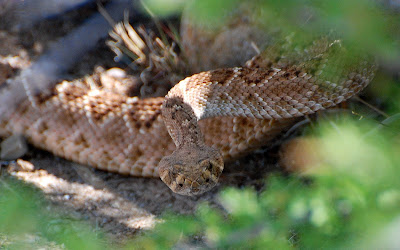 I walk backwards, heart pounding to a safe distance. Gus gets in front of me and starts snapping. He keeps his distance also and the rattler slithers off to the shade and safety of a nearby bush. Gus is disappointed because he wants a better shot. I want to head home because my bladder, which was already wanting relief, is now about to burst from the encounter. I walk up another small bank and around the area where the snake is. Gus finally follows me, but he is still searching for a better shot. As we come down on the other side of the snake, he tries again. I know that home is only a short distance away but I am reluctant to leave this crazy photographer alone in the wash with this snake. I urge him onwards and we hike out the last few steps to home.
 My final count of birds is 24 species but 4 are unidentified. I heard the high buzzy whistling flight of a hummer species but never saw the bird to positively identify it. We have 3 hummer species here whose wings produce that sound. I heard and saw a gnatcatcher but once again, it eluded my attempts to positively identify it. A chunky short-tailed blackbird flew overhead that I suspect was a bronzed cowbird, but, once again, I wasn't confident enough to call it. And though I saw the one sparrow at the beginning of the hike, I never saw another on the rest of the hike. My one mystery bird is this little brown job that I think is a female brown-headed cowbird, but it could be a female indigo bunting as well.
 I am going with the brown-headed cowbird as a flock of 5 showed up at my feeders for the first time this year this morning before we left. All in all, I would say it was a great way to celebrate International Migratory Bird Day. I was able to add a new species to my Sycamore Canyon list, and Gus got his rattlesnake photo. I hope we will be doing this again for there is so much more to explore here in Sycamore Canyon.