Showing posts with label Great Horned Owl. Show all posts

Thursday, May 2, 2013

In Search of Nighthawks

1. Mt. fagan-kab

Mt. Fagan as seen from Sycamore Canyon 1-21-2010

It was a busy weekend here and Sunday we just crashed and watched TV, but by Sunday evening I was itching to get out of the house and see some birds. I know that the nighthawks have been spotted in the area, but I had yet to see any for myself. Knowing that we used to see them all the time in Sycamore Canyon of Corona de Tucson, Gus and I decided to go for a drive and see if we could find some.

The sun is still shining and the air still warm and dry as we hop into the convertible. Gus heads for Old Spanish Trail and we wind our way along the Rincon Mountains and up through Vail in order to avoid the Pima County Fair Traffic on Houghton Rd. Here in Arizona they do their county fair in spring instead of autumn. I am guessing this is due to the weather, which is perfect at this time of year!

2. cactus garden-kab As we drive through Vail Town Center the road starts to climb toward the Santa Rita Mountains. Above us the sky is mostly clear. I am lost somewhere deep in thought as the miles slip by. Soon we are turning onto Harrison Road with the Mt. Fagan and the Santa Rita Mountains looming ahead. Gus cannot resist a drive past our old house and I see that the cactus garden we planted out front is still there and one cactus is blooming bright pink blossoms!
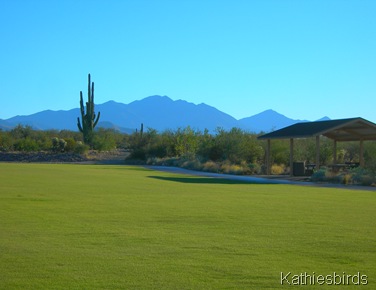
3. Syc Can Park-kab We head down to the park then and park our car and get out. While the park looks pretty much the same, there are a lot more people and dogs in it. Someone has a whole team of huskies! They look so out of place here in the desert. I grab my bins and notebook and we take of walking. Gus soon goes ahead of me while I linger to look for birds, but all I am seeing are Mourning Doves and White-winged doves, and a lone Cactus Wren. In the desert I hear Curve-billed thrashers and Gambel’s Quail.

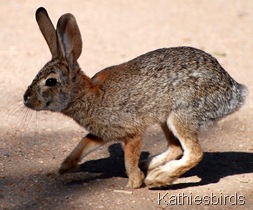
I see a desert cottontail hiding just off the path wanting to get out onto the lush4. cottontail-kab green lawn of the park, but still leery of all the people and dogs. Behind it a jack rabbit looks like a giant as it dwarfs the smaller rabbit with its huge feet, legs, and ears. While I am enjoying seeing these creatures, it is still not what I came to see! I scan the park, the desert, and the sky for nighthawks, but see none. I finish my circuit around the track and make it back near the parking lot. By now Gus has done several laps and the sun has set. People have left the park and we are just about the only ones left. As I wait for Gus to come around again I scan the desert for nighthawks and find a Great Horned Owl perched atop a tall saguaro instead. Its silhouette looks like an eared lump against the tangerine sunset! 5. sunset-kab The temperature has dropped quite a bit by now but we still leave the top down as we get back into the convertible. We drive away from the park and Sycamore Canyon without seeing a single nighthawk. I find this distressing since I know they used to be here on a regular basis. I ask Gus to drive by Road Runner Market at the junction of Houghton and Sahuarita Roads as it has numerous street lights and often there are nighthawks hunting for insects here. We drive east on Sahuarita Road, then turn south on Houghton where Gus does a u-turn and we are now facing north. All this time I have been scanning the sky overhead for nighthawks to no avail. I have not seen one. As we wait at the stop light in the left turn lane to drive down to Sahuarita I suddenly see motion across the street from us on the northeast corner of the intersection. This is not a nighthawk. It is a large raptor, an owl, but too pale for a Great Horned Owl. I train my binoculars on the bird, which has landed on a fence post low to the ground, and discover it is a Barn Owl! With no one behind us we sit through three changes of the light while I watch this magnificent raptor as it turns its head from side to side searching the ground below for prey. We finally make the turn and drive away without knowing if the owl got to eat tonight. As Gus turns the car west I am smiling like a Cheshire Cat moon in the night.
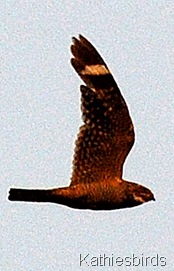
6. Nighthawk-kab All along the ten or more miles to Sahuarita I am looking for nighthawks in street lights to no avail. We spend about 30 minutes or more in the grocery store before getting back into our car to head home. I ask Gus to drive through Rancho Sahuarita as we head north. The paved road snakes through the development with street lights scattered here and there. It is as we are nearing the end of the road that I see a well lit parking lot off on my right. As Gus drive forward suddenly I see the ghostly flash of a bat-like body as it moves in and out of one of the street lights! Nighthawks! “Gus!” I yell, “I think I just saw some nighthawks!” My patient husband turns the car around and we drive back to the parking lot. Sure enough, as we park beneath one of the lights we see the nighthawks swooping and fluttering like giant moths hawking for insects.

7. nighthawk-kab We sit there in the darkness, bathed in the glow of street lights and watch the birds swoop, dive and flutter. Their erratic flight is so unpredictable. Their bodies so cryptically colored, yet I can see their notched tails streaming out behind them, and the white or buffy patches in their wings. We get mostly Lesser Nighthawks here in Arizona, but it is possible to find common nighthawks as well. In the Lesser species the females have a buffy patch on their wings, instead of the white patch of the male Lessers or both sexes of Common Nighthawks.

8. nighthawk-kab I think I could have stayed there and watched those birds all night long, but after ten to fifteen minutes we finally left. It is hard for me to drive away in this cool night air, because I am still concerned for this species of bird. I did not see very many insects in the street lights. When there was a brief bit of insect activity suddenly eight nighthawks came into the lights at once, then they were gone, and so were the insects. Until that one moment Gus and I had only see four nighthawks at the same time. The nighthawks seem to prefer the lights that were nearest the open desert beyond. I did not see them hunting at any of the lights nearer the center of the parking lot.

So, it was with a somewhat sad smile that I left the birds behind me as Gus drove away. Here in Sahuarita the temperature had dropped to 65F! But, by the time we got back up to Tucson it was back to 75F! That just shows you the effect of the “heat bubble” created by the city. I am happy to have finally seen my nighthawks, but a bit concerned about their population. I know so many insects are being poisoned by pesticides and along with them, the wildlife that feed on them. We must find a way to live with these creatures that share the earth with us. All of our lives are enriched by their presence.

Happy Earth Day!
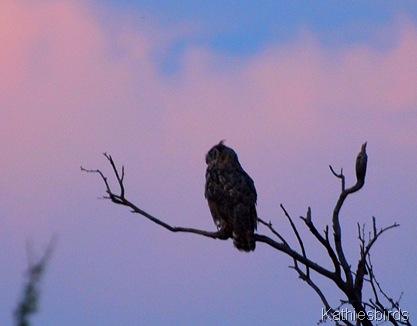
9. GH owl-kabGreat Horned Owl in Sycamore Canyon 8-8-2008

Note: All photos in this post are from my archives from when I lived in Sycamore Canyon between 2007 and 2010. While I no longer live in Sycamore Canyon, I do have friends who do. I did not have my camera with me on this drive. Besides, it was soon too dark for photography! This post was originally posted on my Kathie’s Birds blog for Earth Day.

Saturday, April 17, 2010

Birding From Dawn ‘till Dusk: Day 1

DSC_0057

Great-horned Owl chicks 4-7-10

Kathryn arrived around 10 a.m. and it wasn’t long before we were out the door birding. Besides the birds in my yard, I drove her around Corona de Tucson where we saw these baby owls. Farther south on Houghton Road we also counted birds. We saw our first Ash-throated flycatcher for the year at the base of Mt. Fagan.

These are the birds we saw on the first day:

  1. Gambel’s Quail
  2. Turkey vulture
  3. Great-horned owl
  4. Mourning Dove
  5. White-winged dove
  6. Broad-billed Hummingbird
  7. Gila woodpecker
  8. Gilded flicker
  9. Ash-throated Flycatcher
  10. Cactus wren
  11. Curve-billed Thrasher
  12. Green-tailed Towhee
  13. Black-throated sparrow
  14. Rufous-winged sparrow
  15. White-crowned sparrow
  16. Northern Cardinal
  17. Pyrrhuloxia
  18. House Finch
  19. Lesser goldfinch
  20. House sparrow
  21. Canyon Wren (heard only)
  22. Swallow sp.
  23. Hawk sp.

Monday, March 15, 2010

Birding from Sunrise to Sunset: Kino Springs and Beyond

  DSC_0233

Kino Springs Golf Course 3-5-10

My birding day had started with a sunrise drive to Patagonia where I met Jeff and Dawn Fine.  After six hours of birding at Patagonia Lake SP we decided to finish our birding day at Kino Springs. Kino Springs is a golf resort near Rio Rico, Arizona.  It is a birding hotspot that I have never been to, so when Jeff and Dawn said they knew where it was I asked if they would take me there. I had no idea what we would find, but I was very happy to try someplace new. Driving west on highway 82 we turn onto the road just after the bridge over the Santa Cruz River. It isn’t long before we are seeing birds. Sparrows pop up out of the grass, Say’s Phoebes flit through the sky. Mourning Doves hang on the wires and robins flutter in the trees. Jeff parks the car and goes into the club house to ask permission for us to bird.  It is readily granted and we are off. Dawn and I find Audubon's yellow-rumped warblers in the trees near the sewage treatment pond, then we walk over to another pond across the street from the country club. In spite of recent rain, this one is drying up, yet there is still enough water in it to attract the birds.  A pair of Gadwall and several green-winged teals fly or swim to the farthest edge away from us as we drew near the pond.

 DSC_0236

Great-blue Heron 3-5-10

While we are watching them a Great Blue Heron lands and starts hunting along the edge. A black phoebe flits near the water along with a Says’ phoebe and several Vermillion flycatchers. Most are brilliant red males but we find one female in the bunch. A Loggerhead shrike watches us from some nearby utility wires while across the pond some starlings feed on he ground with a few killdeer.

DSC_0237 We can hear the calls of red-winged blackbirds trilling to the sky from across the pond.

DSC_0240 A vesper sparrow hops up on a branch and takes a look at me.

DSC_0248Then Dawn spots these Lawrence’s Goldfinches in the willows along the bank.  I couldn’t quite believe her at first but after a closer look I discover she is right.  I have never seen more than one Lawrence’s goldfinch at once while Dawn says that whenever she has seen them they have always been in a flock. These are backlit by the setting sun and well hidden in the tree but finally I see the black foreheads and gray backs with a yellow wash on the wings and breast.

DSC_0278Crissal Thrasher 3-5-10 

We are busy looking at a flock of Brewer’s Sparrows in the hedgerow along the fence line when Dawn cries out excitedly, “Crissal thrasher, Crissal thrasher! I spin around with my bins and my camera while Jeff gets it focused in the scope.  I have never seen a Crissal Thrasher in the three years that I have lived here, so, while this is not the trogon, it is a *Life Bird for me and I am very excited. The Crissal sits atop what looks like a dead bush singing a tremulous song.  The notes float over the greening meadow below while Dawn and I stand mesmerized. I alternate between looks through the scope and taking pictures with the camera.  Still, even with the 70-300mm zoom we are quite far away, so Dawn and I start to creep slowly closer.  Step!  Snap!  Step!  Snap!  Until the bird decides that we have gotten too close.  It ceases its song abruptly and flies to the ground for cover.

DSC_0291 We end the day in Rio Rico at the Rio Rico Pond where we see a dowitcher, several ducks, and tree swallows.  The swallows were everywhere today and they are headed north.  Migration has begun.  Get ready.

Our final bird of the day is a Great-horned owl we see on the side of the San Cayentano Mountains where I take Jeff and Dawn to see the lights of Rio Rico and Nogales.  It is twilight as we head down the mountainside and there on the same utility pole where I saw the owls mating last year sits this large bird.  We all get so excited that I think the bird heard us from inside the car for it flies off into the night as we roll down our windows for a better look.

It is a half-hour or more ride back to Patagonia and the RV where I  say good-bye to Jeff and Dawn Fine. On the ride there I chatted like a magpie from the back seat.  It’s something I do when I am really tired.  Jeff and Dawn were so kind. We hug good-bye and I get in my car wondering when or where I will see them again. I feel like we have been friends for a long time already.  I will never forget the birding adventures that we have had together. Now, I still have an hour’s ride home in the dark on the back roads of Arizona. And though I am alone, I am not lonely. I can hear the sound of the road beneath my tires and the songs of birds in my head.  I feel Orion guarding me in the starry sky above. As I approach the border patrol checkpoint on Highway 83 I chat with the young man who is the guard.  I suddenly realize how dark and lonely it must be out here in the night on this back road. He has to stay at his post, while I am heading home with a tired but contented smile on my face to a good husband and a warm bed and a HUGE checklist to compile!

And that’s…

My World Tuesday!

In the end we saw 72 species of birds on this day with 47 species at Patagonia Lake, 28 species at Kino springs, and 11 species in Rio Rico.

*Kathie’s Life Bird Number 371: Crissal Thrasher

Tuesday, September 8, 2009

My World: Gilbert Water Ranch

Black-necked Stilt 8-28-09 by Gusto!

Only in Arizona would they call the place you round up water from the sewage treatment plant a Water Ranch! I only recently discovered the Gilbert Water Ranch when I was viewing and Exploring Data on the eBird website. As I scanned the species of birds in the bar chart I was surprised to discover a wood stork on the list. I quickly clicked on the link to see where in the world one could possible see a wood stork in Arizona, for as far as I know, this is a southeast species. When the map came up I clicked on the display pin marking the bird's sighting. When the record came up it revealed who spotted the bird, when and where. A quick Internet search gave me the information I needed and on Friday, August 28, Gus and I were off!

Black-phoebe 8-28-09 by Kathie

We drive north to Phoenix, then east to the town of Gilbert. Also known as the Riparian Institute, the 110-acre Riparian Preserve at Water Ranch is located at 2757 E. Guadalupe Road east of Greenfield Road, next to the Southeast Regional Library in Gilbert, Arizona. According to the Riparian Institute Website, over 200 species of birds have been sighted here. Though we left from Tucson by 6 a.m it is already 91 degrees F at 8:30 a.m. when we arrive. Donning hat, bins, camera and water bottle we head across the parking lot with a white sun blazing down on us. I always get so excited when I am in a new birding place. I can already see birds ahead of me in the muddy pond as well as on the ground and in the trees surrounding us. On a nearby fence a little black phoebe perches and I quickly snap its picture, but then I hand the camera to Gus. There are just too many birds to see and count!

Long-billed dowitchers 8-28-09 by Gusto!

Before us black-necked stilts, snowy egrets, mallards and sandpipers wade in the shallow water. Overhead turkey vultures soar. We walk from pond to pond. We find long-billed dowitchers, along with more stilts, common and snowy egrets, least and western sandpipers and a lone cattle egret still showing the rust-colored feathers from its fading breeding plumage. The trees surrounding the ponds are full of warblers, blackbirds and sparrows. Abert's towhees and Inca doves land on the dirt paths before us, then fly up as we draw near. In the surrounding trees the great tailed grackles whistle and call. All my senses are on alert! I don't know where to look first!

A flock of 50 white-faced ibis mingles with the egrets, stilts and sandpipers. Then a racuous sound fills the air and a flock of at least 55 more ibis fly in and lands with the rest of them. Standing there by the pond is another birder/photographer. He too is here to try to capture a photo of the wood stork. As we stand there talking it suddenly flies right over our heads and lands in an adjacent pond. We quickly grab our gear and cross the path to that pond.


Wood-stork 8-28-09 by Gusto!

As we scan the sky the wood stock suddenly makes a landing! However, from this angle it is terribly back-lit and in the excitement, Gus gets the best shot that he can at the moment.


Wood stork and Great egret by Gusto!

Gus takes another couple of shots, but none are like he wants. The other photographer says there is a spot from the other side of the pond where we can get better light, so we leave our viewing area and walk around the pond, but by the time we get there, of course the stork is gone!


Great-horned owl 8-28-09 by Gusto!

Instead this great horned owl watches us from a nearby willow tree.


Common egret 8-28-09 by Gusto!

And then Gus photographs this gorgeous great Egret. I am starting to wonder, am I really in Arizona? The temperature has risen significantly now and we are getting so hot. We bid good-bye to our new found photographer friend and head back to the car. There is so much more to explore, but it will have to wait for another cooler day. We grab our small cooler from the car and rest in the shade of one of the ramadas. We drink juice and water and eat some fruit and chips trying to replenish what we have sweated out in the 2 hours we have been here. When we finally get in our vehicle and start it up the car thermometer reads 114 degree F! Yikes! And it's only 11 a.m.! However as soon as we start driving the temp drops to 107F. On the drive home it once again reaches 111F near Casa Grande. Apparently we decided to go birding on one of the hottest days in August. Gilbert Water Ranch is a wonderful place to bird. It has 7 small ponds and we only made it to about 4 of them. We discuss coming back again when it is a bit cooler, but I am not sorry we came. How often does one get the chance to add a wood stork to their Arizona Life List after all! In the end I recorded 4o species of birds at Gilbert Water Ranch. I hope to return one day soon to find the peach-faced love birds that are reported to be hanging out there. And that's....


Juvenile Great Blue Heron 8-28-09 by Gusto!

I want my Mommy!

Bird Report:

Location: Gilbert Water Ranch
Observation date: 8/28/09
Notes: What an amazing place! There were so many birds! I did my best but I could not count or identify all the peeps. We only got to a few of the ponds before the heat drove us away. It was 91F when we arrived and 107F by the time we left at 11:00 A.M.! Photos of stork and ibises.
Number of species: 41

1. Mallard 14
2. Gambel's Quail 2
3. Pied-billed Grebe 1
4. Neotropic Cormorant 30
5. Great Blue Heron 6
6. Great Egret 30
7. Snowy Egret 25
8. Cattle Egret 1
9. Green Heron 1
10. Black-crowned Night-Heron 5
11.White-faced Ibis 105
12. Wood Stork 1
13. Turkey Vulture 7
14. Common Moorhen 1
15. American Coot 1
16. Killdeer 10
17. Black-necked Stilt 25
18. Spotted Sandpiper 1
19. Greater Yellowlegs 1
20. Western Sandpiper 50
21. Least Sandpiper 20
22. Long-billed Dowitcher 40
23. White-winged Dove 1
24. Mourning Dove 12
25. Inca Dove 2
26. Great Horned Owl 1
27. Gila Woodpecker 1
28. Black Phoebe 2
29. Northern Rough-winged Swallow 12
30. Verdin 12
31. Northern Mockingbird 2
32. Curve-billed Thrasher (Western) 4
33. Orange-crowned Warbler 2
34. Yellow Warbler 1
35. Abert's Towhee 5
36. Red-winged Blackbird 20
37. Great-tailed Grackle 30
38. Brown-headed Cowbird 15
39. House Finch 12
40. Lesser Goldfinch 2
41. House Sparrow 12

This report was generated automatically by eBird v2
(http://ebird.org)

Wednesday, April 22, 2009

Earth Day Owlets

Great-Horned Owlets by Gusto! 4-19-08 6:05 PM

w/Nikon D80, 70-300mm lens 1/500 sec - F/5.6

(Click to enlarge for the best view)

HAPPY EARTH DAY!
Gus and I checked on the baby owls mentioned in a previous post on Sunday, April 19th. As you can see, all four of them are growing big. I wonder how much longer they will be here before they fly off on their own to make their way in the world. I wish you well little owls!

Tuesday, April 7, 2009

My World: Owlets!


1. Who is in the Cave? 2:29 p.m. MST 2-15-09


I first spot her in February, high up an embankment in what looks like a little cave. The Great-horned Owl sits in the dark recesses of the red caliche and waits. Below her the cars travel past her unaware of her fragile secret.


2. Nesting Great-Horned Owl 11:49 a.m. MST 3-25-09


I come back again late in the morning on March 25 to see if anything has changed. She is closer to the edge now, her wings spread protectively over her precious future. Can it really be?


I visit in the evening this time on March 31st. Perhaps the mother is out feeding. Perhaps I will see the gray fuzz balls I long to see…


4. Owlets 4:29 p.m. MST 3-31-09


…As I pull off the road my eyes are searching the depths of the little cave. A fuzzy face stars back at me, and then I see another. The little owlets are seeking relief from the western sun and push farther back into the shaded depths. Could there be more than two?


5. Great-horned owlets 5:33 p.m. MST 4-5-09


Gus and I return once again on Sunday evening with the sun lying low and the shadows growing long. We pull of the road into the gravel. We use the car as a blind. The cliff is on the opposite side of the road from us, at least 30 feet away and the cave is 10 feet up the embankment. Tonight the owlets are out at the edge and I can see all four of them. Four!


Four baby Great-horned owls. Four hunters of the night.


Four bright promises of the future.

I watch the shadows lengthen on the road before me. The black ribbon of asphalt heads south towards the peaks of the Santa Rita Mountains, which are the backdrop of my life since moving here two years ago. I see the ocotillo raising blossoms like orange pompoms to the soft blue sky and I can’t help but wonder how these fragile fuzzy owlets will be affected by the proposed Rosemont Copper Mine. It would be just on the other side of the peaks that I can see from here.


8. Evening Road where the owls nest 5:39 p.m. MST 4-5-09


I raise my eyes to the shifting light on the foothills and hope against hope that reason will triumph over greed, and that the long term value of this quiet place, this wild place, this fragile and scenic environment will win over the short term dollars of copper with the long term damage to the environment. I look at fuzzy owl babies and hope that MY World will continue to be a safe and natural place to live.


Photographer's Note: All of today's photography is by Kathie Brown with the Nikon D80 and the 70 to 300mm lens.


Shooting Data:
  1. 1/320 sec - F/4.5 Focal Length 70mm
  2. 1/160 sec - F/5.6 Focal Length 300mm cropped and enlarged
  3. 1/400 sec - F/5.6 FL 300mm Cropped and enlarged
  4. 1/500 sec - F/5.6 FL 300mm Cropped and enlarged
  5. 1/500 sec - F/5.6 FL 300mm Cropped and enlarged
  6. 1/400 sec - F/5.6 FL 300mm Cropped and enlarged
  7. 1/400 sec - F/5.6 FL 300mm Cropped and enlarged
  8. 1/500 sec - F/5.6 FL 70mm
This is MY WORLD Tuesday!

Tuesday, February 17, 2009

My World is a World of Wonder


Gambel's Quail 2-16-09 Corona de Tucson by Kathiesbirds

My World is a world of wonder. A world where birds greet me with merry chirps in the morning and sweet twitterings drift through my open window letting me know that I am alive and life is good. I smile to see the quail at the seed block, jockeying for position in their own version of King of the Mountain.

My World is a world of color where red Cardinals...


...and yellow Lesser Goldfinches come to the feeders,


...and where pink apple blossoms open with the promise of spring.


In My World of Wonder a Red-tailed hawk soars over the Santa Rita Mountains scooping my spirit up in its wings and carrying it high into the steel blue sky.

In My World of Wonder the amazing thing is when wonder creeps up on you unexpectedly, like it did on Saturday in Rio Rico where Gus and I scoured the countryside counting birds for the Great Backyard Bird Count. On the slopes of the San Cayentano Mountains, at a place we call Hawk Hill, the only birds we counted were two ravens and a Red-tailed Hawk. Every time we come here it seems there is one sitting on the utility pole, which is why I call this place Hawk Hill. It is late in the day as we arrive and we watch as the shadows deepen and fall across the valley only to swallow the hillside in darkness around us. We drive into town for a restroom break, and then, we return to watch the city lights from the mountainside as darkness descends.

As we drive up the dirt road in twilight our headlights illuminate the gravel road before us. I am still looking out the windows for birds when I see a thick shape at the top of a utility pole. I tell Gus to stop the car, because I think there is a Great Horned Owl up there, but at first he doesn’t believe me. He thinks it is the hawk. He stops the car so I can look through the binoculars at the large mass of feathers perched above us. Its thick head and neck with ear tufts reveals it to be just what I thought it was, a Great-horned Owl. I pass the binoculars to Gus so he can have a look, and as we are both watching through the windshield of the car the owl raises her hind end as if to vent when suddenly like a ghost another owl appears out of the dusk. Its wings form a massive canopy over the female as he lands on top of her fluttering. I think he is trying to get a foothold on the same pole as her before it dawns on me that I am witnessing the mating of two Great Horned owls! It is all over in less than 20 seconds and he is gone like the wind in the night. The female lowers her rump to the pole and assumes her upright perched position again. Gus and I sit there in wonder as we realize what we have just seen.

Though we try to get a photo of the owl on the pole, by now the darkness has deepened and she is too high up for even the flash to register her shape. We put the car in gear and continue up the mountainside to our favorite lookout spot. High on the side of the mountain the Rio Rico valley sparkles below us. We can see the lights all the way to Nogales and I must say the city lights have never twinkled so brightly. No wonder those owls had romance on their minds!


On Sunday I count birds in Corona de Tucson. I count birds at the schoolyard where I find a flock of Lark sparrows and one sweet-faced bird hops up for a look. Across the street I hear Killdeer call and then watch in awe as four white-bellied birds fly overhead, but it is the memory of the owls that lingers in my mind. So, I drive up the road to a steep dirt bank where I find another Great Horned Owl in a little cave.


Last year she nested here and raised a brood of 4 little owlets. Can she be sitting on eggs again already? What a Wonder that would be! I will check back on her again in a week or two, but as I drive away I am recalling the events of the night before and the wonder I felt as the phantom of the night flew in on silent wings to woo his mate.

GBBC Update: All of today's photos we taken during the GBBC and were birds that I counted and submitted on checklists. I missed counting most of Friday due to Doctor's appointments and other errands, but I counted Birds all day long on Saturday, Sunday and Monday. In the end I submitted 1 checklist for Tucson, 1 for Sahuarita, 8 for Rio Rico and 18 for Corona de Tucson. Last I checked I had submitted the only count of a Fox Sparrow in the whole state which I found scratching in the leaves under a tree near the Rio Rico ponds. I didn't get a photo because Gus had the camera and was photographing the ducks in the pond. It was a red variety and the first Fox sparrow I have seen in Arizona so it went on my Arizona Life list!

Thursday, January 22, 2009

Birding at Breakneck Speed: Part 1

Sandhill Cranes and Snow Geese at Whitewater Draw 1-16-09 by Gusto!

(Note: Most of today's photography is by Gus with the Nikon D80 and the 70-300mm lens. Click on any photo to enlarge for the best view.)

Last Friday was Gus' alternate Friday off. With such fine weather we headed to Whitewater Draw. I had been out birding the day before at Sweetwater Wetlands and Lakeside Park. I only had a few hours sleep, but we were up by 7 and on the road by 8 a.m. While a few cranes flew overhead the mass landing didn't happen until an hour after our arrival. In the meantime, we went looking for sparrows and owls. Gus is the photographer today, while I handle the binoculars searching for birds.


We found the Great-horned Owl in its usual place in the rafters of the pavilion. He cracked one eye open to watch us, then went back to sleep. In the dried winter grasses outside I spot my first song sparrow of the year. Later I find more down by the water, scratching in the weeds. A lone Eastern Meadowlark walks along the fenceline. Gus calls me to come see the owl while i try to be sure which species of meadowlark I am seeing. we can have Eastern, Western and Lillian's, a very light version of the eastern. But this one is bright buttery yellow, not pale enough for that.


We head off to the wooded area by the wetlands where we find a barn owl deep in the trees. The owl roosting area is marked off with signs to keep out, so this is the best photo Gus could get from the boundary line. We searched the trees for Long-eared owls, but without success.


However, over at the marshland the snow geese shine like chemically whitened teeth in the bright morning sunlight. A search through these photos reveals a Ross' Goose as well. Can you see it in the left hand side of the photo? Its forehead is more rounded, and its beak is triangular with a bluish blush near the top. It lacks the prominent grin path of the snow geese.


Gus captured this photo of an Eared Grebe in the pinkish water, another first for this year.


We saw a few shoveler's floating about, along with American Coots. This is their typical posture when not upended looking for food.


Many birds hide in the dry reeds, and this white-crowned sparrow is no exception. We saw some with the starkly contrasting white and black crowns, as well as this buffy-striped headed variety.


As always and everywhere were the raptors. A lovely Ferruginous flew overhead when we were watching the cranes land, but Gus was off by himself with the camera, and I was not able to tell him to get a shot. Harriers glided over the marshland, and almost every phone pole had a red-tail on it. We saw this juvenile Red-tail as we were leaving. I counted 25 species at whitewater draw today, adding 9 more species to my Big January count. But we weren't done yet. Gus decided he wanted to drive over to Rio Rico to visit our favorite place, which we call hawk Hill. Rio Rico is more than 60 miles form where we are now, but since he is driving, I agree to go.


In Rio Rico we stop at the Rio Rico pond alongside Rio Rico Drive. The pond is located in a fenced off pasture, but you can walk up tot he barbed wire and look at the birds. Last time I saw a black phoebe here, but today a little gray flycatcher is hunting form a thorny bush, dipping its tail in the sunlight. Out on the water the ducks immediately paddle to the far reaches of the pond where they are backlit by the sun. Not too great for photos but I could see and count ducks. And out amongst the mallards, shovelers and wigeons I spot a couple of pintails and some gadwalls. We are here less than 15 minutes and then we head up to Hawk Hill.


Before Gus has even parked the car a turkey vulture comes soaring over the ridge line. It is soon joined by another and another until I have counted four in all. If you wonder where the turkey vultures go in winter... well, here they are! I am taking the pictures now while Gus stands on the hillside and gazes out over the valley below.


We enjoy the view from the mountainside and listen to gentle breezes ruffle the grass. All the mesquite trees are little more than scraggly shrubs and with the winter have shed their tiny leaves so that they appear dead. Soon spring rains will come, and with them spring warmth, when once again this dry brown land will blush with green for a season.


For now the black-throated sparrows sing their silver song to me in the waning light of this long day that started with sandhill cranes in the east, and ends with vultures and sparrows and the setting sun in the west.

Big January update:

84. Snow goose: Whitewater Draw 1-16-09
85. Ross' Goose
86. Barn Owl
87. Killdeer
88. Sandhill Crane
89. Eastern meadowlark
90. Song sparrow
91. Ferruginous hawk
92. Eared Grebe
93. Gadwall: Rio Rico 1-16-09
94. Turkey Vulture


Please come back to read about Birding at Breakneck Speed: Part 2 after Skywatch Friday!


On a personal note, it's 4 a.m. and I am tired, but I cannot sleep when I have a blogpost on my mind. However, I don't write as well when I'm tired but I needed to get this done. I'm off to bed now to listen to the pitter patter of rain and breathe in the fresh perfume of the wet desert through my open window. Its been unseasonably warm here and our heat has not been on for days. The clouds moved in yesterday, and we have had a few showers during the night.