Showing posts with label Sycamore Canyon Park. Show all posts

Thursday, May 2, 2013

In Search of Nighthawks

1. Mt. fagan-kab

Mt. Fagan as seen from Sycamore Canyon 1-21-2010

It was a busy weekend here and Sunday we just crashed and watched TV, but by Sunday evening I was itching to get out of the house and see some birds. I know that the nighthawks have been spotted in the area, but I had yet to see any for myself. Knowing that we used to see them all the time in Sycamore Canyon of Corona de Tucson, Gus and I decided to go for a drive and see if we could find some.

The sun is still shining and the air still warm and dry as we hop into the convertible. Gus heads for Old Spanish Trail and we wind our way along the Rincon Mountains and up through Vail in order to avoid the Pima County Fair Traffic on Houghton Rd. Here in Arizona they do their county fair in spring instead of autumn. I am guessing this is due to the weather, which is perfect at this time of year!

2. cactus garden-kab As we drive through Vail Town Center the road starts to climb toward the Santa Rita Mountains. Above us the sky is mostly clear. I am lost somewhere deep in thought as the miles slip by. Soon we are turning onto Harrison Road with the Mt. Fagan and the Santa Rita Mountains looming ahead. Gus cannot resist a drive past our old house and I see that the cactus garden we planted out front is still there and one cactus is blooming bright pink blossoms!
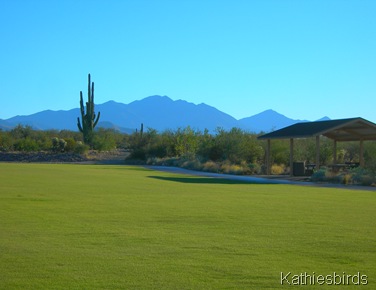
3. Syc Can Park-kab We head down to the park then and park our car and get out. While the park looks pretty much the same, there are a lot more people and dogs in it. Someone has a whole team of huskies! They look so out of place here in the desert. I grab my bins and notebook and we take of walking. Gus soon goes ahead of me while I linger to look for birds, but all I am seeing are Mourning Doves and White-winged doves, and a lone Cactus Wren. In the desert I hear Curve-billed thrashers and Gambel’s Quail.

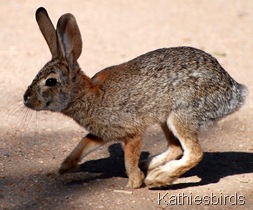
I see a desert cottontail hiding just off the path wanting to get out onto the lush4. cottontail-kab green lawn of the park, but still leery of all the people and dogs. Behind it a jack rabbit looks like a giant as it dwarfs the smaller rabbit with its huge feet, legs, and ears. While I am enjoying seeing these creatures, it is still not what I came to see! I scan the park, the desert, and the sky for nighthawks, but see none. I finish my circuit around the track and make it back near the parking lot. By now Gus has done several laps and the sun has set. People have left the park and we are just about the only ones left. As I wait for Gus to come around again I scan the desert for nighthawks and find a Great Horned Owl perched atop a tall saguaro instead. Its silhouette looks like an eared lump against the tangerine sunset! 5. sunset-kab The temperature has dropped quite a bit by now but we still leave the top down as we get back into the convertible. We drive away from the park and Sycamore Canyon without seeing a single nighthawk. I find this distressing since I know they used to be here on a regular basis. I ask Gus to drive by Road Runner Market at the junction of Houghton and Sahuarita Roads as it has numerous street lights and often there are nighthawks hunting for insects here. We drive east on Sahuarita Road, then turn south on Houghton where Gus does a u-turn and we are now facing north. All this time I have been scanning the sky overhead for nighthawks to no avail. I have not seen one. As we wait at the stop light in the left turn lane to drive down to Sahuarita I suddenly see motion across the street from us on the northeast corner of the intersection. This is not a nighthawk. It is a large raptor, an owl, but too pale for a Great Horned Owl. I train my binoculars on the bird, which has landed on a fence post low to the ground, and discover it is a Barn Owl! With no one behind us we sit through three changes of the light while I watch this magnificent raptor as it turns its head from side to side searching the ground below for prey. We finally make the turn and drive away without knowing if the owl got to eat tonight. As Gus turns the car west I am smiling like a Cheshire Cat moon in the night.
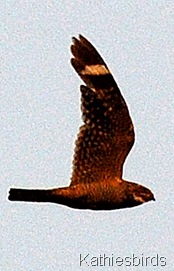
6. Nighthawk-kab All along the ten or more miles to Sahuarita I am looking for nighthawks in street lights to no avail. We spend about 30 minutes or more in the grocery store before getting back into our car to head home. I ask Gus to drive through Rancho Sahuarita as we head north. The paved road snakes through the development with street lights scattered here and there. It is as we are nearing the end of the road that I see a well lit parking lot off on my right. As Gus drive forward suddenly I see the ghostly flash of a bat-like body as it moves in and out of one of the street lights! Nighthawks! “Gus!” I yell, “I think I just saw some nighthawks!” My patient husband turns the car around and we drive back to the parking lot. Sure enough, as we park beneath one of the lights we see the nighthawks swooping and fluttering like giant moths hawking for insects.

7. nighthawk-kab We sit there in the darkness, bathed in the glow of street lights and watch the birds swoop, dive and flutter. Their erratic flight is so unpredictable. Their bodies so cryptically colored, yet I can see their notched tails streaming out behind them, and the white or buffy patches in their wings. We get mostly Lesser Nighthawks here in Arizona, but it is possible to find common nighthawks as well. In the Lesser species the females have a buffy patch on their wings, instead of the white patch of the male Lessers or both sexes of Common Nighthawks.

8. nighthawk-kab I think I could have stayed there and watched those birds all night long, but after ten to fifteen minutes we finally left. It is hard for me to drive away in this cool night air, because I am still concerned for this species of bird. I did not see very many insects in the street lights. When there was a brief bit of insect activity suddenly eight nighthawks came into the lights at once, then they were gone, and so were the insects. Until that one moment Gus and I had only see four nighthawks at the same time. The nighthawks seem to prefer the lights that were nearest the open desert beyond. I did not see them hunting at any of the lights nearer the center of the parking lot.

So, it was with a somewhat sad smile that I left the birds behind me as Gus drove away. Here in Sahuarita the temperature had dropped to 65F! But, by the time we got back up to Tucson it was back to 75F! That just shows you the effect of the “heat bubble” created by the city. I am happy to have finally seen my nighthawks, but a bit concerned about their population. I know so many insects are being poisoned by pesticides and along with them, the wildlife that feed on them. We must find a way to live with these creatures that share the earth with us. All of our lives are enriched by their presence.

Happy Earth Day!
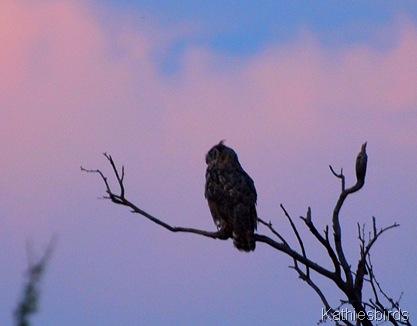
9. GH owl-kabGreat Horned Owl in Sycamore Canyon 8-8-2008

Note: All photos in this post are from my archives from when I lived in Sycamore Canyon between 2007 and 2010. While I no longer live in Sycamore Canyon, I do have friends who do. I did not have my camera with me on this drive. Besides, it was soon too dark for photography! This post was originally posted on my Kathie’s Birds blog for Earth Day.

Saturday, July 24, 2010

The Good-bye Chronicles Chapter 1: Knowing

DSC_0017 Sunset in Sycamore Canyon 7-17-10

July 5, 2010

I have known for 2 weeks that this was possible but so much has been going on. First my son arrived for his last visit before he goes to war in Afghanistan, then my sister arrived for her 50th birthday. While she was here Gus went off for an interview in the Boston area for a new job. I thought we were going to make it here. We both thought we would retire here. We had made it past the three year mark by which we had usually moved. We thought our job was secure in spite of the downturn in the economy. We never thought this would happen. So, we bought a new refrigerator and installed a hot tub. Two weeks later the company my husband works for laid off 250 people. A few weeks after that the program he worked for downsized. He found himself adrift in an unstable situation. Thus his search was launched to find a new job. And so it was that while Alex was home and my sister was here that Gus was in Boston interviewing for a new job.

Desert toad 7-3-10 Gus returned the same night my son left. My sister left the next morning. Now here I am trying to memorize every moment, every bird, every sunset, every star-filled night. The Sonoran desert toad that pokes its head out in the evening makes me smile. Every hummingbird that comes to my feeder makes me wonder if there will be anyone to fill the feeders for them this fall when the fall migration starts and 5 to 6 species of hummingbirds stop by to feed on their way south.

Winter Hummingbirds Last year I had a hard time keeping 5 hummingbird feeders full for their voracious appetites. Who will feed the hummingbirds now? Or the bats?

DSC_0107 lesser long-nosed bat gSeptember into October is the migration of the Lesser Long-nosed  bats. The bats know my yard now. They know they can count on food at this location. Will there be anyone here this year to feed the bats? Will anyone else care if they have something to eat?

In an effort to make each moment count and in light of the current oil spill in the Gulf of Mexico I see how every bird count I do in this area matters. I cannot go to the gulf to count birds, though I would in a heartbeat if I could, but I can count birds here.

Scott's oriole female Female Hooded Oriole 6-28-10 My Backyard

Already the bird populations have changed since I moved in here. Just down the slope from my house the building boom has resumed and there have been over 200 houses added to the once open desert where nighthawks and western kingbirds hunted in summer and raptors soared in the winter. This year the birds are finding their hunting ground gone, replaced by homes set cheek to jowl on hot paved roads where rabbits and ground squirrels succumb to overzealous and inattentive drivers. Where I used to hear great-horned owls on a regular basis, I have not heard one in a very long time. The birds are either moving up or down the mountain into more remote hunting grounds, but if the proposed copper mine goes in, all of this could change even more. The bird counts I do now will document how it was, in case it does change. In case our own version of an Oil Spill happens here.

DSC_0005 I was quite surprised when I researched my eBird records to discover that I have done relatively few bird counts in the greater Sycamore Canyon area. While I count birds almost every day from my own yard, my bird counts of various areas in Sycamore Canyon have not been consistent. Though I have lived here for over three years I was surprised to see that I had only submitted bird counts for the park area 23 times. In response to this knowledge I have been down to the park counting birds three times in the past week, and I plan on going more. I feel the urgency of collecting as much data as I can before I go. If I go.

DSC_0056 Female Costa’s Hummingbird 7-19-10

For now we wait. We will know in about a week what Our Fate will be. And then, I will really start to say  “Good-Bye.”

DSC_0169

Friday, December 4, 2009

Skywatch Friday: Mountain Lion Alert!

Sycamore Canyon Park 11-21-09 @ 8:28 a.m.

An alert has gone out that a Mountain Lion has been spotted in Sycamore Canyon. On November 20th it was spotted in the Sycamore Canyon Park area. So what did I do? I grabbed my camera early the next morning and headed down there hoping to see it. Alas, all I saw were sunlight, saguaros, and the Santa Rita Mountains...

Our sophisticated warning system 11-21-09


...and one sunbathing roadrunner who doesn't seem the least concerned about mountain lions.


Visit more amazing skies at

(click on any photo to enlarge for the best view!)

Tuesday, February 19, 2008

Sunday's Story of the GBBC


Every day is warmer and drier and the birds have dispersed from my yard. Though they still show up in hordes, there is not the number or variety as there was on Friday when the storm rolled through. Today I expand my horizons and try to find some new birding areas close to home. Gus and I are both still fighting this cold, and he stays home to rest. My obsession drives me from the house to add to the greater knowledge of bird populations across the U.S.A. Besides, I am determined to have Corona de Tucson well represented in the bird count, so off I go.

I start at the local park in our neighborhood where I am horrified to see they have started to tear the desert up to make way for the community center. The area is all marked off and heavy equipment is parked at the edge. I knew this was coming but it still makes me sad to see it happening. I know how many birds and bunnies inhabit the scrub they will now tear up. Cactus will be plowed over, though some will be saved, and in the end a pool and club house will be built, all with new landscaping. New birds will move in to inhabit the landscaped areas, but the wild delicate species will be gone, driven off to find new habitats in undisturbed areas.

Today I count a mixed flock of Brewer’s, Rufous-winged, and Black-throated sparrows among the thin grasses. The usual suspects of Gila woodpeckers, cactus wrens, and curved-billed thrashers are present also. The thrashers and cactus wrens make their nests in spiny cholla (pronounced choy-a) cactus. The fruit from these cacti hang down in chains and drop to the ground to be eaten by other desert animals. When a cholla cactus dies it leaves behind a beautiful gray skeleton. This latticework trunk makes a nice addition to the yard or even as part of your interior decorating if you find a good piece. Here in nature, the birds simply use it as a perch. I’m sure for them the appeal is purely practical and they are unaware of its esthetic appeal.

From the park I simply drive around trying to find a good area to bird. A Sunday morning quiet has descended on the area but over on Houghton Rd I see and hear a bunch of birds in some tall trees in an older part of town. I pull over in front of what I later discover in the Tin Cup Lounge and Country Club for the Santa Rita Golf Course. There are lots of cars at this place, so I pull a little farther down the road and park in front of a vacant lot. This vacant lot proves to be a gold mine as I soon discover.


It’s only a small area of land about 1 ½ acres in size. To the north if a hair salon, the east border is formed by the golf course with tall pines and other trees. On the south the Country Club frames the lot with tall eucalyptus trees and some juniper. The western border is formed by the road which has a constant stream of traffic. But, here in this little abandoned and scrubby field the birds have found refuge. I’m drawn in by the chirping, tweeting, cackling sounds. Feathered motion is everywhere. Tiny birds flit from brush to bush, cactus to cactus and tree to tree. The sparrows fly up briefly, then dart into the grasses again. I find thrashers and cactus wrens building nests. Before I am done I count Brewer’s, Rufous-winged, White-crowned, and Black-throated sparrows. I suspect there are others I can’t identify.

Then I see something different and focus on it. It has a larger beak, a striped breast, central breast spot, dark malar stripe…what am I looking at? Dickcissel and Lark Bunting go through my mind, but I put down my binoculars and swing up my camera. I need to capture a picture if I want to be sure. The little scallywag runs for cover. It stays low in the grasses but I snap away. When I get home I discover it IS a lark bunting! A new bird for my bird count at least! On Sunday I count 21 species in this forgotten bit of earth. When I return here on Monday I add two more species to the count. I also observe the red-tailed hawk bringing nesting material to a tall pine on the golf course. I suppose someday this forgotten piece of land will be plowed up to make way for a parking lot or something, but for now I can only hope it stays this way for a long time to come.


Birds Counted in and around the vacant lot: 1. Red-tailed hawk, 2. Mourning dove, 3. Anna’s hummingbird, 4. Costa’s hummingbird, 5. Gila Woodpecker, 6. Say’s Phoebe, 7. Chihuahuan Raven, 8. Cactus Wren, 9. Ruby-crowned Kinglet, 10. Curved-billed thrasher, 11.European Starling, 12.Yellow-rumped warbler, 13.Canyon towhee, 14.Rufous-winged sparrow, 15.Brewer’s sparrow, 16.Black-throated sparrow, 17. Lark bunting, 18.White-crowned sparrow, 19.Phrrhuloxia, 20.Great-tailed grackle, 21.Housefinch 22. Hutton’s vireo, 23. Orange-crowned warbler.

Monday, December 3, 2007

Coyotes and Quail

Late yesterday afternoon while the guys were watching football I decided to take Blossom for her evening walk. We hadn’t been to the park in a few days, so off we headed for the grass. She usually likes to go there to smell all the places the other dogs have been. The sun was just setting at the western end of the park as I walked onto the paved track that encircles the grassy area. A huge flock of mourning doves were gathered on the lawn and as I started to walk the track I noticed movement at the far end. I had to shield my eyes from the setting sun but that’s when I saw the coyotes—2 of them! I did not fear for myself but Blossom’s safety was cause for concern. Everything I have read says coyotes will attack and eat small dogs like her. I wanted to sit and watch them romp, but turned and headed back toward the road and home. I called Gus on my cell phone to come pick me up because it was only a short trot across the grass and a slim strip of desert for the coyotes to get to us. It wasn’t long before he was there. I guess I’ll just have to walk Blossom closer to home from now on.

As I headed for bed last night I took a quick peek out the back door. After 48 hours of constant wind the velvet night was now so still. I could see the stars brightly shining in the cool night. By morning I had to add an extra blanket to the foot of the bed because our room was so chilly from sleeping with the door cracked about 4 inches. As soon as I wake up I am out the door again to see what the day is like. The sky has not yet begun to lighten and a slight breeze has picked up. I see a falling star in the northern sky as I gaze at the big and little dippers.

Later in the morning as I bustle about my kitchen I smile to see a male Costa’s hummingbird show up. I think he is the same young male I saw coming to the feeder yesterday for he has this bit of fuzzy down poking out the back from the crown of his head giving him a punk-ish look. I’m totally enthralled with these tiny feathered emeralds.

I busy myself about the kitchen once again and as I turn to put another batch of Christmas cookies in the oven I see a large bird walking along the top of the block wall. It isn’t the shape of a mourning dove but more upright with a little question mark sprouting from the top of its head. I can’t believe my eyes. A Gambel’s quail! I rush to the den to retrieve my camera but freeze in my tracks, my jaw slack, when I see a whole covey of quail feeding at my quail block and beneath my seed feeder. They scratch away in the soil and peck at the quail block. All the while the little question mark plume atop their heads bobs up and down with the motion of their feeding. While I have seen coveys of quail numerous times in the desert around here, this is the first time I have seen this many at my house. There are between eight and ten birds! Prior to this I have only seen 1 pair feeding here, and that was months ago.

This afternoon as I am returning from town, I decide to drive down to the park to see if the coyotes are there again. I park my car and get out with camera and binoculars in hand. I have arrived earlier than yesterday and the sun is still above the horizon. The sprinklers are running in the park making the grass glisten with their spray. No mourning doves or coyotes in sight, but I walk the perimeter anyway enjoying the peace of the empty park and the long shadows cast by the late afternoon sun.

For the moment there are no houses near the park. It is still surrounded by undeveloped desert. I don’t know how long it will be this way, but for now its beautiful. The Santa Rita Mountains rise to the south, while the northern horizon is rimmed by the Catalinas. Huge saguaros spot the desert around the park. At the far end is one down a bit of a gravel path and it is here that I see a Gila woodpecker clinging to the edge of a hole in one of the saguaro’s arms. Its back is to the west as if waiting to catch the last warm rays of the setting sun. I creep ever closer and quietly snap a picture. It doesn’t seem to mind, but then decides I am too close and flies farther up the tall saguaro to another hole where he laughs his squeaky laugh at me.

I head back to the pavement and continue the rest of the way around the circle. I am on the south side of the park now, and to the north through the sparkles of spray I see two ravens fly in and land at that edge of the grass. Have they come in for some water? I watch them walk and strut on the lawn in their sleek black suits. Perhaps they are the desert version of the Mafia. They look as if they are having a conversation with each other. As I near the car another movement catches my eye. This time it is a cactus wren in a spikey cholla cactus. It hopes down to the ground seeking who-knows-what in the grass and weeds. Then a curved-billed thrasher comes out from behind a prickly pear near a mesquite tree. It starts to taunt the cactus wren, but upon seeing me it retreats cautiously to the cover of the cactus once again. The bold cactus wren is undisturbed. It is joined by another and they continue to hop about searching the ground for insects.

The soft hiss of the sprinklers follows me as I head back to my car. In the short time I was there the sun has sunk even lower and with it the temperature. I’m feeling chilled as I get into my car, but internally I am warmed by beauty of this place.

Sunday, November 25, 2007

Winter Warmth

The golden sun rises now behind Mt. Fagan. There is a chill in the air as I step out my back door to read the thermometer. It registers 44 degrees at 7:35 a.m. Last night we turned our heat on for the first time in this new house. A new sound came from the garage as the furnace kicked in. It filled the rooms with the odor of heat and stale air. Still, the heat felt good against the evening chill as we came back from our walk with Blossom. I am really wanting a fireplace!

This morning the sunlight only slants across the farthest kitchen corner. The winter angle of the sun and the permanent placement of my house prevents sunlight from piercing the interior now when I want it most. The sun will briefly flood my bathroom with light as it has the only south-facing window in the house. Then, in late afternoon the front bedroom will be full of light as the sun sets in the west, but that will be it. If I want to bask in sunlight now I will have to go outside and find a place sheltered from the wind.

After breakfast Gus and I decide to take Blossom for a walk to the park. We feel the chill in the air as we head out. At the bottom of the cul de sac we cut through the desert trail. Across the wash my eyes catch the movement of a large bird in a tree. While I have left my binoculars behind, the huge dark bird is plainly visible. As it flies from its perch its red tail confirms it as a Red-tailed Hawk, probably the same one I heard crying as I stepped out the front door. The whole desert seems alive this morning. I see towhees, sparrows, thrashers, and cactus wrens all the way to the park. Once again I hear the silver tinkling of black-throated sparrows. As I think about it, I am amazed at how many birds I can tell by their voices now. This is a new skill for me, but I still have a long way to go.

We walked the paved trail around the park, the only place we can see grass out here. The green lawn is dotted with rabbit scat. They must come out in herds at night to feed. The green expanse glistens with silver water droplets from the morning’s irrigation. On the sidewalk I also observe fox scat. Unlike dog excrement, it is full of animal hair and sometimes, small bones or seeds. They like to mark their territory in this manner. We walked one loop around the park, then headed home. By now the air has warmed and we are feeling it.

In the late afternoon we drive to Sahuarita to get pizza, an easy and welcome change after days of turkey leftovers. Gus drives while I look out the windows, scanning as always for birds. I see another Red-tail perched atop a phone pole. Small birds perch on wires, or fly through desert scrub. The sun is sinking behind a bank of clouds low over the horizon. On Old Nogales highway we drive through a tunnel of pecan trees, still in full green leaf.

The pecan groves wind like a green river through Sahuarita and Green Valley. I have been watching the pecan trees to see if they change color before they drop their leaves. I know they drop their leaves, for their bare branches reached into the winter skies in January when we visited. However, it is almost December and there is only the faintest gold appearing in some trees. If the leaves change and fall, it must happen quickly, and they aren’t gone for long. By the time we moved into this house in April a faint lime blush was visible in the pecan orchards. New leaves were already emerging.

With the sinking sun the temperature falls once again. While these nighttime lows are nothing compared to Utah, Connecticut or Maine, it certainly feels cold when the winds blows. After daytime highs in the 80’s last week, the 40’s chill my bones. I still get that cozy winter feeling, so I make a cup of hot chocolate and curl up with a good book. For winter warmth I have my cats who curl up with me and radiate heat.