
It is two days after we have an answer when I meet Donna Simonettie at Sweetwater Wetlands. She has come to town for a concert and we agree to meet here to go birding. Sweetwater is a place I learned about when I first did my Important Bird Area Training almost 3 years ago now. It is one of my favorite places in the Tucson area to go birding and I always come away with a rather large list of birds. An oasis in the desert, Sweetwater attracts all kinds of birds from the typical desert favorites to the exotic tropical species. It is a manmade wetlands formed from treated wastewater. One never knows what they will find here.

I meet Donna in the parking lot and we grab our gear and head for the trail. The air hangs heavy and humid and soon a light shower is falling. I head back to the car to grab a plastic bag to cover my camera with. I do not think the shower will last long, but any amount of water on my camera is not good. We head for the path once again and right off the bat we are seeing birds. Swallows fill the sky as we cross the bridge over the manmade creek. Purple matins are mixed in with the swallows and Donna informs me this is a life bird for her.

I told Donna about our planned move when she first arrived, but now we are lost in the birds of this wetland. I keep telling her that there are not many birds here today. It seems so quiet. The birds are quiet, but they are here. With cameras at the ready and binoculars in hand, we scan the ponds, the trees and the reeds. We watch the sky for birds. Some sort of rodent scurries along the path and disappears into the reeds. Off to the east we scan the drainage ponds for birds. Here we find killdeer, sandpipers and black-necked stilts. There are more birds than we can positively identify for some small sandpipers are far across on the mudflats and neither of us has a spotting scope, so we do the best we can with our bins and cameras and wait to enlarge blurry pictures at home. Some birds we just have to let go, but we do get a good look at a solitary sandpiper that is close by as well as a spotted sandpiper and a couple of Leasts.

We catch the flight of a Harris Hawk overhead circling on dark wings with chestnut shoulders. We see the characteristic white tail coverts as the bird flies overhead. I know that a family of Harris Hawks nests nearby and this is a reliable place to see them. Then Donna spots a Kestrel and we add that species to our list. The brief rain shower stopped awhile ago and now the sun is out turning all the cool moisture to hot steam. I feel its affects and cling to the edge of the trail where I can stay in the shade of willows and cottonwoods. I see a shape like a stump up in a willow and train my binoculars on it. Is is a bird? I call Donna to have a look and we both wonder and hope that we are seeing a bittern, but it turns out to be a juvenile Green Heron trying to blend in with the branch. It keeps a wary eye on us as we pass by, then flies farther across the pond for refuge.

In the winter there are so many ducks here in these ponds but for today we are only seeing mallards with a few ruddy ducks, a pied-billed grebe and a couple of teals. There are usually more birds than this I say as we walk on.

There are no lack of lizards, however, and we have seen several kinds, including desert spiny lizards, zebra tails, a greater earless lizard, and a possible tiger whiptail.

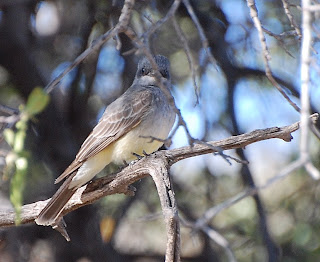
In the farthest ponds we find great egrets, more mallards, a few neotropic cormorants and some green-winged teals. We have been here for a couple of hours now and my list is getting longer. We have been seeing kingbirds and we are wondering, are any of these Tropical Kingbirds? We find a western kingbird at the far edge of the wetlands near the open desert and a large wash. Across the street we see the Rogers Road wastewater treatment plant and there on the fence is a Cassin’s Kingbird with its dark gray head and white throat. We follow the paths back into the interior of the ponds where we see 3 other kingbirds perched at various heights on a cottonwood tree.

They are all silent in the heat of the day but they are not shy and we are both able to snap away. Our photos reveal the typical notched tail, brighter yellow breast and the faint mask of the tropical kingbird. This is a life bird for Donna and we stand there enjoying the moment. I am remembering that I saw my first one here last year and this is only my second sighting of this species. Last year they we flying about chattering away. This calm bird is so different from the behavior I observed last year, but I am beginning to think these kingbirds have more sense than me! The sun has risen higher and with it the temperature and the humidity! I feel like I am melting! Donna and I make our way to the gazebo where we sit in the shade and talk and watch birds. I am starting to realize that I have filled several pages of my notebook. I wonder how many species we have seen after all. After telling Donna all morning long that there are not many birds here today we end up with a list of 48 species of birds! Not bad for 3 1/2 hours of birding!
We say good-bye at the parking lot, not knowing when or if we will see each other again. I first met Donna just a couple of months ago when we went birding together in Portal. Donna is like Dawn and Jeff Fine and I. We can bird all day long without getting tired, but today the heat and humidity have gotten to me. I am ready to get in my car and go home. I drive away from Sweetwater with so many sweet memories of birding here with friends and by myself. My heart if brimming with thankfulness for ever moving here and finding this magical place.
Who hatched from these eggs? We found them along one of the paths. They were soft and leathery, a sweet gift of nature that we both enjoyed seeing. If you have any idea, please tell me!
Location: Sweetwater Wetlands
Observation date: 7/22/10
Notes: Birding w/Donna Simonetti. Cloudy with a light sprinkle when we first arrived, then the sun came out and it got hot and humid. We walked the entire perimeter of the ponds.
Number of species: 49
Mallard 65
Green-winged Teal (American) 2 smaller than mallard; small,dark bill; mottled cinnamon brown; green wing bar
Ruddy Duck 8
Gambel's Quail 1
Pied-billed Grebe 1
Neotropic Cormorant 3
Great Egret 2
Green Heron 1 gray back, streaked neck
Turkey Vulture 1
Harris's Hawk 3
American Kestrel 1
Common Moorhen 6
American Coot 12
Killdeer 8
Black-necked Stilt 20
Spotted Sandpiper 1
Solitary Sandpiper 1
Western Sandpiper 3
Least Sandpiper 3
Eurasian Collared-Dove 1
White-winged Dove 30
Mourning Dove 7
Black-chinned Hummingbird 2
hummingbird sp. 1
Gila Woodpecker 6
Ladder-backed Woodpecker 1
Black Phoebe 3
Ash-throated Flycatcher 1
Brown-crested Flycatcher 1
Tropical Kingbird 3 notched tail
Cassin's Kingbird 1 dark gray head and back, white cheek/throat square tail with pale tip. No white side tail feathers
Western Kingbird 1 pale yellow belly,white side tail feathers at farthest end of ponds near open desert and wash
Bell's Vireo 1
Purple Martin (Desert) 2
Barn Swallow 6
Cliff Swallow 14
Cactus Wren 2
Curve-billed Thrasher (Western) 2
Yellow Warbler 2
Common Yellowthroat 6 heard all over and saw 1 singing from branch of tree over pond
Abert's Towhee 3
Song Sparrow 1
Western Tanager 2
Red-winged Blackbird 35
Great-tailed Grackle 30
Brown-headed Cowbird 1
House Finch 6
Lesser Goldfinch 1
House Sparrow 1
This report was generated automatically by eBird v2(http://ebird.org)
Greater Roadrunner 1 (I saw this bird while I was waiting for Donna to arrive)


 In the top of a tree I spot a prairie falcon on the lookout for breakfast. We watch the bird quietly and Gus tries to get a photo, but it is too far away. The falcon flies to a nearby agave flower and perches on one of the arms. The agave stalk is over 15 feet tall and dry as it is last year’s bloom. These dry stalks decorate the horizon throughout the desert and many birds use them like trees to perch on and scan their domain. I've included this photo so you can see the relative size of the agave stalk to the nearby trees. Can you see the falcon perched near the top?
 There are enough blooms for bees and butterflies alike.




 We see the bridge over the canyon that we will soon cross. It’s getting late and our stomachs are starting to growl. The sun has gotten so hot that we’ve rolled up the windows once again. We saw the most birds in the first 3 miles of the journey, but I think that is due to the time. As the sun rises the birds go down into the cool places of the canyon. We stop on the bridge to see what we can see and Gus spots a white-tailed deer as it moves from the cover of one bush to another.


 In the end, we saw 33 species of birds that I identified, with a few more that I didn’t. I am always intrigued by the smaller birds now, but Gus likes the big ones that he can photograph easier. For those of you who are interested, here’s the final count:


