Showing posts with label Rincon Mountains. Show all posts

Wednesday, June 25, 2008

Wednesday Morning Wake Up

(Mt. Fagan)

I wipe my groggy eyes and roll over in bed. The room is dark and cozy with a soft gray light. I wonder what time it is since it feels later but the room is still so dark. It’s 7:45 a.m., long past the time when the sun should have illuminated my room like the high beams of a truck parked outside. I snuggle into the covers, enjoying this overcast morning. Breezy Boy, my cat, curls up into the hollow of my body and purrs away. I am thinking that maybe I will stay in bed and enjoy this luxury just a few moments longer but suddenly I hear scratching on the patio door. Gus had let the dog out just before he left and now Blossom wants to come in.

I trundle out of bed and open the door. Blossom prances in like she owns the world. I pop my head out to feel the day and catch a whiff of rain in the air. Dark clouds are mounting over the Santa Ritas. Mount Fagan looks dark and broody. It looks like a curtain of rain is falling on the Rincons, but still the slopes are sending smoky plumes into the sky, and mixed with the smell of wet desert I can also smell the smoke. There are 8 fires burning now in Southern Arizona and the Distillery Fire in the Rincons has grown to over 5,000 acres.
(Rincon Mountains)

The cats follow me out to the kitchen winding around my legs and begging for breakfast. I step out this patio door to see the thermometer. It is 83 degrees and comfortable with a strong breeze gusting sometimes to a full wind. Off to the west, however, the sky is blue and clear. Sunlight beaming out from beneath the edge of the cloud bank illumines the mine tailings of Green Valley into a golden table land. It cuts a sharp edge against the pale blue sky.

(Green Valley Mine Tailings)

Once I shut the door the birds return to feasting in the backyard. Once again the finch feeder is covered in Lesser Goldfinches.


(Lesser Goldfinches on thistle seed feeder)

Mourning Doves are gleaning the seeds from the ground while flickers, Gila Woodpeckers and thrashers all vie for the peanut feeder. Out the den window a lone juvenile Gambel’s Quail pecks beneath my globe shaped feeder. His bland gray color blends in with the mourning doves but his shape and the plume atop his head betrays his true species. Over on this side of the house the house finches mob the globe shaped feeder while house sparrows pick at the quail block. A Canyon Towhee joins the fray and grabs whatever seeds it can. Then a feisty Cactus Wren flies in and chases away a thrasher to grab a peanut that was dropped on the stony ground. It’s just another day for Kathie’s Birds here in Sycamore Canyon, but the Monsoon is creeping ever closer and we may get storms this afternoon.


(Canyon Towhee at seed cake)

For now, I leave you with this peaceful scene of a potted dove. She has built her nest in this pot on a neighbor’s front porch. The family can sit in their bench and she does not flinch or fly away. My neighbor says she has seen the eggs when the mother flies off to feed in the evening. The male hangs around on nearby rooftops, waiting for the hatching and his job to begin of feeding the little brood. For me, the question arises: does the mother actually trust my neighbor and her children, or is her mother’s instinct so strong that she will not abandon the nest in spite of great fear? If the latter is true, I can’t help but wonder if I could confront my own fears in the same way.

Note: All of today's photography is by Kathiesbirds with the Nikon D80 and the 70-300mm lens except for the morning dove which was photographed Saturday, June 21, with the 18-70mm lens.

Tuesday, June 24, 2008

Fire in The Rincon Mountains

(Distillery Fire June 23, 2008 photo by Kathie @5:58 p.m. MST)

If you live in the west then you come to know summer as fire season. This was true in Idaho, Colorado, and Utah. It is also true here and over the weekend dry lightening sparked 2 fires at the south end of the Rincon Mountains. The Rincons are part of the Coronado nation Forest and Saguaro National Park, East. I see them every day from my back yard. They are part of the “place” where I now live.


(Distillery Fire photo by Kathie June 23, 2008 @ 5:57 p.m. MST)


Yesterday afternoon the smoke billowing from the Distillery Fire filled the eastern sky. From my house these mountains are 10 to 15 miles away. The houses seen in the foreground are only the length of a football field away. According to the news last night this fire has grown to over 2000 acres but is being allowed to burn since it is not threatening any structures. It is being treated as a controlled burn that will help prevent more serious fires in the future. The Cumero Fire, farther east in Happy Valley is being contained since there are homes in that area.


Last night I experimented with the night photo button on my camera and took these shots of the flames creeping down the slopes in an ever widening ring of fire. At first I hand held the camera but that resulted in blurry edges to the flames. So, I set the camera on the stone cap of a pillar in the block wall and took the photo again. This is the resulting photo which I have sharpened but that’s it.

Shooting Data for night photo taken by Kathie:

(Nikon D802008/06/23 22:25:39.9JPEG (8-bit) NormalImage Size: Large (3872 x 2592)ColorLens: VR 70-300mm F/4.5-5.6 GFocal Length: 300mmDigital Vari-Program: Night LandscapeMetering Mode: Multi-Pattern4 sec - F/5.6Exposure Comp.: 0 EV)


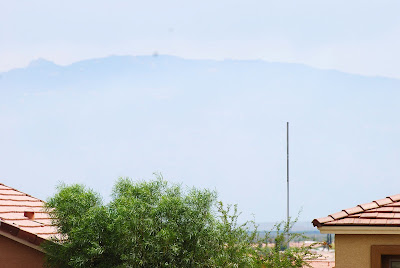
This morning when I woke up the air was flat with smoky haze that I could smell as I watered my plants and filled the bird baths. Look at all three photos to see the roof lines of the houses and make a comparison.

(Rincon Haze by Kathie June 24, 2008 @ 8:40 a.m. MST)

You will notice a dark spot on the image. That is a dust spot that is on my camera optics that I have not been able to remove. It is inside the camera and not the individual lenses since it shows up whether I am using the 18-70mm lens or the 70 -300 mm lens. Any suggestions anyone? I have wiped the mirror and top of the optics with a soft lens cloth to no avail. I certainly don’t want to damage my new camera but it is so frustrating to have this spot ruining my photos.

Update: As of noontime today the Distillery Fire has grown to over 4,000 acres. An attempt is being made to fight and contain the fire.

Saturday, October 27, 2007

Perigean Moon

The Perigean Moon. That’s what our local weather forecaster, Chuck George called it. It’s the full moon when the moon is closest to the earth making it appear 14% bigger and 30% brighter then when it’s in apogee, or farthest from the earth. Knowing its name is one kind of understanding, but watching it rise behind the Rincon Mountains large and glowing like a moon balloon is another. Hearing the coyotes yapping and howling at one a.m. in the silvery light of this bright night makes me wonder if they, too, are affected by a Perigean Moon.

I walk out into the yard to see the source of this midnight day. A few feathery clouds float in the velvet sky. Overhead the pearly orb is circled by a ring of light. If this was winter in the north the ring around the moon would portend a snowstorm, but here in Arizona, what does it mean? When the sun rises later this morning it will rise in a blazing ball of autumn heat that will raise our temperatures into the 90’s: No snow here. So, what does a moon ring mean to coyotes? Did it tell the Native Americans anything?

I go inside and fall asleep with silver moonlight pouring into my bedroom. A few hours later the howling of coyotes once again awakens me. They sound so close! I shake the cobwebs from my brain and throw the covers off. In the pale light streaming through the door I find my sandals and run outside. I so want to see the wild dogs of the night. I cross the yard to the block wall and peer beyond it in the direction of the sound, but all I see is an empty wash and the model home beyond the far wall. I cross the yard to the north side where the wall is lower and I have a better view, but still nothing. The coyotes have quit singing, though the neighborhood dogs haven’t quite settled down yet, their anxious barks still piercing the night.

I ran out the door so fast that I had no idea what time it was. I came out because the coyotes called me, but now the pure beauty of the night holds me spellbound. The Big Dipper is upended in the northern sky. The Little Dipper is not visible, save for the North Star in its constant place. Above the eastern horizon a planet glows brightly at me. I do not know enough astronomy to tell you which one it is, but it shines so big and bright I can almost imagine another world on its surface.

I am hot from being under the covers in bed, but now I press my body against the cool block wall as I scan the neighborhood still hoping the coyotes will caper into view. A cool eastern breeze ruffles my hair as my nightgown flutters against my legs. I rest my chin on the block wall after first scanning it for bird droppings. When you feed the birds, you have to watch out for things like that, but the feeders are located near the back wall—apparently I am safe!

How still and cool the early morning is! The shrill chirping of the monsoon crickets is all but gone, replaced by a soft and gentle autumn song. By now the moon has moved farther into the west but I am amazed at how high in the sky it still is. While I am wondering if it will still be visible at dawn I hear my clock chime five times through the open windows. The sun will rise in about an hour. Will it say "Good morning" to the moon?

A little over an hour later I have my answer as the eastern sky turns a light mango behind the lilac mountains. Now the wispy clouds that appeared white in the night are smoky gray. Far above the western horizon the moon awaits the coming of the sun. A few minutes more and the sky changes to a baby blue; gray clouds blush pink and lavender. Still the moon shines brightly. Will moonbeams touch sunbeams when the sun breaches the horizon? I have my answer now. They will greet each other with reflected light before the perigean moon sets in the western desert.