Showing posts with label Rufous hummingbird. Show all posts

Tuesday, August 11, 2009

My World: Hummingbird Season

Costa's hummingbird immature male 8-10-09

In My World it is the season of hummingbirds. While the rest of the country enjoys hummingbirds in the heat of the summer, for me they arrive in August and stay all winter long.

Male Costa's 8-9-09

Though I have seen a few Costa’s females during June and July, it is only recently that the males started to show up again.

Black-chinned male 8-10-09

Then, on Saturday I saw my first black-chinned male of the season. By Sunday the flood gates had opened and theses tiny feathered jewels are here in force. I now have two rufous hummingbirds battling for my feeders along with at least 2 black-chins and numerous Costa’s hummingbirds. I have already seen some Anna’s and soon the broad-billed hummingbirds will arrive. My back yard has become a war zone with these feathered weapons flying about. They use their tiny beaks like swords or lances and dive at each other to defend whichever feeder they have claimed as their own.

Fiery rufous 8-10-09

Of all the hummingbirds in the yard the rufous hummingbirds are the most fiery. If they are at a feeder and an intruder tries to feed, they hover in the air, orange tail feathers spread and buzz and chirp and dive until they drive the intruder away.

Rufous Hummingbird 8-10-09

Unafraid, the hummingbirds will whizz past my head like a shot, and I will flinch before they will. It makes it hard to get anything done, for they are so fascinating to watch. I tried not to love them just because everyone else does. I am a bit of an oppositional child in this way, but I could not resist. They have won me over and I am in love with them.


Rufous immature 8-10-09

I will only have this wide variety of species for a short time. Soon most of them will migrate even farther south, and I will be left with mostly Costa’s and Anna’s hummingbirds. The Costa’s will establish their breeding territories and by January and February they will be nesting once again.

Feeding in harmony 8-10-09

I can easily see how native tribes lived so in tune with the earth that they named the seasons according to what was happening at the moment. For me, the season of the purple martins is about to end, as I know they will soon be migrating south. Now the season of the hummingbirds has arrived and after that, it will be the season of the raptors and waterfowl as those species return from the north. I know I still have so much to learn about my desert home, but as the days pass and I tune in to this wonderful world around me I begin to feel the beating heart of this earth and hear the breath of the land. I begin to know and understand the moods of this land I live on, this earth that I am a part of, this place that gives me Life.

And that's...

Wednesday, October 15, 2008

A Feast of Hummingbirds

Costa's Hummingbird (male) at feeder outside my kitchen window 9-30-08
Click on photos to enlarge for best view

I didn't want to fall in love with hummingbirds. After all, that's what everyone else does and I don't want to be like everyone else. I resisted as hard as I could, but I did put out feeders and these tiny feathered jewels showed up. They came in such an array of colors; so many varieties, so much energy, so much fighting, so much laughter, that I couldn't resist. I've fallen and I don't want to get up. I kind of like it here in the winter world of flying gems.

I am not a hummingbird expert by anyone's stretch of the imagination, but I've taken lots of photographs and I am trying to learn. I pour over bird guides and study field marks. When they didn't provide enough data, I borrowed Hummingbird guides from the library. I look and look and look. Some things I have figured out and others have left me totally confused. Females and immatures are especially difficult, but I am doing my best. So, enjoy the hummingbird feast. These are just a few of the beauties who have passed through my yard since August, when the little birds started showing up once again.

Anna's Hummingbird

Male Anna's in mesquite tree 10-13-08


Anna's are one of the two helmeted hummingbirds we have here in Arizona. That means their reflective feathers go up from the throat and over the head. This bright male has been hanging around since September. His gorget flashes rose-red in the sunlight.
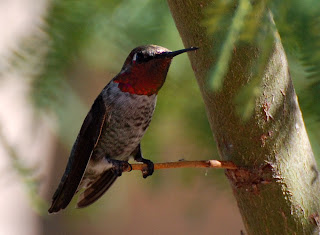
Male Anna's Hummingbird 9-23-08

At about 4 inches in length, the Anna's is a chunky bird with a pot-bellied silhouette. It is common around neighborhood gardens in the southwest. I usually see them after it has warmed up for the day. They tend to chase away the more timid Costa's.


Anna's Hummingbird 9-23-08

Unlike the Costa's, the Anna's tends to hold it's tail still and in line with it's body when hovering. This guy is defending his territory and his tail is a little more cocked for a fight. Look at those ferocious feet!

Black-Chinned Hummingbird


Black-chinned hummingbird 8-31-08

The male black-chinned hummingbird has a mostly black chin with a thin slice of purple that flashes in the sunlight. The black wraps around its head to the green neck with no white stripe of any kind. A long slender hummingbird, it constantly pumps its tail while hovering. While Costa's do this also, the black-chin's tail is longer and the motion is more pronounced.


Black-chinned female 9-13-08

Archilochus alexandri is the western version of the Eastern Ruby-throat, though the Ruby-throat does not pump its tail in flight. Notice the flat headed appearance of this female with the long straight bill. The forehead is grayer than a Costa's and the neck slimmer. Notice that the tail extends well past the wingtips.


Black-chinned male 8-31-08


The male Black-chinned characteristically shows a white collar beneath his black chin separating it from the scaly gray vest it wears.


Black-chinned female at the feeder 8-31-08 The black-chins do not nest around here. These were just passing through on their way to their winter home in Mexico. They showed up mid-August and were gone by mid-September.


Broad-billed Hummingbird

Broad-billed hummingbird 8-30-08

The broad-billed hummingbird is strikingly beautiful to me with its broad red bill tipped in black, it long blue forked tail, iridescent green body and blue throat and crown.


Broad-billed hummingbird at the new feeder 8-31-08

Stokes Beginner's Guide to Hummingbirds says they breed in remote dry canyons below 6000'. I saw my first one in Sycamore Canyon last spring. This fall they have been much more numerous, but I do not know if they will stay the winter here. I have counted them numerous times on our IBA survey of Sabino Canyon where they do nest for the summer. I will find out if they hang around there for the winter this year as we continue our survey.


Immature Broad-billed 9-30-08

I was so excited to see the above hummingbird, hoping it was a white-eared hummingbird, which would have been a new record for Sycamore Canyon and a life bird for me, but after consulting my bird guides I learned it was an immature male. He is still pretty and a delight to look at. He stayed around for a day or two and them was gone.

This is a close-up of the same bird at a closer feeder. Notice the feathers just coming in on its throat and breast.


Just when I thought the broad-bills were gone, this pretty boy showed up on 10-7-08. In this light his head almost looks purple and his chest blue. Could it be a hybrid of some sort, or is it just the play of light on its feathers?

Female Broad-tailed Hummingbird

Female Broad-tailed hummingbird 8-30-08

So, I am going out on a limb here, tell me what you think. After consulting bird guides I have decided this is a female broad-tailed due to the slender body, the speckled throat, the long, straight bill, and the limited rufous/peach to the flanks and tail. The female broad-tailed and the female and immature Rufous are similarly colored but the Rufous has more extensive rufous in the body and tail. The Rufous also frequently has a orange throat patch but the female or immature broad-tail lacks this throat patch. Male broad-tails have a rose-colored gorget and their wings make a high-pitched whistle when they fly. I heard and saw some males but they did not hang around for long and I was not able to photograph one.

Calliope Hummingbird


Calliope female or immature 8-30-08

The Calliope Hummingbird is the smallest hummingbird in North America. While the male has a very distinctive frayed looking red-colored gorget, the female and immature look alot like a female broad-tailed. Short billed and short tailed, this little hummer is very compact at 3.25 inches. The short tail is square and mostly black. The wingtips just barely reach the tail.

I have found this bird to be wary and shy, only coming to the feeder in the early morning or late afternoon and usually to the less frequently visited side feeder where there is less competition.


While a male would be an easy call, I was not sure if I could really call this a Calliope, but the bird was so obviously smaller than any other hummingbird, and all the other characteristics fit. So, this is a new bird for Sycamore Canyon and a life bird for me.

Costa's Hummingbird


Costa's Hummingbird in Palo Verde tree 8-17-08

When this Costa's showed up I had no trouble identifying it with that long, flared, purple gorget. After last winter and spring I was quite familiar with this little hummer, which nests in this high desert and was the most common and sometimes the only hummingbird I saw here last year. I fed them through April and early May, then they were gone. I took my hummingbird feeders down after that, and only put them back up when these guys started visiting my yard in August.

Costa's Hummingbird male 9-30-08

Costa's Hummingbird female 9-30-08

The Costa's female can be a challenge to differentiate between it and the female black-chinned. Both are similarly colored and both pump their tails while hovering, but notice the short-necked and short tailed appearance to this little girl. Also, her forehead is more of a greenish tinge while the female black-chin's is flatter and grayer. Still, I sometimes have trouble when there are immatures and females about.

Rufous Hummingbird

Rufous Hummingbird female 9-7-08

While I have not seen a Rufous male hummingbird around here yet, I have frequently seen these female hanging about. Notice the orange throat patch and the extensive rufous in the body and tail. When the tail is spread the rufous extends to all the bird's retices, or tail feathers. The female broad-tail only has rufous at the base of her outermost tail feathers if my bird guides are correct.

Rufous female 9-3-08

She doesn't seem to hang around for long but I have seen them more than once. Each time I am drawn to the rufous coloration in the body and tail. I usually see it in the house as I walk by the windows. Then, I grab my binoculars and sometimes my camera, but this bird is also shy and wary and not quite so easy to photograph.

Rufous female 10-13-08


The bird guides say this hummer is short and stocky with rufous flanks, a medium length straight bill and a central spot of orange-red on the throat.

These hummingbirds truly are a feast for the eyes and I hope you have enjoyed watching them with me!

An unknown female hummingbird flares her tail at a male broad-billed hummingbird 8-31-08.


Photographer's note: All of today's photography is by Kathie, taken with the Nikon D80 and the 70 to 300mm lens set in sports mode. All photographs are copyrighted 2008 by Kathiesbirds. Please do not use without my permission.

Monday, April 7, 2008

5 days of Birding: Day 4, Patagonia

It isn’t until Sunday morning, March 30th, that we decide for sure to head to Patagonia Lake State Park. Kathryn and I rush around eating breakfast and packing up. The drive to Patagonia takes us about an hour as we wind our way down Highway 83 through Davidson Canyon, past the proposed Rosemont Mine site to the Sonoita Junction. There we turned right on Highway 82 where we see a Border Patrol Checkpoint we will have to pass through on our return trip. Highway 82 proceeds through the town of Patagonia with all its little artists’ galleries, craft shops and bars. I have never stopped to check out the town and we talk about doing it on our way home.

About 7 miles south of Patagonia is the State Park. It is a world class birding destination with the Elegant Trogon being the Holy Grail of the trip. Would we see the Trogon today? My heart pounded with anticipation as we turned in the winding road to the lake. I immediately started scanning the skies for vultures because this is one place in the state where you are likely to see black vultures. I learned from one of the naturalists later on that, while black vultures have better eye sight, turkey vultures have a better sense of smell, so the black vulture will often follow the turkey vultures soaring high above them. When the turkey vultures have gotten close to carrion the black vultures will spot it from above and swoop down to join in or even pre-empt the feast. However, the only bird of prey we spotted was a southwestern version of a red-tailed hawk. Here in Arizona our red-tails are lighter colored and often lack the traditional “bellyband” that most birders look for as a field mark.

We stopped in the visitor center first to use the restroom and get some information with the intention of heading out to the north end of the lake to the well known birding trail. The visitor center desk was manned by a naturalist named Ken who informed us of a 10:00 a.m. Avian Boat Tour which still had space available. The tour lasts an hour and only coast $3 a person. We didn’t even know about this and we had no idea we were so lucky to get spots on this trip. The next day we met people from Oregon who had tried for months to get space on one of the boat tours and couldn’t. At the moment we were blissfully ignorant and signed ourselves up, though we foolishly almost didn’t!

Since it was only 9 a.m. we had about a half hour to go birding before we have to be back in time to get fitted with life jackets for the tour. We drive through the parking lots to the north end of the lake and walk a short distance down the trail. The trail winds along the edge of the lake on a high bluff but soon descends through the trees down a steep path and through a barbed-wire fence opening. The north end of the lake is part of a rangeland where cattle still graze and come to the lake to drink. Right now the trees are full of yellow-rumped warblers gleaning insects from the new spring leaves. Coots cackled and squawk down in the reeds and we spy a green-winged teal dabbling in the shallow water.

We haven’t gone far before it is time to head back to the visitor center for our boat tour. As we are fastening our life-jackets someone rushes in from the deck to inform us a gray hawk is flying overhead. Park Rangers and visitors alike crowd through the doorway and spill out onto the deck, binocs raised to catch the sight of the gray soaring above the lake. In the trees surrounding the visitor center the great-tailed grackles whistle and call. Red-winged black-birds trill, and broad-billed hummingbirds hover at the feeders suspended from the roofline.

A group of 6 passengers, including Kathryn and I head down to the dock to take our seats on the flat platform-like boat. The volunteer naturalist leading the tour is a guy named Larry from Colorado. Ken, the ranger we met earlier is driving. A group of 4 other women birders sits at the front of the boat while Kathryn and I take our place at the back near Ken. Ken and Larry have laminated pages from Sibley’s Bird Guide of the most likely species to be seen on the lake inserted into a 3 ring binder to make it easier for all of us to look up field marks. We head out of the cove past fishermen lining the banks or out on the lake in their own boats. The campground is full for the weekend with people everywhere.

Out on the lake the first bird we see is an eared grebe paddling away from the boat, then diving beneath the surface. We find another near the shore with its tiny head, red eyes, and black “ears”. The birds are still in their winter plumage and have not acquired the gold ear feathers of their breeding plumage as of yet. Ahead of us at the north end of the lake a group of 25 or more Neotropic Cormorants are roosting on some willow snags in the water. Larry and Ken set about telling us that Neotropic cormorants are the most likely species to be seen here, however, they are not easy to distinguish from double crested cormorants. They proceeded to tell us that Neotropic cormorants have longer tails, are slightly smaller, and the bare skin patch at the backs of their bills is pointed instead of curved. There are a couple of larger birds that we wonder if they were Double-crested Cormorants, but in the end the consensus is that all were Neotropic. I have no complaints about this as I have seen Double -crested Cormorants from New England to Utah, but these are a new species and a life bird for me.

The boat slowly churns about the lake along the shore line. Patagonia Lake is really a manmade reservoir created by damming Sonoita creek. The lake is long and narrow with many hidden coves and arms. Along the western border we spot some black-crowned night herons roosting in the trees, but they are so far in and the boat so shaky that I don’t attempt a photo. The winds really start to pick up while we were on the water. Someone exclaims, “An osprey!” and all binoculars point skyward. We can hardly believe it when the hour is up and we have to return to the shore, but after a quick lunch purchased from the little convenience store in the park, Kathryn and I are really to go at it again and we head back to the north end bird trail.

This time we meander down the path through the mesquite and willows. Green-winged teals, dabble in the shallow water near the reeds. Yellow-rumped warblers bustle about the tree tops. Vermillion flycatchers are in profusion with a new one around each corner. We count 11 in all, including a mating pair. In the tangled vines atop a small tree we find a nesting pair of Lesser Goldfinches. Then, as we rounded a corner we come upon some bridled titmice bustling among the treetops covered in yellow pollen.

At the west side of the north end of the lake we have a clear view of the water again where ruddy ducks and northern shovelers share the water with the cormorants we saw from the boat. While we are watching the cormorants we hear a sound of flapping wings and look up to see a great-blue heron flying up from the reeds. It's slow heavy wing beats soon carry it above the lake to some other hidden feeding ground among the reeds.

Where Sonoita creek tumbles into the lake a Green Heron flies up and off into the woods. We try to follow it for a better view as Kathryn has never seen one before, but it circles around just ahead of us to land back at the creek mouth again. By now the winds are gusting and we decided to head back to our car. As we head back on the trail we spot a yellow warbler high in the willows, our first for this trip. I keep searching for a black phoebe for Kathryn for some other birders we met had seen one, and this is prime habitat for them. We are almost back when we finally spot one near the water's edge. On our way back along the trail a golden heifer crosses our path to drink from the shallow lake end.


Nearby a cinnamon teal floats unconcerned with the heifer's presence.

As we ascended the trail up the bluff we pause to photograph two white-tailed does walking along the ridge above us. While we never saw the Elegant Trogon, we did record 52 species of birds today.

It is late afternoon as we head back towards Sonoita and home, but on the way we pull off Main Street in Patagonia to check out Paton's Bird Haven, a spot every birder and park naturalist told us about today. Apparently the Patons feed the birds in the back yard of their modest home near Sonoita Creek Preserve, a Nature Conservancy Property. We find their home on a dirt road just past a wash on the left, as we were told it would be. At first we were timid about entering someone else’s backyard, but then we see other birders in the backyard looking through binoculars and scopes, so, we park the car, grab our gear, and walk across the front yard to the back.


In the backyard are park benches set up under a crude awning. When I see the set-up, I can't help but think that the bird watchers are being watched! Meanwhile, people walk about quietly or sit on the benches with binocs and scopes. As we enter through the gate we see a white-breasted nuthatch making its way down a tree to a nearby feeder, but we are quickly distracted by the humming birds buzzing around the numerous nectar feeders suspended along the roof line and from trees.

“Rufous on C” someone calls out, and we quickly lock on it. There is a Rufous Humming bird shining like copper in the sun. Numerous broad-billed hummingbirds hover over the feeders or sit at various ports drinking nectar. The rufous soon flies off but then the most elegant hummingbird I have ever seen alights on a perch and starts to sip nectar up its broad red beak.

It is a Violet-crowned hummingbird, another lifer for me as well as for Kathryn. We watch amazed as hummers flit from feeder to feeder. I take as many shots as I can sitting quietly on the bench. Then at the far end of the yard Kathryn spies lazuli buntings on a feeder over there. I creep up to a nearby tree, using it to shield my presence, and snap off a few photos from this position. While I have seen lazuli buntings in Utah before, at Kathryn’s house as a matter of fact, this is the first time I have seen one here in Arizona.

One by one the others leave as the afternoon shadows grow longer. Soon only Kathryn and I are left and we stuff a couple of dollar bills in the “sugar fund” box before we leave. In Sonoita we pass easily through the Border patrol checkpoint, then turn north on highway 83 towards home. We are exhausted and the sun is setting as we finally turn into Sycamore Canyon, but this trip was well worth it and I can’t wait to go back again. The Elegant Trogon is just waiting for me there. I know it!