
Every day is warmer and drier and the birds have dispersed from my yard. Though they still show up in hordes, there is not the number or variety as there was on Friday when the storm rolled through. Today I expand my horizons and try to find some new birding areas close to home. Gus and I are both still fighting this cold, and he stays home to rest. My obsession drives me from the house to add to the greater knowledge of bird populations across the U.S.A. Besides, I am determined to have Corona de Tucson well represented in the bird count, so off I go.
I start at the local park in our neighborhood where I am horrified to see they have started to tear the desert up to make way for the community center. The area is all marked off and heavy equipment is parked at the edge. I knew this was coming but it still makes me sad to see it happening. I know how many birds and bunnies inhabit the scrub they will now tear up. Cactus will be plowed over, though some will be saved, and in the end a pool and club house will be built, all with new landscaping. New birds will move in to inhabit the landscaped areas, but the wild delicate species will be gone, driven off to find new habitats in undisturbed areas.

Today I count a mixed flock of Brewer’s, Rufous-winged, and Black-throated sparrows among the thin grasses. The usual suspects of Gila woodpeckers, cactus wrens, and curved-billed thrashers are present also. The thrashers and cactus wrens make their nests in spiny cholla (pronounced choy-a) cactus. The fruit from these cacti hang down in chains and drop to the ground to be eaten by other desert animals. When a cholla cactus dies it leaves behind a beautiful gray skeleton. This latticework trunk makes a nice addition to the yard or even as part of your interior decorating if you find a good piece. Here in nature, the birds simply use it as a perch. I’m sure for them the appeal is purely practical and they are unaware of its esthetic appeal.
From the park I simply drive around trying to find a good area to bird. A Sunday morning quiet has descended on the area but over on Houghton Rd I see and hear a bunch of birds in some tall trees in an older part of town. I pull over in front of what I later discover in the Tin Cup Lounge and Country Club for the Santa Rita Golf Course. There are lots of cars at this place, so I pull a little farther down the road and park in front of a vacant lot. This vacant lot proves to be a gold mine as I soon discover.

It’s only a small area of land about 1 ½ acres in size. To the north if a hair salon, the east border is formed by the golf course with tall pines and other trees. On the south the Country Club frames the lot with tall eucalyptus trees and some juniper. The western border is formed by the road which has a constant stream of traffic. But, here in this little abandoned and scrubby field the birds have found refuge. I’m drawn in by the chirping, tweeting, cackling sounds. Feathered motion is everywhere. Tiny birds flit from brush to bush, cactus to cactus and tree to tree. The sparrows fly up briefly, then dart into the grasses again. I find thrashers and cactus wrens building nests. Before I am done I count Brewer’s, Rufous-winged, White-crowned, and Black-throated sparrows. I suspect there are others I can’t identify.
Then I see something different and focus on it. It has a larger beak, a striped breast, central
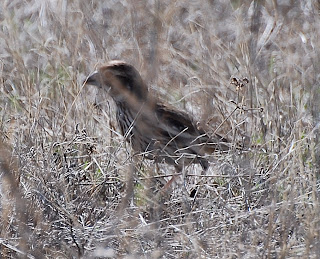
breast spot, dark malar stripe…what am I looking at? Dickcissel and Lark Bunting go through my mind, but I put down my binoculars and swing up my camera. I need to capture a picture if I want to be sure. The little scallywag runs for cover. It stays low in the grasses but I snap away. When I get home I discover it IS a lark bunting! A new bird for my bird count at least! On Sunday I count 21 species in this forgotten bit of earth. When I return here on Monday I add two more species to the count. I also observe the red-tailed hawk bringing nesting material to a tall pine on the golf course. I suppose someday this forgotten piece

of land will be plowed up to make way for a parking lot or something, but for now I can only hope it stays this way for a long time to come.
Birds Counted in and around the vacant lot: 1. Red-tailed hawk, 2. Mourning dove, 3. Anna’s hummingbird, 4. Costa’s hummingbird, 5. Gila Woodpecker, 6. Say’s Phoebe, 7. Chihuahuan Raven, 8. Cactus Wren, 9. Ruby-crowned Kinglet, 10. Curved-billed thrasher, 11.European Starling, 12.Yellow-rumped warbler, 13.Canyon towhee, 14.Rufous-winged sparrow, 15.Brewer’s sparrow, 16.Black-throated sparrow, 17. Lark bunting, 18.White-crowned sparrow, 19.Phrrhuloxia, 20.Great-tailed grackle, 21.Housefinch 22. Hutton’s vireo, 23. Orange-crowned warbler.


 Cactus Wren nest in Sycamore Canyon cholla 3-19-08 by Kathie


