Showing posts with label Red-tail Hawk. Show all posts

Sunday, July 25, 2010

The Good-bye Chronicles Chapter 2: Ambivalence

DSC_0142

July 5, 2010

We’ve been in the house all day and I just need to get outside so I ask Gus to take me for a ride before the sun sets. We head south on the Sonoita Highway as the sun dips behind the Santa Rita Mountains. The rolling hills around me are casting deep shadows as we drive past the possible future site of the Rosemont Mine. I can’t help but wonder if I go away, will this still be this way when I come back? Right now the gentle slopes rise unblemished to the sky, but for how long?

We pass over the crest of the hill and drop down on the south side. On my right is Greaterville Road and the way through Box Canyon to Madera Canyon. I know that there is good birding in there, but we will not be going that way at this time of night. Instead we pass the Border Patrol Checkpoint and turn left into Las Cienegas National Conservation Area. By now the sun has slipped beneath the horizon and all that remains is the soft glow of dusk. I immediately spot a Red-tailed Hawk in an old oak tree. I think he was in that same tree when I first came here 3 year ago. A Mockingbird flies up and lands nearby, its white wing and tail patches flashing as it flies. It is in no danger from the Red-tail, which eats mostly mammals instead of birds.

DSC_0147

The rolling grassland of Las Cienegas is spread before us. We drive slowly down the dirt road with windows open, all senses alert. The air is much cooler here and I feel its coolness wash over me, cleansing me from the 100 degree heat of the day. We watch as the car’s thermometer drops into the 80’s and finally into the 70’s before we leave. Now, as we drive down the road I hear the soft twitter of sparrows, a thin “zeet zeet” in the grass, and some raucous chatter I do not recognize, nor can I find in the long grasses and fading light. What are you? Where are you? I just want to know who you are!

DSC_0145Lillian’s Eastern Meadowlark 7-5-10 

We only drive a little under 3 miles before we turn back for home. It has taken us an hour to do this and now twilight has descended around us. As we pause at the end of the road I can see Venus, Mars and Jupiter all lined up in the western sky. Their line is tilted upwards, as if pointing to the heavens. I feel my spirits lifted even as a sadness settles within my soul. This is such a great place to live. It is so beautiful here. The weather is great and the scenic beauty is outstanding. There are so many habitats, so many places to see. I have only lived here three years and I have barely scratched the surface.

When I was a teenager we always had spelling words to learn for a weekly spelling test in high school. One week the teacher gave us the word, “ambivalence.” I had never heard the word before but when I looked up the definition I was astonished. It became my word, my definition of how I feel much of the time. Ambivalence means to feel two strong conflicting emotions at the same time. This could be my middle name! It is how I am feeling right now. I do not want to leave this place, yet I am excited about new possibilities and new adventures. But how can I leave this beauty and this wild life? Has Arizona gotten into my soul and become my new love?

We stop at the Roadrunner Market in Corona de Tucson on our way home. It is pitch dark by now and Gus goes into the store while I step out and walk to the corner of the parking lot to watch Lesser Nighthawks whirl through the sky. They are hunting insects drawn to the bright street lights at the intersection. Their bat-like flight is erratic at best as they fly in and out of the darkness. I stand there silent and alone drinking it all in, trying desperately to preserve this memory in case I need it on some cold New England winter night to get me through.

Ambivalence.

DSC_0464

This story begins in the previous post: Knowing

Thursday, May 13, 2010

Birding from Dawn ‘till Done, Kathryn’s last Day in Sycamore Canyon

DSC_0024 Can a day start out any better than with a red-tailed hawk soaring in a bright blue sky?

Skywatch Friday!

DSC_0031 Since Kathryn's plane did not leave until late afternoon we spent our last morning going for a hike in Sycamore Canyon. in 30 seconds we were in the Big Wash or the main Canyon and seeing birds. An unfamiliar song led me to this familiar bird, a canyon towhee.

DSC_0039Farther up the canyon we were startled when a red-tailed hawk flew screaming out of this nest high over our heads in a saguaro.  We had not seen the nest nor taken notice of the cactus until the bird flew out. since we did not want to disturb the bird or the nestlings we hurried away from that location.

DSC_0041Meanwhile mama (or papa) bird continued to scream at us from across the canyon in a mesquite tree on the opposite rim.

DSC_0052 We were seeing so many birds in the sycamore Canyon, a reminder to me that I need to come out here more often!  while I am chasing birds all over SE Arizona, once again I am discovering that there is a treasure trove right in my own backyard! We found this little bird and I took several photos of it.  I’ve studied and studied it and finally come to the conclusion…

DSC_0057 …that it is a Western (Pacific/Cordilleran) Flycatcher due to the lack dusky smudges on its undertail coverts, the short primary projection, the slight crest and the eye ring pointed at the back.  If you have a different opinion please tell me and tell me why!

DSC_0060 However, the male Phainopepla presents no such problem in identification with his silky black crest and red eyes.

We saw so many birds out in the wash and the whole time I kept saying to Kathryn that I was so surprised we had not seen a black-headed grosbeak out there. We barely got back home and I was dressing after taking a shower when Kathryn called out to me that there was a black-headed grosbeak in the acacia tree in the front yard!

DSC_0064

While I saw it there I was unable to get its picture, but then the bird obliged me by flying to the backyard and landing in the mesquite tree which made photographing it a bit easier as I could gently slide the sliding glass door open and poke out my lens.

 DSC_0070 What a great way to end her birding trip.  To top it all off, as we left for the airport we saw a Swainson's Hawk soaring at the bottom of the road in my neighborhood, her final species for this trip and a new addition to her AZ Life list! Sycamore Canyon is a great place to live!

Location: Sycamore Canyon Wash
Observation date: 4/13/10
Notes: Birding with Kathryn.
Number of species: 28
Turkey Vulture 5
Red-tailed Hawk (Western) 3 one hawk on nest in saguaro.
White-winged Dove 5
Mourning Dove 22
Greater Roadrunner 1
Costa's Hummingbird 2
hummingbird sp. 1
Gila Woodpecker 6
Gilded Flicker 4
Gray Flycatcher 1
Cordilleran/Pacific Slope flycatcher 1
Bell's Vireo 3
Gray Vireo 1
Common Raven 2
Verdin 7
Cactus Wren 6
House Wren 1
Black-tailed Gnatcatcher 1
Northern Mockingbird 5
Curve-billed Thrasher (Western) 6
Phainopepla 6
Lucy's Warbler 2 pair building a nest.
Green-tailed Towhee 1
Canyon Towhee 1
Rufous-winged Sparrow 1
Pyrrhuloxia 2
House Finch 10
Lesser Goldfinch 1
House Sparrow 1
This report was generated automatically by eBird v2(http://ebird.org)

Location: 17 S. Vermillion Sunset Dr.
Observation date: 4/13/10
Notes: Birding with Kathryn. Her last day here.
Number of species: 17
Gambel's Quail 6
White-winged Dove 2
Mourning Dove 15
Gila Woodpecker 8
Gilded Flicker 3
Say's Phoebe 2
Chihuahuan Raven 1
Cactus Wren 3
Curve-billed Thrasher (Western) 6
European Starling 3
Rufous-winged Sparrow 1
Lincoln's Sparrow 1
Northern Cardinal 1
Black-headed Grosbeak 1
House Finch 9
Lesser Goldfinch 6
House Sparrow 9
This report was generated automatically by eBird v2(http://ebird.org)

Tuesday, February 17, 2009

My World is a World of Wonder


Gambel's Quail 2-16-09 Corona de Tucson by Kathiesbirds

My World is a world of wonder. A world where birds greet me with merry chirps in the morning and sweet twitterings drift through my open window letting me know that I am alive and life is good. I smile to see the quail at the seed block, jockeying for position in their own version of King of the Mountain.

My World is a world of color where red Cardinals...


...and yellow Lesser Goldfinches come to the feeders,


...and where pink apple blossoms open with the promise of spring.


In My World of Wonder a Red-tailed hawk soars over the Santa Rita Mountains scooping my spirit up in its wings and carrying it high into the steel blue sky.

In My World of Wonder the amazing thing is when wonder creeps up on you unexpectedly, like it did on Saturday in Rio Rico where Gus and I scoured the countryside counting birds for the Great Backyard Bird Count. On the slopes of the San Cayentano Mountains, at a place we call Hawk Hill, the only birds we counted were two ravens and a Red-tailed Hawk. Every time we come here it seems there is one sitting on the utility pole, which is why I call this place Hawk Hill. It is late in the day as we arrive and we watch as the shadows deepen and fall across the valley only to swallow the hillside in darkness around us. We drive into town for a restroom break, and then, we return to watch the city lights from the mountainside as darkness descends.

As we drive up the dirt road in twilight our headlights illuminate the gravel road before us. I am still looking out the windows for birds when I see a thick shape at the top of a utility pole. I tell Gus to stop the car, because I think there is a Great Horned Owl up there, but at first he doesn’t believe me. He thinks it is the hawk. He stops the car so I can look through the binoculars at the large mass of feathers perched above us. Its thick head and neck with ear tufts reveals it to be just what I thought it was, a Great-horned Owl. I pass the binoculars to Gus so he can have a look, and as we are both watching through the windshield of the car the owl raises her hind end as if to vent when suddenly like a ghost another owl appears out of the dusk. Its wings form a massive canopy over the female as he lands on top of her fluttering. I think he is trying to get a foothold on the same pole as her before it dawns on me that I am witnessing the mating of two Great Horned owls! It is all over in less than 20 seconds and he is gone like the wind in the night. The female lowers her rump to the pole and assumes her upright perched position again. Gus and I sit there in wonder as we realize what we have just seen.

Though we try to get a photo of the owl on the pole, by now the darkness has deepened and she is too high up for even the flash to register her shape. We put the car in gear and continue up the mountainside to our favorite lookout spot. High on the side of the mountain the Rio Rico valley sparkles below us. We can see the lights all the way to Nogales and I must say the city lights have never twinkled so brightly. No wonder those owls had romance on their minds!


On Sunday I count birds in Corona de Tucson. I count birds at the schoolyard where I find a flock of Lark sparrows and one sweet-faced bird hops up for a look. Across the street I hear Killdeer call and then watch in awe as four white-bellied birds fly overhead, but it is the memory of the owls that lingers in my mind. So, I drive up the road to a steep dirt bank where I find another Great Horned Owl in a little cave.


Last year she nested here and raised a brood of 4 little owlets. Can she be sitting on eggs again already? What a Wonder that would be! I will check back on her again in a week or two, but as I drive away I am recalling the events of the night before and the wonder I felt as the phantom of the night flew in on silent wings to woo his mate.

GBBC Update: All of today's photos we taken during the GBBC and were birds that I counted and submitted on checklists. I missed counting most of Friday due to Doctor's appointments and other errands, but I counted Birds all day long on Saturday, Sunday and Monday. In the end I submitted 1 checklist for Tucson, 1 for Sahuarita, 8 for Rio Rico and 18 for Corona de Tucson. Last I checked I had submitted the only count of a Fox Sparrow in the whole state which I found scratching in the leaves under a tree near the Rio Rico ponds. I didn't get a photo because Gus had the camera and was photographing the ducks in the pond. It was a red variety and the first Fox sparrow I have seen in Arizona so it went on my Arizona Life list!

Thursday, January 22, 2009

Birding at Breakneck Speed: Part 1

Sandhill Cranes and Snow Geese at Whitewater Draw 1-16-09 by Gusto!

(Note: Most of today's photography is by Gus with the Nikon D80 and the 70-300mm lens. Click on any photo to enlarge for the best view.)

Last Friday was Gus' alternate Friday off. With such fine weather we headed to Whitewater Draw. I had been out birding the day before at Sweetwater Wetlands and Lakeside Park. I only had a few hours sleep, but we were up by 7 and on the road by 8 a.m. While a few cranes flew overhead the mass landing didn't happen until an hour after our arrival. In the meantime, we went looking for sparrows and owls. Gus is the photographer today, while I handle the binoculars searching for birds.


We found the Great-horned Owl in its usual place in the rafters of the pavilion. He cracked one eye open to watch us, then went back to sleep. In the dried winter grasses outside I spot my first song sparrow of the year. Later I find more down by the water, scratching in the weeds. A lone Eastern Meadowlark walks along the fenceline. Gus calls me to come see the owl while i try to be sure which species of meadowlark I am seeing. we can have Eastern, Western and Lillian's, a very light version of the eastern. But this one is bright buttery yellow, not pale enough for that.


We head off to the wooded area by the wetlands where we find a barn owl deep in the trees. The owl roosting area is marked off with signs to keep out, so this is the best photo Gus could get from the boundary line. We searched the trees for Long-eared owls, but without success.


However, over at the marshland the snow geese shine like chemically whitened teeth in the bright morning sunlight. A search through these photos reveals a Ross' Goose as well. Can you see it in the left hand side of the photo? Its forehead is more rounded, and its beak is triangular with a bluish blush near the top. It lacks the prominent grin path of the snow geese.


Gus captured this photo of an Eared Grebe in the pinkish water, another first for this year.


We saw a few shoveler's floating about, along with American Coots. This is their typical posture when not upended looking for food.


Many birds hide in the dry reeds, and this white-crowned sparrow is no exception. We saw some with the starkly contrasting white and black crowns, as well as this buffy-striped headed variety.


As always and everywhere were the raptors. A lovely Ferruginous flew overhead when we were watching the cranes land, but Gus was off by himself with the camera, and I was not able to tell him to get a shot. Harriers glided over the marshland, and almost every phone pole had a red-tail on it. We saw this juvenile Red-tail as we were leaving. I counted 25 species at whitewater draw today, adding 9 more species to my Big January count. But we weren't done yet. Gus decided he wanted to drive over to Rio Rico to visit our favorite place, which we call hawk Hill. Rio Rico is more than 60 miles form where we are now, but since he is driving, I agree to go.


In Rio Rico we stop at the Rio Rico pond alongside Rio Rico Drive. The pond is located in a fenced off pasture, but you can walk up tot he barbed wire and look at the birds. Last time I saw a black phoebe here, but today a little gray flycatcher is hunting form a thorny bush, dipping its tail in the sunlight. Out on the water the ducks immediately paddle to the far reaches of the pond where they are backlit by the sun. Not too great for photos but I could see and count ducks. And out amongst the mallards, shovelers and wigeons I spot a couple of pintails and some gadwalls. We are here less than 15 minutes and then we head up to Hawk Hill.


Before Gus has even parked the car a turkey vulture comes soaring over the ridge line. It is soon joined by another and another until I have counted four in all. If you wonder where the turkey vultures go in winter... well, here they are! I am taking the pictures now while Gus stands on the hillside and gazes out over the valley below.


We enjoy the view from the mountainside and listen to gentle breezes ruffle the grass. All the mesquite trees are little more than scraggly shrubs and with the winter have shed their tiny leaves so that they appear dead. Soon spring rains will come, and with them spring warmth, when once again this dry brown land will blush with green for a season.


For now the black-throated sparrows sing their silver song to me in the waning light of this long day that started with sandhill cranes in the east, and ends with vultures and sparrows and the setting sun in the west.

Big January update:

84. Snow goose: Whitewater Draw 1-16-09
85. Ross' Goose
86. Barn Owl
87. Killdeer
88. Sandhill Crane
89. Eastern meadowlark
90. Song sparrow
91. Ferruginous hawk
92. Eared Grebe
93. Gadwall: Rio Rico 1-16-09
94. Turkey Vulture


Please come back to read about Birding at Breakneck Speed: Part 2 after Skywatch Friday!


On a personal note, it's 4 a.m. and I am tired, but I cannot sleep when I have a blogpost on my mind. However, I don't write as well when I'm tired but I needed to get this done. I'm off to bed now to listen to the pitter patter of rain and breathe in the fresh perfume of the wet desert through my open window. Its been unseasonably warm here and our heat has not been on for days. The clouds moved in yesterday, and we have had a few showers during the night.


Friday, January 16, 2009

Big January: In Praise of Vacant Lots


Some of my best times birding are spent looking for the hidden spots of the world. I find the most unusual birds and sometimes the most peace in vacant lots. They are undiscovered and abandoned places, full of mystery, trash and treasure, and if undisturbed for a long time, they are often the happy habitats of birds.

We have driven to Coolidge for the afternoon to spend some time with my son. It is football playoffs time and as the men settle in for their football game I wander out into the warm afternoon sun. As I pad across the pavement a Eurasian collared-dove eyes me from the overhead wires.


I glance across the flat expanse of desert before me. I use to find so many birds in this vacant lot, but today only jackrabbits scuttle up from the brush as I hike across the dusty earth. A lone Say’s Phoebe bobs its tail from the top of some desert broom. It has a vast terrain to hunt in, but it looks like slim pickin’s to me! In the distance I see the crumbling walls of the Casa Grande Monument. I head in that direction, but take a meandering path.

For the next half mile I see nothing other than mourning doves and grackles flying overhead but as I cross the road I start to hear the sounds of birds. In the two years that I have lived in Arizona I have watched the open land disappear as new neighborhoods and houses go in. Along with the neighborhoods come the new schools, and more land is lost to wildlife. Out here the west seems so big that the loss of a few acres doesn’t seem like it could matter much, but it does. Each little piece of earth is home to wildlife and as the habitat is fragmented and the humans become more numerous the wildlife moves on, moves out, or dies off all together. My son says he has not seen the little owl in the vacant lot I just crossed in a very long time.


But I am here now, here in this wild and discarded place. A neighborhood is growing to the west of it. The curbs and roadways are already in. To the East a new school has risen since the last time I was here. How do they build them so fast? And right here where old trees tower, and remnants of another day lie discarded and rotting the trees and bushes are full of evening birds.


I walk soft as I can on the dried grasses. Leaves and sticks crumble and crack beneath my feet. Mourning doves make heavy silhouettes as they roost on utility wires and on the tangled branches of the trees. I stop to admire the scraggly branches that loom above my head.


Why do I find the bare leaved trees so beautiful and sculptural? In this evening light their bark looks gilt with gold.

A silver silo rises up from the golden land, a monument to man’s discarded past.


Farther down through the vacant lot I wander with yellow-rumped warblers singing me along my path. They don’t seem to mind the garbage strewn about their domain, but I start to wonder if I am safe back here. I’m quite a ways off the road. Would anyone hear me if I needed help?


A flock of White crowned sparrows flutters by and lands in a thicket. Their thin voices call a soft “zeet zeet!” in the waning light.


Then a flock of Gambel’s quail scurries across an opening. Everything about them says, “Hurry! Hurry!” but they have nothing to fear from me. How I wish I could communicate that to them.


With the sun below the horizon the full moon rises in the eastern sky. It is a round balloon in a lavender sea.


I know my time here is short now but I see a lone dark shape high atop a utility pole in the distance. I walk closer hoping for a better view but as I do clouds of mourning doves rise from the tree lined canal that borders the vacant lot and separates it from the Casa Grande monument. Wave after wave of birds rise alerting the hawk to my presence. It lifts on dark wings into the sky and vanishes into the night.


In the pale light that remains I gaze across the canal as if gazing across time to an ancient day when native peoples roamed this land and grew crops that they irrigated with water from the Gila River. The adobe walls of the Casa Grande Ruins are all that remains of those times and those days. I wonder what birds and wildlife lived here then?

As I head back out to the road the mourning doves settle down again to their nighttime roosts. There had to be at least 200 hundred of them, maybe more. As the darkness deepens I grow colder and a bit more concerned about my location. I call my son who comes and picks me up in the moonlit night. If the vacant lot is still here next time I return, I will come back again. The birds are waiting for me.


Big January Update:

70. Brewer’s Blackbird; Rita Ranch Fry’s Parking lot 1-10-09
71. Green winged Teal; Santa Cruz River at Ina Road, Marana 1-10-09
72. Road Runner; Picacho resevour dirt road. 1-10-09
73. Eurasian collared Dove; Coolidge, AZ 1-10-09
74. Great-horned Owl; Sycamore Canyon 1-12-09

Big January Participants:

Larry: The Brownstone Birding Blog
Mary: Mary’s View
Mike: 10,000 Birds
Ruth: Body, Soul and Spirit
The Strobels: Bird Couple

If you are participating in Big January just let me know and I will add your link to this list!

Good Birding Everyone!

Scroll down to see Skywatch Friday: Coolidge Sunset/Moonrise

Tuesday, January 6, 2009

My World: Arivaca Cienega


Amado Sewage Pond with clouds streaming off the Santa Rita Mountains 1-3-09 by Gus


In pursuit of my Big January Count Gus and I headed to Arivaca Cienega on Saturday morning. Our route takes us south on I-19 to the Amado exit south of Green Valley. As we exit the highway we take a left and cross beneath the underpass to the frontage road and the Amado Sewage Pond. I have never stopped here before but I have been seeing the pond full of winter ducks when w pass by on the highway. It’s early morning and the sun is still low in the sky as we pull up on the western edge of the pond. We pull off on the frontage road, which I assume will have little traffic, and try to see the birds. The pond is fenced all around with “No Trespassing” signs attached, but you are allowed to view the duck from beyond the fence. I count 6 species of duck here before we head on our way.

We continue our way west-southwest on Arivaca Rd. Here the terrain is hilly and the road winding. We greet the border patrol as we pass by, telling them to look for us on the way back, we are going birding! Soon the pinnacle of Baboquivari Peak looms ahead before disappearing beyond the horizon as the road dips once again. Finally we pull into the parking lot of Arivaca Cienega at 10 a.m. MST. Arivaca Cienega is part of the Buenos Aries National Wildlife Refuge and an Audubon Important Bird Area.

As soon as I open the car door a huge white and brown raptor flies low overhead. It looks just like a photo I saw on someone else’s blog of a Rough- legged Hawk, but I see the dark leading edge to the wings that indicates a red-tail. This puts me off and I am unsure of which bird I am seeing. Gus hasn’t gotten the camera out yet, so we don’t get a photo. Soon the bird disappears beyond the tree line and I don’t add it to my count.


Red-tailed Hawk soars over tree top by Gus 1-3-09

Though the sun is shining brightly, a stiff wind is blowing cold. I bundle up with three layers of shirts and we head down the path. Last year I found sparrows, woodpeckers, and wrens along this paved walkway, but today all is silent. There is no bird movement around as we walk through the Mesquite Bosque. Soon the trail opens up to the grassland and marshes of the Cienega. Towering cottonwoods stand as sentinels along the creek bed. At the point where the path diverges left and right a huge old cottonwood is often a great place to find Great-horned Owls, but today it is void of birds, except for raptors. A red-tail sits on a high limb and the sky is full of them. Red-tails circle endlessly above us. I search their numbers for harriers, but so far this common raptor is missing from the fray.

Arivaca Cienega by Gus 1-3-08

We decide to head east on the loop trail, hoping to find the Green Kingfisher in the pool where we found him last year. Nope. The pond is empty except for a lone Black Phoebe. This is also the area where I usually see Abert’s Towhees. Nothing. As the wind gusts past us I hold onto my hat. I am starting to think the wind is keeping all the small birds down. We continue around the trail under wind scoured skies. A red-tail lands in a nearby willow trailing bronze limbs like strands of hair blowing in the wind, but no other birds are found. No song sparrows by the creek in the forest, no great blue herons in the marsh. No towhees anywhere.

Searching for Birds by Gus 1-3-09
Then, at the far eastern point of the boardwalk, where the path becomes dirt again, I see movement low in the brush at the edge of forest and field. The initial shape looks like a flycatcher, but this bird is bobbing its tail like a phoebe. However, its shape is like an Eastern phoebe and not our more common Say’s Phoebe. What am I seeing? It disappears farther into the trees and I take the camera from Gus and try to follow it, hoping for a photograph, but the bird is gone. Later on I look it up in my bird guides and discover that the Gray Flycatcher is our most numerous winter flycatcher and is noted for its habit of bobbing its tail like a phoebe! ID confirmed: 1 Gray Flycatcher!

Cottonwood Giant by Gus 1-3-09
We wander past the hilly eastern edge of the loop trail with the marshland off to our right. Where the trail takes its turn back towards the west I see some motion and a slight patch of red in the thicket. A look though the bins reveals first one Pyrrhuloxia, then another. Deep in the thicket they hide from us, and we continue down the trail. In this open area we can see across the marsh to the cottonwood tree beyond where all is tan and blue.

The wind is starting to die down a bit as we enter another wooded section of the path. I usually like this section, for it reminds me of the eastern forest I prowled as a child with dappled sunlight speckling the trail before me. We are so close to the marshland now that the cattails and rushes are seen through the trees and red-winged blackbirds call from deep within. Today I hear the call of one, simply one red-winged blackbird. I feel lucky to have heard that one, for this is not the usual time of day for them to give voice. But other than that, this path through the woods is void of birds, whereas last year I saw towhees, cardinals, juncos and sparrows all on this section of the trail.


Red-shafted Flicker 1-3-09 by Kathiesbirds

As we emerge into the sunlight again I spot more red-tails soaring overhead, and another darker bird. Its black silhouette is different. Its long flat wings are totally black, except for the white wingtips. Could this be a Black Vulture? I thought they had all flown farther south for the winter, but as I continue to watch, I have no doubts about what I am seeing. I did not expect to see this bird on this trip, and many others I did expect to see are not here. So, I add a black vulture to my list and continue on the trail as it crosses a bridge over the meandering creek. Another Black Phoebe chirps from the rushes and nervously flits about the reeds. Then a yellow-rumped warbler makes an appearance. Things are starting to look up. Now the Marsh Hawks are up and soaring, white rumps flashing as they fly low over the marsh. Marsh hawks were recently renamed Northern harriers, but their old name is more descriptive to me, and I use the names interchangeably. Gus isn’t feeling well and heads back to the parking lot, giving me the camera as I continue on the trail. At this point the trail turns back across the marsh over a board walk, or you can take a little spur up a hill that overlooks the big marsh and a smaller marsh and pond. I go this way and am rewarded by finding Red-shafted flickers, white-crowned sparrows and a Wilson’s snipe.


Northern Harrier (Marsh Hawk) by Kathie 1-3-09

What I love about Arivaca Cienega is the way the trail wanders in and out of sunlight and crosses various terrains. It loops up hilltops and down to marshland. Golden grasses wave in this pale winter’s light. A single lesser goldfinch peeps at me from a treetop and deep in the wooded area of the marsh I find a Northern Harrier perched on a snag looking over the creeks, its owl-like face focused and searching.


Sunflower Jungle by Kathiesbirds 1-3-09

Once past the creek and pond the land becomes quite marshy once again. In my search for birds I try to follow the path I have before where I have seen meadowlarks, plovers and snipe, but what a difference a year makes. Apparently the wild sunflowers took over this part year and now their dry canes tower overhead like a bamboo forest. Still, someone has broken a crude trail through this jungle of weeds and I follow the damp path searching, searching, searching. But, despite sunshine and what looks like it should be good birdy habitat, all I see are weeds. After a few meters of this I finally decide to turn back as the only motion or sound comes from the wind and the rustling grass and weeds.


I have surrendered. I give up. There will not be a large bird list for me here today. As I emerge from the sunflower jungle I meet a wonderful older couple on the path. Their names are Hank and Dot, short for Dorothy and Harold. I am pleasantly surprised as I tell them those were my grandparents’ names. Hank and Dot are from Green Valley and they are newlyweds of 4 years. They tell me that they dated in high school, then married other people. When their respective spouses passed away, they reconnected after all these years, fell in love and married each other. Together the three of us walk back towards the parking lot.


Red-tailed Hawk in Tree by Kathiesbirds 1-3-09
We continue to see Harriers and Red-tails. As we cross the boardwalk some Eastern Meadowlarks fly up and drop into the marshland once again. Then, a kestrel races by us and we turn to watch its rapid flight. We find Gus sitting in the sunlight on a bench where the loop begins by the old cottonwood tree and I introduce him to my new found friends. Dot and Hank are staying to have a picnic, but Gus and I both aren’t feeling well.
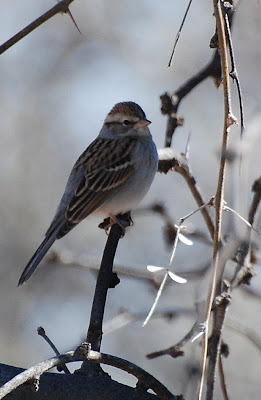
Chipping Sparrow 1-3-09 by Gus

We decide to leave, but before we do, I hit the restroom once again, since it is an hour’s drive through a rural landscape to get back home. By now I assume my birding is over, but as we draw near the car I finally spot a chipping sparrow in the ticket. First one, and then another, then a small flock. Gus takes some photos for me. Then, when I emerge from the restroom I hear the chipping of wood in the nearby mesquite trees.


Female Ladder-backed Woodpecker by Kathiesbirds 1-3-09

I still have my bins with me and I finally spot a female Ladder-backed Woodpecker working vigorously on a fallen limb. She pecks and pounds away, undeterred by my presence. I hurry to the car to get the camera, since Gus is already in the vehicle waiting for me. As I start snapping photos I catch some motion from the corner of my eyes.


There in another tree is a vireo. When I turn to focus on it, it disappears in the thick tangle of branches but I find a Verdin, then a Bewick’s Wren and more chipping sparrows, all in the same tree! In my last five minutes at Arivaca Cienega I find five more species of birds!


In the end I counted 23 species of birds at Arivaca Cienega. A little over a year ago, on December 30, 2007, I counted 26 species of birds. We didn’t have the D80 at the time, and though it was ordered, it hadn’t arrived in the mail yet. It was our Christmas present to ourselves last year, and now we are putting it to good use this year. Arivaca Cienega continues to be one of my favorite birding areas in Arizona and today’s visit goes to show that you just never know what you are going to see. This is part of the charm of birding, or bird watching. It is an adventure. It is full of surprise and delight. It gets you outdoors and into nature, and for me, it renews my spirit. As an added bonus, you never know when you are going to meet some really interesting and kind people. I can only hope I will bump into Dot and Hank again someday. Since they are bird watchers like me, this is entirely possible! (Dang! I wish I had taken their photograph!)


Verdin 1-3-09 @Arivaca Cienega by Kathiesbirds
(click on any photo to enlarge for the best view)


Arivaca Cienega (site profile) is desingnated as an Important Bird Area by Tucson Audubon.


Birds Seen January 3, 2009 (Big January Count Continued)

23. Red-tail hawk: Sycamore Canyon
24. Chihuahuan Raven: Sahuarita
25. Northern shoveler: Amado Sewege Pond
26. Canvasback: Amado
27. Lesser Scaup: Amado
28. Bufflehead: Amado
29. Ring-necked duck: Amado
30. Ruddy duck: Amado
31. Black Vulture: Arivaca Cienega
32. Red-winged blackbird
33. Pyrrhuloxia
34. Chipping sparrow
35. Yellow-rumped warbler
36. European Starling
37. Bewick’s wren
38. Verdin
39. Plumbeous Vireo
40. Black Phoebe
41. Gray Flycatcher
42. Northern Flicker
43. Ladder-backed woodpecker
44. Wilson’s Snipe
45. American kestrel
46. Northern Harrier; Arivaca Cienega
47. Rock Pigeon; Arivaca Junction