Showing posts with label Hummingbirds. Show all posts

Saturday, July 24, 2010

The Good-bye Chronicles Chapter 1: Knowing

DSC_0017 Sunset in Sycamore Canyon 7-17-10

July 5, 2010

I have known for 2 weeks that this was possible but so much has been going on. First my son arrived for his last visit before he goes to war in Afghanistan, then my sister arrived for her 50th birthday. While she was here Gus went off for an interview in the Boston area for a new job. I thought we were going to make it here. We both thought we would retire here. We had made it past the three year mark by which we had usually moved. We thought our job was secure in spite of the downturn in the economy. We never thought this would happen. So, we bought a new refrigerator and installed a hot tub. Two weeks later the company my husband works for laid off 250 people. A few weeks after that the program he worked for downsized. He found himself adrift in an unstable situation. Thus his search was launched to find a new job. And so it was that while Alex was home and my sister was here that Gus was in Boston interviewing for a new job.

Desert toad 7-3-10 Gus returned the same night my son left. My sister left the next morning. Now here I am trying to memorize every moment, every bird, every sunset, every star-filled night. The Sonoran desert toad that pokes its head out in the evening makes me smile. Every hummingbird that comes to my feeder makes me wonder if there will be anyone to fill the feeders for them this fall when the fall migration starts and 5 to 6 species of hummingbirds stop by to feed on their way south.

Winter Hummingbirds Last year I had a hard time keeping 5 hummingbird feeders full for their voracious appetites. Who will feed the hummingbirds now? Or the bats?

DSC_0107 lesser long-nosed bat gSeptember into October is the migration of the Lesser Long-nosed  bats. The bats know my yard now. They know they can count on food at this location. Will there be anyone here this year to feed the bats? Will anyone else care if they have something to eat?

In an effort to make each moment count and in light of the current oil spill in the Gulf of Mexico I see how every bird count I do in this area matters. I cannot go to the gulf to count birds, though I would in a heartbeat if I could, but I can count birds here.

Scott's oriole female Female Hooded Oriole 6-28-10 My Backyard

Already the bird populations have changed since I moved in here. Just down the slope from my house the building boom has resumed and there have been over 200 houses added to the once open desert where nighthawks and western kingbirds hunted in summer and raptors soared in the winter. This year the birds are finding their hunting ground gone, replaced by homes set cheek to jowl on hot paved roads where rabbits and ground squirrels succumb to overzealous and inattentive drivers. Where I used to hear great-horned owls on a regular basis, I have not heard one in a very long time. The birds are either moving up or down the mountain into more remote hunting grounds, but if the proposed copper mine goes in, all of this could change even more. The bird counts I do now will document how it was, in case it does change. In case our own version of an Oil Spill happens here.

DSC_0005 I was quite surprised when I researched my eBird records to discover that I have done relatively few bird counts in the greater Sycamore Canyon area. While I count birds almost every day from my own yard, my bird counts of various areas in Sycamore Canyon have not been consistent. Though I have lived here for over three years I was surprised to see that I had only submitted bird counts for the park area 23 times. In response to this knowledge I have been down to the park counting birds three times in the past week, and I plan on going more. I feel the urgency of collecting as much data as I can before I go. If I go.

DSC_0056 Female Costa’s Hummingbird 7-19-10

For now we wait. We will know in about a week what Our Fate will be. And then, I will really start to say  “Good-Bye.”

DSC_0169

Thursday, June 10, 2010

Today in Sycamore Canyon

DSC_0054

Today in Sycamore Canyon the Costa's hummingbirds are back.  I have been seeing males for the most part for the past couple of weeks, but today a female Costa's showed up.  I love feeding hummingbirds but the feeders do present a challenge. Not only do bees tend to hover around them at certain times, but now I am busy fighting ants drawn to the sugary syrup. I used to have a different feeder here on the window under the covered patio over my patio table because hummingbirds like to feed in the shade and this arrangement keeps them dry when it rains.  The other feeder I had was the inversion type where you flip it over to fill it and then invert the bottle for the birds to feed.  The problem is that with the high temperatures we have been having lately the nectar is forced out of the bottle do to the increased pressure when the liquid inside expands, thus dripping all over my table and attracting ants. So, for now I am trying this type of feeder in this location which is a saucer feeder and tends to discourage ants and bees.  However, the Gila woodpeckers may still hang from it to feed which will also cause it to drip and then I will have to think of something else!

Meanwhile, I still have the inversion type of feeders elsewhere in my yard. The ants have also found these and are climbing the shepherds hooks I have them on, as well as the glass window where my window feeder is held on by suction cups.  In my war against the ants I have tried several things.  First I broke down and sprayed a chemical spray after removing all feeders and plants from the area.  I immediately felt guilty for this and washed it all away.  While it killed the ants I could see, it didn’t stop them from coming back later in the day.  Then I tried ant traps. It was all well and good until fresh nectar dripped on the table.  The ants bypassed the bait and went straight for the sugar-water! What now? Well, I changed the feeder as stated above.  I tired spraying the ants with my white vinegar solution I use to clean the windows with.  It killed the ants but didn’t keep them from coming back. So, I am now trying this…

DSC_0042 Vaseline and Vicks Vaporub on the pole…

DSC_0047 and around the edges of the window.  So far they will not cross this and they seem to hate the odor of the vaporub but will it also chase away the birds? I am watching and waiting. I have taken great precautions to make sure that none of this will end up on the wings of the birds which could be disastrous! I’ll let you know how it all turns out.

Meanwhile…

DSC_0003 the finches are feeding…

DSC_0006

… as well as this baby curve-billed thrasher being fed by its parent.

 DSC_0012 The Baby Gambel’s Quail are starting to arrive…


DSC_0057 …but the parent birds have been digging nests in the cool soil beneath my bougainvillea and other garden plants.  I don’t mind that they do this except it tears up the roots and kills the plants!  I have resorted to placing large rocks beneath the plants just to protect them from the birds!

DSC_0058

My bougainvillea in bloom today.

 DSC_0061 Female Gambel’s Quail digging herself a nest hole beneath the nearby grass and bougainvillea!

DSC_0064 She’s just relaxing and cooling off and apparently eating in bed!

DSC_0041 In the backyard the whirling butterflies (guara) are in bloom…

DSC_0044 And while I was watering my garden I saw a toad disappear into this hole beneath the spigot! I planted Irish moss here to catch the drips of water from the hose.  It seemed a good idea and so far it is growing but apparently a toad has decided it makes a perfect home. I tired to flush it out for a look by filling the hole with water.  No luck…

DSC_0056 …but when I came back later on in the afternoon I noticed the hole plugged up with debris.  Seems the toad shut the door on me!  One question: Since he lives in Irish Moss, does that make him an Irish toad?

Hot, sunny, and windy here in Sycamore Canyon today.  It was 77 degree F when I first got up at 7:30 a.m. but has now risen to 102 degrees F. A few clouds are wafting overhead and the wind has picked up quite a bit.  It is suppose to blow quite fiercely over the next few days and the temperature is suppose to drop into the high 80’s!  That is almost unheard of for June and will be a relief after the triple digit temperatures we have been having as of late.

Today in Sycamore Canyon I am also thinking of fellow blogger, birder, and artist Debby Kaspari. Debby and her husband Mike had their home and studio destroyed last month in an F4 tornado in Oklahoma. Julie Zickefoose has written a fantastic article about it on her blog with links to where you can donate if you are interested. Please take a look and see if you would like to help. Debby and Mike escaped with only their lives and their cat.  Click on the links below to read the amazing stories and see photos for yourself.  Debby, I wish you all the best.  May you start painting again soon for all of us and For the Birds!

The May 10 Tornado

Meet Debby Kaspari

Debby’s Blog: Drawing the Motmot

Thursday, October 29, 2009

Hummingbird Morning

Costa's and Anna's Hummingbirds 10-29-09

It was 38 degrees here in Sycamore Canyon when I awoke this morning. As soon as the sun rose the birds started to appear. The temperature dropped sharply yesterday driving the birds into my feeders. There was a feeding frenzy last night just before the last few rays faded from the sky. When the morning sun touched the earth once again the hummingbirds were back to refuel. Hummingbirds usually don't like to share the feeder, but when it is this cold and there are so many, they seem to give up and focus their energy on feeding instead of fighting. Most of these are Costa's hummingbirds, but the one hovering to the right with a central throat patch is actually a female Anna's Hummingbird. How great is it to live someplace where you get hummingbirds in autumn and winter?


Immature male Anna's Hummingbird 10-29-09

Don't mess with me!


This immature male Anna's isn't about ready to share his stash with anyone! He sits here on the hand of my ballerina sculpture and chases all the other hummingbirds away! Sometimes when he is busy chasing off one small intruder another slips in and gets a drink!

Tuesday, August 18, 2009

My World is MAGNIFICENT!

Magnificent Hummingbird 8-16-09 by Gusto!


Magnificent Hummingbird by Gusto! 8-16-09

Magnificent Hummingbird with green gorget flashing.


Magnificent Hummingbird in a pine tree. 8-16-09


Magnificent hummingbird at feeder with other hummers.


On Sunday Gus and I took a drive up Mt Lemmon, a 9000 ft mountain located at the northeast side of Tucson in the Catalina Mountains. A drive up the Catalina Highway starts in the Sonoran Desert with towering saguaros. As we head up the highway the temperature is already 98 degrees F at noontime. As the road follows the steep switchbacks higher and higher we watch the temperature gauge drop and the terrain around us changes from sonoran desert to mountain pine forest. By the time we reach the Palisades Visitor Center the temperature has dropped to 77 degrees!

Today Gus is taking the photos as I have injured my left arm trying to put away a suitcase on a shelf high overhead and strained my rotator cuff. I am alright but the gist of the matter is, I can't use my left arm. So Gus is doing all the photography today. That's fine by me. I am pleased that he is with me and that he finds pleasure in photographing the birds. We scurry out of the car, for the Plaisades Visitor Center is well known as a great location to see a Magnificent hummingbird. If I do see one here it will be a *Life Bird for me.

We take up positions on the deck of the visitor center and watch as broad-tailed hummingbirds and rufous buzz and whizz by. They land at the feeder in groups and drive each other away fiercely. Then suddenly a large black looking hummer lands on the perch, dwarfing the rest of the birds. In the shadows he appears black but then the sunlight bounces off his throat and the lime green gorget flashes like a neon sign. After drinking a moment he flies off into the nearby pine tree and lands on a slim twig. I watch with mouth agape as the smaller hummers dive past him and he flashes his feathers once again. This time I see not only the lime green gorget, but the purple crown feathers on his head. Is there any wonder they named this bird "Magnificent?"

Magnificent Hummingbird at feeder, Palisades Visitor Center,
Mt Lemmon, AZ 8-16-09 by Gusto!
with the Nikon D80 set in sports mode.


and that's...


Go visit!
*Life Bird-the first time one sees a species of bird and adds it to their Life List. Most birders maintain a list of all the bird species they ave seen in their lives. I am no exception. I have been keeping a list since I was around 16 years old. This makes #355 for me, but I have not entered all my historical data into eBird yet and this number could change.

Tuesday, August 11, 2009

My World: Hummingbird Season

Costa's hummingbird immature male 8-10-09

In My World it is the season of hummingbirds. While the rest of the country enjoys hummingbirds in the heat of the summer, for me they arrive in August and stay all winter long.

Male Costa's 8-9-09

Though I have seen a few Costa’s females during June and July, it is only recently that the males started to show up again.

Black-chinned male 8-10-09

Then, on Saturday I saw my first black-chinned male of the season. By Sunday the flood gates had opened and theses tiny feathered jewels are here in force. I now have two rufous hummingbirds battling for my feeders along with at least 2 black-chins and numerous Costa’s hummingbirds. I have already seen some Anna’s and soon the broad-billed hummingbirds will arrive. My back yard has become a war zone with these feathered weapons flying about. They use their tiny beaks like swords or lances and dive at each other to defend whichever feeder they have claimed as their own.

Fiery rufous 8-10-09

Of all the hummingbirds in the yard the rufous hummingbirds are the most fiery. If they are at a feeder and an intruder tries to feed, they hover in the air, orange tail feathers spread and buzz and chirp and dive until they drive the intruder away.

Rufous Hummingbird 8-10-09

Unafraid, the hummingbirds will whizz past my head like a shot, and I will flinch before they will. It makes it hard to get anything done, for they are so fascinating to watch. I tried not to love them just because everyone else does. I am a bit of an oppositional child in this way, but I could not resist. They have won me over and I am in love with them.


Rufous immature 8-10-09

I will only have this wide variety of species for a short time. Soon most of them will migrate even farther south, and I will be left with mostly Costa’s and Anna’s hummingbirds. The Costa’s will establish their breeding territories and by January and February they will be nesting once again.

Feeding in harmony 8-10-09

I can easily see how native tribes lived so in tune with the earth that they named the seasons according to what was happening at the moment. For me, the season of the purple martins is about to end, as I know they will soon be migrating south. Now the season of the hummingbirds has arrived and after that, it will be the season of the raptors and waterfowl as those species return from the north. I know I still have so much to learn about my desert home, but as the days pass and I tune in to this wonderful world around me I begin to feel the beating heart of this earth and hear the breath of the land. I begin to know and understand the moods of this land I live on, this earth that I am a part of, this place that gives me Life.

And that's...

Wednesday, October 15, 2008

A Feast of Hummingbirds

Costa's Hummingbird (male) at feeder outside my kitchen window 9-30-08
Click on photos to enlarge for best view

I didn't want to fall in love with hummingbirds. After all, that's what everyone else does and I don't want to be like everyone else. I resisted as hard as I could, but I did put out feeders and these tiny feathered jewels showed up. They came in such an array of colors; so many varieties, so much energy, so much fighting, so much laughter, that I couldn't resist. I've fallen and I don't want to get up. I kind of like it here in the winter world of flying gems.

I am not a hummingbird expert by anyone's stretch of the imagination, but I've taken lots of photographs and I am trying to learn. I pour over bird guides and study field marks. When they didn't provide enough data, I borrowed Hummingbird guides from the library. I look and look and look. Some things I have figured out and others have left me totally confused. Females and immatures are especially difficult, but I am doing my best. So, enjoy the hummingbird feast. These are just a few of the beauties who have passed through my yard since August, when the little birds started showing up once again.

Anna's Hummingbird

Male Anna's in mesquite tree 10-13-08


Anna's are one of the two helmeted hummingbirds we have here in Arizona. That means their reflective feathers go up from the throat and over the head. This bright male has been hanging around since September. His gorget flashes rose-red in the sunlight.
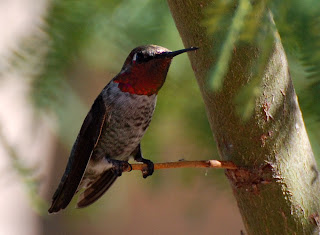
Male Anna's Hummingbird 9-23-08

At about 4 inches in length, the Anna's is a chunky bird with a pot-bellied silhouette. It is common around neighborhood gardens in the southwest. I usually see them after it has warmed up for the day. They tend to chase away the more timid Costa's.


Anna's Hummingbird 9-23-08

Unlike the Costa's, the Anna's tends to hold it's tail still and in line with it's body when hovering. This guy is defending his territory and his tail is a little more cocked for a fight. Look at those ferocious feet!

Black-Chinned Hummingbird


Black-chinned hummingbird 8-31-08

The male black-chinned hummingbird has a mostly black chin with a thin slice of purple that flashes in the sunlight. The black wraps around its head to the green neck with no white stripe of any kind. A long slender hummingbird, it constantly pumps its tail while hovering. While Costa's do this also, the black-chin's tail is longer and the motion is more pronounced.


Black-chinned female 9-13-08

Archilochus alexandri is the western version of the Eastern Ruby-throat, though the Ruby-throat does not pump its tail in flight. Notice the flat headed appearance of this female with the long straight bill. The forehead is grayer than a Costa's and the neck slimmer. Notice that the tail extends well past the wingtips.


Black-chinned male 8-31-08


The male Black-chinned characteristically shows a white collar beneath his black chin separating it from the scaly gray vest it wears.


Black-chinned female at the feeder 8-31-08 The black-chins do not nest around here. These were just passing through on their way to their winter home in Mexico. They showed up mid-August and were gone by mid-September.


Broad-billed Hummingbird

Broad-billed hummingbird 8-30-08

The broad-billed hummingbird is strikingly beautiful to me with its broad red bill tipped in black, it long blue forked tail, iridescent green body and blue throat and crown.


Broad-billed hummingbird at the new feeder 8-31-08

Stokes Beginner's Guide to Hummingbirds says they breed in remote dry canyons below 6000'. I saw my first one in Sycamore Canyon last spring. This fall they have been much more numerous, but I do not know if they will stay the winter here. I have counted them numerous times on our IBA survey of Sabino Canyon where they do nest for the summer. I will find out if they hang around there for the winter this year as we continue our survey.


Immature Broad-billed 9-30-08

I was so excited to see the above hummingbird, hoping it was a white-eared hummingbird, which would have been a new record for Sycamore Canyon and a life bird for me, but after consulting my bird guides I learned it was an immature male. He is still pretty and a delight to look at. He stayed around for a day or two and them was gone.

This is a close-up of the same bird at a closer feeder. Notice the feathers just coming in on its throat and breast.


Just when I thought the broad-bills were gone, this pretty boy showed up on 10-7-08. In this light his head almost looks purple and his chest blue. Could it be a hybrid of some sort, or is it just the play of light on its feathers?

Female Broad-tailed Hummingbird

Female Broad-tailed hummingbird 8-30-08

So, I am going out on a limb here, tell me what you think. After consulting bird guides I have decided this is a female broad-tailed due to the slender body, the speckled throat, the long, straight bill, and the limited rufous/peach to the flanks and tail. The female broad-tailed and the female and immature Rufous are similarly colored but the Rufous has more extensive rufous in the body and tail. The Rufous also frequently has a orange throat patch but the female or immature broad-tail lacks this throat patch. Male broad-tails have a rose-colored gorget and their wings make a high-pitched whistle when they fly. I heard and saw some males but they did not hang around for long and I was not able to photograph one.

Calliope Hummingbird


Calliope female or immature 8-30-08

The Calliope Hummingbird is the smallest hummingbird in North America. While the male has a very distinctive frayed looking red-colored gorget, the female and immature look alot like a female broad-tailed. Short billed and short tailed, this little hummer is very compact at 3.25 inches. The short tail is square and mostly black. The wingtips just barely reach the tail.

I have found this bird to be wary and shy, only coming to the feeder in the early morning or late afternoon and usually to the less frequently visited side feeder where there is less competition.


While a male would be an easy call, I was not sure if I could really call this a Calliope, but the bird was so obviously smaller than any other hummingbird, and all the other characteristics fit. So, this is a new bird for Sycamore Canyon and a life bird for me.

Costa's Hummingbird


Costa's Hummingbird in Palo Verde tree 8-17-08

When this Costa's showed up I had no trouble identifying it with that long, flared, purple gorget. After last winter and spring I was quite familiar with this little hummer, which nests in this high desert and was the most common and sometimes the only hummingbird I saw here last year. I fed them through April and early May, then they were gone. I took my hummingbird feeders down after that, and only put them back up when these guys started visiting my yard in August.

Costa's Hummingbird male 9-30-08

Costa's Hummingbird female 9-30-08

The Costa's female can be a challenge to differentiate between it and the female black-chinned. Both are similarly colored and both pump their tails while hovering, but notice the short-necked and short tailed appearance to this little girl. Also, her forehead is more of a greenish tinge while the female black-chin's is flatter and grayer. Still, I sometimes have trouble when there are immatures and females about.

Rufous Hummingbird

Rufous Hummingbird female 9-7-08

While I have not seen a Rufous male hummingbird around here yet, I have frequently seen these female hanging about. Notice the orange throat patch and the extensive rufous in the body and tail. When the tail is spread the rufous extends to all the bird's retices, or tail feathers. The female broad-tail only has rufous at the base of her outermost tail feathers if my bird guides are correct.

Rufous female 9-3-08

She doesn't seem to hang around for long but I have seen them more than once. Each time I am drawn to the rufous coloration in the body and tail. I usually see it in the house as I walk by the windows. Then, I grab my binoculars and sometimes my camera, but this bird is also shy and wary and not quite so easy to photograph.

Rufous female 10-13-08


The bird guides say this hummer is short and stocky with rufous flanks, a medium length straight bill and a central spot of orange-red on the throat.

These hummingbirds truly are a feast for the eyes and I hope you have enjoyed watching them with me!

An unknown female hummingbird flares her tail at a male broad-billed hummingbird 8-31-08.


Photographer's note: All of today's photography is by Kathie, taken with the Nikon D80 and the 70 to 300mm lens set in sports mode. All photographs are copyrighted 2008 by Kathiesbirds. Please do not use without my permission.