Showing posts with label Pyrrhuloxia. Show all posts

Monday, July 26, 2010

The Good-bye Chronicles Chapter 3: Waiting

DSC_0043 Desert Spiny Lizard 7-6-10 My Backyard

July 6, 2010

This day has started with golden sunshine streaming through my bedroom window as Gus heads off to work. Perhaps today we will know more. Perhaps today the waiting will end.

Pyrrhuloxia_0122 Pyrrhuloxia 7-5-10 My Yard

I get up and start my morning routine of feeding pets and counting birds. I smile as I see a fat collared lizard doing its warming push-ups on the block wall in the bright morning sun. I have plenty of things to do today while I wait. As usual, there are bird feeders to fill and plants to water. I watch a small rabbit nibble on the seed block. I count the birds out my windows. I look at each species differently now and realize that these will not be my backyard birds anymore if we move away. There are no Canyon Towhees in New England. I will not see Pyrrhuloxias or Cactus Wrens there. I do not take these birds for granted here, but I have relaxed with them and count on seeing them everyday. If one species does not show up I notice. I have become accustom to the rhythms of their life here in Sycamore Canyon. It has become my rhythm. Will I carry this song with me if we leave?

DSC_0127

In the afternoon I visit my friend, Sherri. Her yard looks out over a larger green space than mine. The mesquite trees and Palo Verdes create a dense light green canopy over the desert. I can see a few birds here and there as they fly over the wash and across this ribbon of green. A male cardinal pops up to sing from a branch, its color a bright red spot in all that feathery green. The desert is full of doves, both mourning and white-winged. In the heat of the day they seek refuge in shade and do not move about so much. They, too, are waiting, but they wait for rain.

DSC_0054 House finches 7-14-10 My yard

This day passes slowly. The heat drives me inside. There is no word today. All I can do is wait.

DSC_0126

Chapter 3 of The Good-bye Chronicles

Tuesday, July 20, 2010

My World: My Own Peaceable Kingdom

1. Gambel's Quail male

Male Gambel’s Quail 7-13-10

On any given day I see so many creatures in and around my yard.

 2. Gambel's female Female Gambel’s Quail 7-13-10


3. Desert cottontail

 Desert cottontail 7-8-10

One day earlier this month I looked out the front window to see this bunny rabbit resting beneath my gold star (yellow bells) bush. I smiled even wider when I noticed a covey of juvenile Gambel’s quail lying beneath the same bush snuggled into the stones and the shade like little gray buns in an oven. Perched on the branches of this same bush and just over the bunny’s head was a juvenile pyrrhuloxia. In the upper branches of that same bush Lesser-goldfinches and Costa’s Hummingbirds were feeding or perching. That is when I realized I have my own little peaceable kingdom right here in my own yard. Throughout the rest of this month other birds and creatures have appeared. Often they are most comfortable in the company of other species.

4. juv cowbird Juvenile Brown-headed cowbird 7-5-10

5. juv pyrrhuloxia Juvenile Pyrrhuloxia 7-5-10

6.desert spiny lizard Desert spiny Lizard 7-17-10

7. male costa's Male Costa’s hummingbird 7-19-10 hiding in honeysuckle vine

8. female Costa's Female Costa’s Hummingbird 7-19-10 feeding


9. male BH Cow Male Brown-headed cowbird 7-13-10

10. juv BH cow and finch Juvenile Brown-headed Cowbird drinking from fountain with female House Finch 7-13-10

11. Black-headed grosbeak Black-headed Grosbeak 7-20-10

12. Black-headed grosbeak Black-headed Grosbeak 7-20-10

13. dove and quail

MY World Tuesday

Wednesday, June 23, 2010

Today in Sycamore Canyon

DSC_0098

Today in Sycamore Canyon the sun continues to blaze. At 1:30 PM MST it is 102F degrees. However, this Mourning Dove has figured out how to stay cool. But the need for water drives the birds to desperate measures.


DSC_0131 My succulents have been stripped of their juicy leaves…

DSC_0133… the leaf debris is scattered on my patio.

DSC_0147

Out front my newly planted purslane is being gobbled away.

 DSC_0152At the tip of a slender stem a tender bud struggles to survive.  When I first moved here I often wondered why all the plants have thorns and spines.  I now know why: because if you don’t, you get eaten!

DSC_0155

I should have done this long ago but today I am finally fighting back.  I do not know if birds or beasts are eating my purslane but I am trying to save it. We shall see what happens.

 DSC_0166 Meanwhile, even the pyrrhuloxias are desperate for food. This young female is trying to break free some seed from the seed block. Food is scarce in the desert now. We are all waiting for rain.

Friday, January 30, 2009

Big January: Pyrrhuloxia No. 107

Male Pyrrhuloxia in Sycamore Canyon 1-29-09 by Kathie Brown


Pyrrhuloxia has to be one of the funniest words I have ever heard and one of the hardest to remember how to spell, but the bird it signifies is outstanding and one of the easiest to mistake for a female cardinal if you are not familiar with it. Pyrrhuloxias are found in brushy and arid habitats in the desert southwest. They sound and behave similar to Northern Cardinals and are often found together.


While most people can identify a male Northern Cardinal with his bright red plumage, black mask, and red crest, the female of the species can be more difficult to identify, especially when in Pyrruloixa territory. So, how do you tell them apart? Well, as seen above, the male Pyrrhuloxia is not red all over. The red is confined to certain areas of the body. The Phyrruloxia, whether male or female, does not have a black mask. Pyrrhuloxias have a short, stubby yellow beak. Cardinals have a red conical shaped beak, though the female cardinal's can appear reddish-orange.


If you look at the photos above, you can see the difference between a male Pyrrhuloxia and a female cardinal. Though it isn't very dark the female cardinal still has a hint of the black mask around her beak. Notice how her beak is also longer, reddish, and more cone shaped. You can clearly see the yellow stubby beak of the male Pyrrhuloxia here. As an interesting point, the Cardinal Symbol used by the Superbowl challengers Arizona Cardinals have it all wrong. If you look at the Symbol they use, their Cardinal is depicted with a Yellow beak. Another case of Art trumps reality!


I had not seen a phyrrhuloxia yet this year but I knew they were resident here in Sycamore Canyon. On Thursday I went hiking in the wash with some new birders I met. (Come back for My World Tuesday to read about this hike) We did see one out in the wash, but it flew down behind some brush before I could capture a photo of it. I was sorely disappointed but we enjoyed ourselves anyway. Later, when I was back at home uploading my bird count into eBird I looked up to see a Pyrrhuloxia right outside my window in the bird feeder. I quickly grabbed the camera off the desk and starting snapping, but the bird was in the shadow and inside the bird feeder. Those shots aren't worth publishing here, but then, to my surprise and delight, this gorgeous male hopped out onto the fence in the sunlight and I was able to snap off several shots before he flew away.


Big January Update: 107: Pyrrhuloxia


Female Northern Cardinal 2-9-08 by Gusto! at Tucson Botanical Gardens


Update 1-31-09: I must have been on drugs when I posted the original title. It's number 107, not 207! Also, the pronunciation is "pie-rul-ox-ee-a."

Wikipedia's Pyrruloxia entry says: Its name comes from Greek terms describing its coloration (πυρρος = pyrrhos = reddish or orange) and the shape of its bill (λοξος = loxos = oblique, hence crossbill).

Monday, October 6, 2008

Project Feeder Watch 2008

Pyrrhuloxia and House Finches May 16, 2008 (photo by Kathie)


Press release from the Cornell Lab of Ornithology:

Project FeederWatch Benefits Birds and People

Connection with nature promotes wellness

Ithaca, NY-­More than 100 studies have shown that getting closer to nature reduces stress and promotes a feeling of well-being in children and adults. So, filling feeders and counting the birds that visit may be just what the doctor ordered! For more than 20 years, that’s what participants in the Cornell Lab of Ornithology’s Project FeederWatch have been doing-­benefitting themselves and the birds.


"It is a great winter time activity for the whole family," says Alaska FeederWatcher Nancy Darnell. "If you have children, they will come to love watching the birds. All of this is fun and a chance to contribute to scientific studies, too!"


The 2008-09 season of Project FeederWatch gets underway November 8 and runs through April 3. Participants count the numbers and kinds of birds at their feeders each week and send the information to the Cornell Lab of Ornithology. Participants submitted more than 115,000 checklists during the 2007-08 FeederWatch season, documenting unusual bird sightings, winter movements, and shifting ranges-­a treasure-trove of information that scientists use to monitor the health of the birds and of the environment. “Being a FeederWatcher is easy and fun, and at the same time helps generate the world’s largest database on feeder-bird populations,” says project leader David Bonter. “We are grateful for the contributions our participants have made for the birds and are proud of the joy they say it brings to their busy lives. Since we started in 1987, more than 40,000 people have submitted observations, engaging with the wildlife beyond their windows.”


“Project FeederWatch opened up a whole new world for me,” says participant Cheri Ryan of Lockport, Kentucky. “It’s so interesting to watch the activities of the birds. I learn something new each time I participate.”


Scientists learn something new from the data each year, too, whether it’s about the movements of common backyard birds or unusual sightings of rarely-seen species. Highlights of the most recent season include the largest southward movement of Red-breasted Nuthatches in the history of the project­-part of an expected influx of northern birds that fly farther south when their food supplies run short. Other northern species showing up in record numbers included Common Repolls and Pine Siskins. Among the rare birds reported was a Streak-backed Oriole in Loveland, Colorado-­the state’s first report of this bird, native to Mexico. A December nor’easter deposited a Dovekie in Newton, Massachusetts, the first time this North Atlantic seabird has ever been reported to Project FeederWatch.


Long-term data show some species increasing in number, such as the Lesser Goldfinch in the Southwest. Other populations continue a downward trend, such as the Evening Grosbeak throughout their range. Once one of the most common species seen at feeders in the northern half of the continent, the grosbeaks are declining for unknown reasons.


Beyond the benefits to birds and science, however, is the benefit to participants. “Nature is not merely an amenity; it is critical to healthy human development and functioning,” says Nancy Wells, Cornell University assistant professor of design and environmental analysis. Her studies find that a view of nature through the window or access to the environment in any way improves a child’s cognitive functioning and reduces the negative effects of stress on the child’s psychological well-being. Wells also notes that when children spent time with nature early in life it carries over to their adult attitudes and behavior toward the environment.


Project FeederWatch welcomes participants of all ages and skill levels, from scout troops and retirees to classrooms and nature center visitors. To learn more and to sign up, visit http://www.feederwatch.org/ or call the Lab toll-free at (800) 843-2473. In return for the $15 fee ($12 for Lab members) participants receive the FeederWatcher’s Handbook, an identification poster of the most common feeder birds in their area, a calendar, complete instructions, and the FeederWatch annual report, Winter Bird Highlights.


Many FeederWatchers echo this comment from Mary Strasser of Wisconsin: “The greatest reward for me as a participant in Project FeederWatch these many years has been observing birds and behavior that I might have missed had I not been part of this project.”

Note: Photos are available at http://www.feederwatch.org/. To find local participants for stories, contact David Bonter at (607) 254-2457 or email dnb23@cornell.edu. Visit the “Explore Data” section of the web site to find the top 25 birds reported in your region, rare bird sightings, and bird summaries by state or province.


Media contact in Canada: Kerrie Wilcox, Bird Studies Canada, (519) 586-3531, kwilcox@bsc-eoc.org


The Cornell Lab of Ornithology is a membership institution dedicated to interpreting and conserving the earth’s biological diversity through research, education, and citizen science focused on birds. Visit the Lab’s web site at http://www.birds.cornell.edu/ .

Thursday, June 12, 2008

Sycamore Canyon Birds: What I'm Seeing and What I'm Feeding

(Purple Martin on Ocatillo by Kathie 5-22-08 Nikon D80: Focal length 300mm; F/5.6-1/800 sec)

We are at the end of dry summer now with whispers of the Monsoon’s soon approach. Already the weather forecasters are tracking it, watching as the moisture inches ever closer up from the Gulf of Mexico. For now, the desert grasses have turned to gold, the ocatillo have dropped their leaves, while the prickly pear fruit is starting to ripen.

(House Finches in feeder June 12, 2008 3:15 p.m. MST Photo by Kathie)


Here in Sycamore Canyon the birds are most active morning and evening, but they still come to my feeders and bird bath pretty much all day. The air is so dry that I refill the bird bath twice a day since it evaporates so quickly. When I first moved here last year and set the thing up, I was surprised that the birds did not bath in it. I thought maybe they didn’t know how to bathe, since they are desert birds, but, when the Monsoon came and rain was a regular occurrence, they seemed to relish splashing in the water and drying in the sun afterwards.
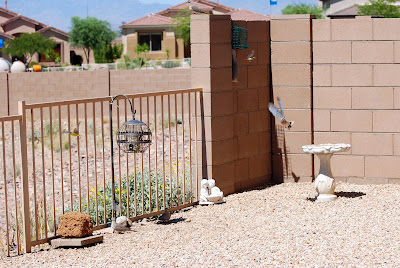
(Bird Feeding area on north side of house: Photo by Kathie 6-12-08 3:15 p.m. MST)
This year I am noticing the same pattern. Right now, the birds don’t bathe. They drink thirstily from the bird bath and water dish I put out for them, but they don’t bathe in it. Could it be that they, too, realize they need to conserve every precious drop?


(Gilded Flicker Photo by Kathie June 8, 2008 Nikon D80; focal length 300mm; F/5.6-1/1000 sec)


Like everyone else, I have birds that I see on a regular basis around here, but the population is always in flux and flow. While House Finches, Lesser Goldfinches and Mourning Doves are year round visitors, the White-winged Doves are summer birds for me, though they do overwinter in other areas as close as Green Valley. I am definitely seeing more Curved-billed Thrashers and Gilded Flickers. It is not at all unusual to see 3 or 4 Gilded Flickers or Gila woodpeckers at my feeders at one time. If they see me looking at them they try to hide behind the feeder, and peek around the edges to see if I am gone.
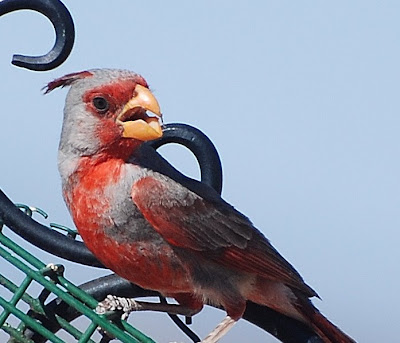


(Pyrrhuloxia photo by Kathie 6-10-08 Nikon D80; Focal length 300; F/5.6-1/640 sec)


The flickers, Gila Woodpeckers, Curved-billed Thrashers, Pyrrhuloxias and even the Cactus Wrens all like the peanuts. Phyrrhuloxias and Gambel’s quail seem to like safflower seed. If I put out a suet cake, it is gone in less than 2 days. In May a black-headed grosbeak stopped by to feed on the suet cake in my yard, but he was only here for a day or two, before he moved on. Still, I was able to capture a couple of shots through the window before he left. Notice the large conical beak from which he derives his name "grosbeak."


(Black-headed Grosbeak by Kathie May 2008 Nikon D80 focal length 300 F/5.6-1/320 sec)


I feed Niger seed to attract the Lesser Goldfinches. Of course, the house finches like it also. Sometimes a stray siskin shows up at the Niger seed feeder along with the finches. I tried finch food with white proso millet last year thinking that, since I live in the desert, I wouldn't have to worry about it sprouting. Well, when the Monsoon rains came I had a lawn growing on the side of my house. I spent the next month or two plucking grass each time I went to fill the feeders. I never feed the cheaper "Wild Bird Seed" that is sold in almost every grocery store as most of it is wasted as the birds spill it on the ground searching for black oil sunflower seeds in the mix. It also tends to attract the more undesirable birds like pigeons and house sparrows. Plus, it also tends to sprout. I do feed black oil sunflower seeds now and again, but not often as I don't want to have to cleanup the hulls from beneath the feeders. Instead, I use sunflower seed hearts which the birds love but be careful to watch for mold if it gets wet.


(Bird feeders as seen from my den window 6-12-08 @3:15 p.m. MST)

While I do put out a quail block to attract the quail, they are more interested in whatever falls from the bird feeders. It is the house sparrows that seem to like the quail block the best. Quail babies show up almost every day now, sometimes even twice a day. They follow their parents everywhere and can now fly as well as the adults if they feel threatened. This morning I noticed that papa quail has gone from being the look-out for the family to teaching his youngsters about the pecking order. Today as the family fed beneath the feeder, papa chased the younger birds away, while allowing Momma bird to feed at will. I think soon these youngsters will be out on their own, fending for themselves. Perhaps Mama will soon be setting on another clutch of eggs and the cycle will repeat itself again.

(Gambel's Quail female and young: Photo by Kathie 6-8-08 Nikon D80 Focal Length 300 F/5.6-1/200 sec.)

The cactus wrens are also showing up more often.


(Cactus wren photo by Kathie June 9, 2008 Nikon D80 Focal length 300 mm F/5.6 -1/250 sec)


They hunt along the edges of my house and bushes looking for insects hiding in the foliage or in cracks and crevices of the block walls and foundation. But they are not above snatching a peanut or too if the opportunity presents itself.


(Purple Martin photo by Kathie 7:30 a.m. 6-12-08 Nikon D80 sports mode)

I took a very short walk on the desert’s edge this morning and it was enough to convince me I need to go back out into the wash once again. I could hear and see birds all around me, and the purple martins were gliding through such deep blue skies you could almost imagine them swimming in air! I was so concerned that they wouldn’t come back, but they are here, out in the wash, nesting in the tall saguaros once again.


(Purple Martins and saguaro taken by Kathie 6-12-08 @ 7:30 a.m. MST with Nikon D80 set in sports mode.)

Tuesday, May 20, 2008

Birds At My Feeder

With migration and breeding in full swing I am getting so many birds at my feeder. On Friday alone these culprits showed up:


Papa Quail....


Mama Quail...


and babies!!!!!!!!!


I feel like the proud grandma!


Excuse me if I show off one more picture.


The gilded flickers come by almost everyday...


Thrashers are here in droves....


I keep looking for a Bendire's Thrasher with it's shorter, straighter bill, smaller triangular spots on its chest, pale base to its lower mandible and yellow eyes. Is this it? But then I read that juvenile Curve-billed thrashers are virtually identical to Bendire's Thrashers and since it is breeding and nesting season..., well, I just gave up on trying to find a Bendire's amongst my Curve-bills.

However, a beautiful Lark Sparrow was showing up for about 5 days last week. He was elusive at first, hiding in the wash and only hopping through the fence briefly, but finally he relaxed a bit and I was able to get this beautiful shot of his head.

Every few days a Canyon Towhee shows up. This one was here on Friday also.


I have discovered the Pyrrhuloxias love peanuts and I caught this one escaping from the feeder when I was busy photographing the baby quail. You can certainly see the short, stubby yellow beak that is so different from a Cardinal's. Plus, the Pyrrhuloxia does not have any black around its beak like a cardinal.


Can anyone say Kewpie Doll?


The White-winged doves are everywhere. They can be a nuisance and are the bullies of the feeders but I do love their beautiful faces.


At the end of the day as the sun was going down I glanced out the window to see this bird. I grabbed my camera, which, thank fully was within arm's reach, and snapped these photos of....

Do you know what this is?


Look at the red eye, the flat head, and the ruffed neck.

I saw my first one here last year on June 12, 2007. It's a Bronzed Cowbird!


Along with the regulars of Mourning Doves, Gila Woodpeckers, House Finches, House Sparrows and Lesser Goldfinches, I also had a Pine Siskin visiting for a couple of days. Cowbirds stop by every now and then. Lesser Nighthawks fly in the evening and early morning. Saturday I saw a Say's Phoebe in the wash and Turkey Vultures are seen daily along with Ravens. A roadrunner crossed in front of our car on Sunday and today, May 20th, I finally saw Purple Martins flying in and out of the Sentinel Saguaros at the top of the cul de sac where they stand guard on the rim of the canyon. My first sighting of them last year was May 21st.

Bye!

(I couldn't resist just one more photo of the baby Gambel's Quail!)
Note: All of today's photos were taken by Kathie on Friday, May 16, 2008 except for the Gilded Flicker photo which was taken earlier in the week. All photos were taken with the Nikon D80.