
(photo by Gus)
On Mother’s Day I get to choose what we do so I chose to avoid the crowds and get lost in nature instead. Gus and I drive east and then south on Highway 83 towards Sonoita through Davidson  Canyon. Just south of mile marker 40 we turn east into Las Cienegas, a National Conservation Area. Here the terrain is so different from the Sonoran Desert that surrounds my house. We drive over a cattle guard into a vast grassland reminiscent of an African Savannah. Mesquite trees dot the rolling hillsides while wildflowers bloom along the edges. The frilly white blossoms of this wildflower greet us as soon as we entered Las Cienegas, a fitting start to Mother’s Day.
I have no idea what to expect from Las Cienegas. We have only been here one time before and that was late in the evening in the winter when raptors were the most common bird we saw. That day we only drove about 5 miles into the NCA before it got dark and we had to leave. We are here early enough today at 8:00 a.m., but already the sun is beating down and the temperature rising. At this time of year many of the birds settle down for the day by ten a.m., but we are going enjoy the drive whether we see any birds or not. With such an open area, Gus says he won’t get any good opportunities for photographs.
 (Say's Phoebe: photo by Gus)
As soon as Gus pulls over to photograph the wildflowers we see our first bird. It is a Say’s phoebe, which surprises me since I haven’t seen them in over a month. Farther down the road a Cassin’s kingbird perches atop a sign before flying off to a nearby mesquite. The dirt road soon comes to a T and we turn left towards a creek area about 3 miles north. Here we pull into a parking lot beneath towering cottonwood trees. A large cottonwood trunk lies on the ground, its trunk naked and silver in the shade of its kin. The sounds of bird songs fill my ears as soon as I step from the car. My heat starts to beat like the wings of a nighthawk with fluttering anticipation. We head for the path at the far end of the parking area and enter another world.
The dirt trail winds through a bit of a meadow at first. Off to the right the cottonwood, willows and ash trees rim the small creek that flows. To the left mesquite and cottonwood trees grow on the edge of the meadow against steep caliche banks cracked by sun and water. Gus stops to photograph a butterfly feeding from a lavender thistle.

I hear birds all around me, and we spot an Abert’s towhee hiding in the thick foliage. As the path winds closer to the creek we suddenly spy a bright orange dragonfly clinging to a grass stem. Gus captures these beautiful images of this jewel-like insect.
 (Flame Skimmer Dragonfly Photo by Gus: Identification courtesy of Doug Taron at Gossemer Tapestry)
We drag ourselves away from the bug and enter the forest primeval, for that is what it feels like. We are here alone. All sights and sounds of civilization are gone. The tender new grasses and flower sprout beneath our feet. Duck weed floats in the slow moving creek. Lizards move through the grass and forest detritus and I startle easily after Saturday’s encounter with the rattlesnake. The dappled sunlight bathes the forest floor as we wander further down the path. Gus amazes me by spotting a summer tanager before I do. I have never seen one before and it is a life bird for me.

(Summer Tanager: Photo by Gus)
I marvel at the striking red of this bird set in the shadows of this dark grove. Soon the path narrows and hugs the giant roots of cottonwood trees on our left. To the right the bank has fallen away dropping 4 or more feet to the creek level. Gus and I both clamber over thick roots that hold the remaining soil together, but I can’t help thinking I wouldn’t want to be on this path during the coming monsoon! 
(photo by Gus)
We finally reach an area that has flattened out and we stand beneath towering trees. It is so quiet, save for the bird songs and the gentle rustle of leaves overhead. In this thick forest there is not much undergrowth and I wonder if there are any birds here at all, but the forest is ready to surprise us as a vermillion flycatcher lands on the dead limb of a nearby tree. It is a little female, but soon a male flies into view.

(Vermillion Flycatcher: Photo by Gus)
The pair chase each other back and forth through the trees, then alight on a limb to mate. We linger in this area for quite awhile as more vermillion flycatchers and summer tanagers flit in and out of the trees. Suddenly I hear a loud ruckus in the trees above me. Gus and I tip our heads to see what is causing the commotion. We locate the sound just in time to see a smaller bird chasing a larger white bird from the treetops. A white-tailed kite! I have read about them on the way down here and now I am seeing one for the first time. I watch its white rump disappear over the forest edge and silence descends on the forest once again.
 (photo by Gus)
We turn and head back to the parking area as my throat is getting quite dry. Once back on the other side of the giant tree roots we are closer to the water once again. Now I spot a yellow-breasted chat along the creek edge. Then I find another. Next, a song sparrow flies to a sapling and sings its melodious song, its head tipped back to let the notes roll from its tiny throat. Such a big song for such a small bird!

(Song Sparrow: photo by Gus)
I spot a flash of yellow and find a common yellow-throat. Maybe common for some, but this is also a life bird for me.
(Yellow-breasted chat: photo by Gus)
Gus is able to capture one image before the bird disappears into the greenery. Next we finally find the source of the constant tapping we have heard ever since entering this wood.

 (Pipevine Swallowtail Butterfly Photo by Gus: Identification courtesy of Doug at Gossemer Tapestry)
As we step from the shade of the woods into the meadow again it is like stepping into an oven. The canopy of the trees kept us comfortably cool, but here in the desert southwest it’s all about radiant heat. The sun warmed air is hot and dry and we head for our car for much needed liquid refreshment. On the way across the meadow we find a Pipevine Swallowtail butterfly sipping on thistle nectar.

(Photo by Kathie)
While Gus rests in the shade of the car, I wander around under the giant cottonwood grove. I see more summer tanagers, more vermillion flycatchers, ash-throated flycatchers, and, to my surprise, a nesting pair of white-breasted nuthatches going in and out of this hole in a tree limb with moths in their beaks to feed their young.

(White-breasted Nuthatches in nest hole: Photo by Kathie)
Then, as I am about to leave, I spot a small sparrow hopping and digging beneath one of the cottonwood trees. When I look with my binoculars I see a rusty cap, and a white malar stripe bordered by black. My heart starts to pound for I think this is a Rufous-crowned sparrow, an elusive sparrow that I have been on the search for ever since I learned about it. I keep hoping to see one in Sycamore Canyon, but so far have only found Rufous- winged sparrows and Chipping sparrows. This species is differentiated from the other two rusty capped sparrows by its conspicuous eye-ring, and only one dark whisker mark. The rufous-winged sparrow has two. The chipping sparrow has none. Since I have the camera with me I snap off 30 or more photos. Once at home I am able to confirm my suspicions. Yet another lifer for me today!
 (Rufous-crowned sparrow: photo by Kathie)

(Photo by Gus)
We find two more Cassin’s Kingbirds and then a pair of Black-throated sparrows alongside the road. Then I spot a sparrow with a very patterned face. We stop the car and as Gus tries to get a photograph it flies off to the safety of a mesquite bush. Still, he is able to get this photo of the beautiful face of a lark sparrow!
(Lark sparrow photo by Gus)
 Just as Route 82 comes into view we come to a cattle guard and to my surprise I see a male and female lark bunting on the dirt road before us. The cows in the nearby corral quietly chew their cuds and stare at the crazy humans so enthralled with birds. Our final bird of the day we find accidently as we followed the flight of another kingbird right in front of our car. Gus stopped to get a photo but the bird flew off to more distant cover, but there on a small shrub right next to it this horned larked clung to the twigs with sunlight pouring down, it’s feathery horns raised in beautiful display. Since it was on my side of the car, Gus handed me the camera and I got this shot, the last of the day.
 ( Horned Lark: Photo by Kathie)
In the end, after all my fears of not seeing any birds and Gus’ fear that they would all be too far away for any good shots, I ended up recording 29 species of birds (and it would have been more if I could have indentified the flycatchers and the thrush) and Gus got more than enough opportunity to get some awesome photographs. His favorite is the dragonfly and this shot of last year’s yucca blooms against the desert sky.

To read about Doug Taron's interesting adventure at Las Cienegas click here.


 Ash-throated flycatchers cling to an ocotillo searching the sky for insects to dine on. A gilded flicker calls from atop a towering saguaro which looks like a giant prickly pickle thrust into the azure blue sky. Gus is captivated with the beauty of the desert and stops to photograph the spines of a teddy bear cholla. White-winged doves are thick as fleas this time of year and I see them perched on the blooming saguaros and flying overhead from one rim of the canyon to the other. Then, to my surprise, a lesser nighthawk flutters overhead and disappears in the distance in its final search for insects before bedding down for the day.


 Gus is snapping pictures of whatever captures his fancy, including this Empress Leilia butterfly.


 We head through a narrow sandy channel still looking for birds. Suddenly I hear a buzzy rattle and instinctively leap backwards. There on the open sand before me a rattlesnake is coiled in a striking posture. About 3 feet long its thick tan body is patterned with diamond-shaped spots leading me to susspect it is most likely a
 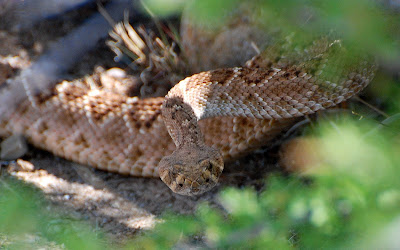 I walk backwards, heart pounding to a safe distance. Gus gets in front of me and starts snapping. He keeps his distance also and the rattler slithers off to the shade and safety of a nearby bush. Gus is disappointed because he wants a better shot. I want to head home because my bladder, which was already wanting relief, is now about to burst from the encounter. I walk up another small bank and around the area where the snake is. Gus finally follows me, but he is still searching for a better shot. As we come down on the other side of the snake, he tries again. I know that home is only a short distance away but I am reluctant to leave this crazy photographer alone in the wash with this snake. I urge him onwards and we hike out the last few steps to home.
 My final count of birds is 24 species but 4 are unidentified. I heard the high buzzy whistling flight of a hummer species but never saw the bird to positively identify it. We have 3 hummer species here whose wings produce that sound. I heard and saw a gnatcatcher but once again, it eluded my attempts to positively identify it. A chunky short-tailed blackbird flew overhead that I suspect was a bronzed cowbird, but, once again, I wasn't confident enough to call it. And though I saw the one sparrow at the beginning of the hike, I never saw another on the rest of the hike. My one mystery bird is this little brown job that I think is a female brown-headed cowbird, but it could be a female indigo bunting as well.
 I am going with the brown-headed cowbird as a flock of 5 showed up at my feeders for the first time this year this morning before we left. All in all, I would say it was a great way to celebrate International Migratory Bird Day. I was able to add a new species to my Sycamore Canyon list, and Gus got his rattlesnake photo. I hope we will be doing this again for there is so much more to explore here in Sycamore Canyon.


 As a result, we saw a Black-crowned Night Heron in a wooded area near some water, and an Inca dove feeding on the ground beneath a bird feeder suspended from a tree. The Inca dove was feeding with a flock of house sparrows and you can really get a good idea of their size in relation to that common bird. Inca doves are quite small. You can see their all over scaly pattern in this picture.
 Ground doves would be ruddy colored underneath their wings, and these weren’t, plus, ground doves also have a pinkish or orange-ish base to their bills and these clearly don’t.
  Gus took all the pictures at the zoo and I have to confess, this one is my favorite. I’m including it here, simply because I love the feathers. Can you guess what bird it is? Enjoy!


 We stop alongside the road when we see a Cooper’s hawk perched in a mesquite tree. As we creep closer we realize it is eating prey.
  Whatever the hawk clutches in its talons is already too ripped up to identify, but this Coopers is certainly enjoying a hearty breakfast today. This is good as Jean informs me they have 2 nesting pairs of Cooper’s hawks here at this end of the canyon.
  Well, this bird doesn’t appear to be sharing as it gulps down bit after bit of torn flesh. It is undisturbed by our presence as we stand and watch, and I snap of shot after shot of the feeding bird.
 No chance of that happening with me! I’ll just enjoy looking at them, thank you! Since it is peak migration we hope to see some new birds today. It hasn’t rained in quite awhile and I can tell the creek level has definitely fallen since the last time we were here. It is rattlesnake season, however, and we keep a close lookout for where we place our feet as we head down the transect route along the riparian area. While we don't find any rattlesnakes, we do find this cone shaped depression in the sand which indicates the presence of an


 With such a thick tail, it’s almost hard to tell which end is which, but you can clearly see the eyes in this head shot.
  I have been told that seeing a Gila monster in the wild is a rare occurrence but though I have only lived here a year, I have seen three of them in the wild!


