Tuesday, June 17, 2008

Well, it's Too Darned Hot! (but the birds are still here)

With temperatures reaching 104 by 9:30 a.m. MST I am not venturing too far from home these days. The summer heat for me is what winter cold was like living in the north. It is the time of year to stay home, do indoor projects, or curl up in the air conditioning and watch a movie. The birds are drinking water faster than I can fill the dishes, but still they come for seed and peanuts. I have discovered that they are occasionally salad feeders and my verbena and petunias have fallen victim to their foraging. One day I had flowers, then next day stubble! On Friday night around 6:30 p.m. a flock of house finches flew into the yard and started grazing on this weed I allowed to grow beneath my newly planted Palo Verde tree. I figured the leaves would help shade the roots and keep the tree a tiny bit cooler. I had no idea I was providing a salad bar! The shadow from the house had fallen across the tree and the little house finches are perfectly camouflaged beneath it. Look closely and see how many you can find.

Photo taken 6-13-08 by Kathiesbirds


Another well camouflaged bird in Sycamore Canyon is the Canyon Towhee. Canyon towhees are one of the scruffiest non-descript birds I have ever seen. When I saw my first one here last year I thought it was a cross between a House Finch and a Curved-billed Thrasher. It wasn’t until I looked it up that I learned what it really was. On Saturday morning Gus and I took a walk in the canyon and this bird flew out from the bank and landed on a rock in the middle of the wash in front of us. Can you see it?

Photo taken by Gus 6-14-08 around 7:30 a.m. MST

We stood frozen and watched as it proceeded to walk the rest of the way across the gravel canyon bottom. Its bedraggled appearance coupled with its dirt-colored feathers provides perfect camouflage as it crosses this wide expanse. It must have walked at least 15 feet pausing every few steps to look around before continuing onward. Whenever it stood still, it looked like a stone. Once it reached the opposite bank, it disappeared into the brush.


Canyon Towhee Photo taken by Gus 6-14-08 Cropped and enlarged.


On Saturday as the sun was setting in the west, these two flickers and a Gambel’s Quail came for their evening meal. In the golden light of the setting sun, they lined up like a perfect birdie totem pole, so I grabbed the camera and snapped away!


Photo by Kathiesbirds 6-14-08

We have our own bird tribe here in Sycamore Canyon!


Gambel's Quail Tribal Mask 8x10 Acrylic on Canvas Copyright 2008 by Kathiesbirds

Sunday, June 15, 2008

How to Make a Grown Man Cry

Thursday night when Gus picked up the mail there was a small padded envelope addressed to Gus from our youngest son. I have not mentioned it before because I wanted to protect him, but our youngest son just returned from fighting in Iraq. Even though the package was addressed to Gus, he passed it to me and left the room. As soon as I opened it, I knew what it was and that it was meant for his Dad. Below is a picture of our son with what the package contained, and what was written in the card. It was enough to make a grown man cry.


Happy Father’s Day to my sweet husband, Gus the father of our four children.


Happy Father’s Day to my dear father-in-law who fought in the Korean War as a sailor and is the only father I have.


Happy Father’s Day to my oldest son, G, who is a new father this year. This is his first Father’s Day.


Happy Father’s Day to my middle son, who loves his kids so much.


Happy Father’s Day to all our service men who fight to keep us safe, who fight to keep us free.


Happy Father’s Day to all the fathers out there who love their children with unconditional love.

Friday, June 13, 2008

NIGHTHAWK! (Skywatch Friday)

Lesser Nighthawk: Photo No. 8 in series of 9 all taken by Kathie June 12, 2008 @ approx. 7:30 a.m. MST in Sycamore Canyon Wash. All photos shot with the Nikon D80 70 -300mm zoom lens set in sports mode. All photos copyright of Kathiesbirds 2008.

Lesser Nighthawk No. 1

I got it! For those of you new to this blog, a few weeks ago I posted this entry berating the fact that I could not get a shot of a Nighthawk. Well, dear sweet husband gallantly said, I'll get that photo for you honey, and this Nighthawk Photo was his attempt. I love the artistic quality but you really can't see the bird. But, yesterday morning when I was out in the wash shooting pictures of Purple Martins, this beauty was still up hunting insects and he came swooping and gliding right towards me and then past. Look at the whole series to get the feeling of this magnificent flyer who eats a pile of insects every night. Nature's insect control in not harmful to the environment and so much more fun to watch!
Lesser Nighthawk 2
Lesser Nighthawk 3
Lesser Nighthawk No. 4.
Lesser Nighthawk 5

Lesser Nighthawk 6


Lesser Nighthawk 7


Lesser Nighthawk 9

Lesser Nighthawks are cepuscular birds, hunting insects mainly at dawn and dusk. The Lesser Nighthawk, also known as the Trilling or Texas Nighthawk, is different from the more common nighthawk in range and voice. Lesser nighthawks hunt and breed over semi arid desert and grassland. the female lays 2 eggs on the ground and stays with them to incubate the young. While she tends to the eggs, the male hunts and brings her food. Nighthawks belong to a group of birds called Goatsuckers on the mistaken belief that, with their wide mouths, they sucked milk from goats. To learn more about Nighthawks visit:


All About Birds Online

Wikipedia

Whatbird


To see more entries visit Skywatch Friday hosted by Wigger's World.

Thursday, June 12, 2008

Sycamore Canyon Birds: What I'm Seeing and What I'm Feeding

(Purple Martin on Ocatillo by Kathie 5-22-08 Nikon D80: Focal length 300mm; F/5.6-1/800 sec)

We are at the end of dry summer now with whispers of the Monsoon’s soon approach. Already the weather forecasters are tracking it, watching as the moisture inches ever closer up from the Gulf of Mexico. For now, the desert grasses have turned to gold, the ocatillo have dropped their leaves, while the prickly pear fruit is starting to ripen.

(House Finches in feeder June 12, 2008 3:15 p.m. MST Photo by Kathie)


Here in Sycamore Canyon the birds are most active morning and evening, but they still come to my feeders and bird bath pretty much all day. The air is so dry that I refill the bird bath twice a day since it evaporates so quickly. When I first moved here last year and set the thing up, I was surprised that the birds did not bath in it. I thought maybe they didn’t know how to bathe, since they are desert birds, but, when the Monsoon came and rain was a regular occurrence, they seemed to relish splashing in the water and drying in the sun afterwards.
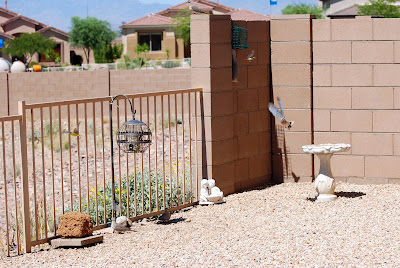
(Bird Feeding area on north side of house: Photo by Kathie 6-12-08 3:15 p.m. MST)
This year I am noticing the same pattern. Right now, the birds don’t bathe. They drink thirstily from the bird bath and water dish I put out for them, but they don’t bathe in it. Could it be that they, too, realize they need to conserve every precious drop?


(Gilded Flicker Photo by Kathie June 8, 2008 Nikon D80; focal length 300mm; F/5.6-1/1000 sec)


Like everyone else, I have birds that I see on a regular basis around here, but the population is always in flux and flow. While House Finches, Lesser Goldfinches and Mourning Doves are year round visitors, the White-winged Doves are summer birds for me, though they do overwinter in other areas as close as Green Valley. I am definitely seeing more Curved-billed Thrashers and Gilded Flickers. It is not at all unusual to see 3 or 4 Gilded Flickers or Gila woodpeckers at my feeders at one time. If they see me looking at them they try to hide behind the feeder, and peek around the edges to see if I am gone.
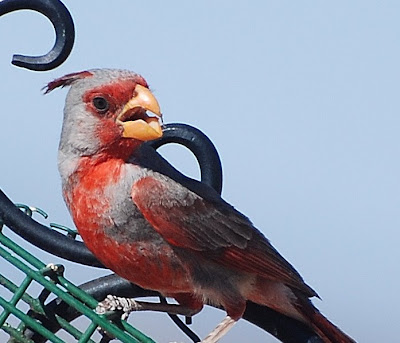


(Pyrrhuloxia photo by Kathie 6-10-08 Nikon D80; Focal length 300; F/5.6-1/640 sec)


The flickers, Gila Woodpeckers, Curved-billed Thrashers, Pyrrhuloxias and even the Cactus Wrens all like the peanuts. Phyrrhuloxias and Gambel’s quail seem to like safflower seed. If I put out a suet cake, it is gone in less than 2 days. In May a black-headed grosbeak stopped by to feed on the suet cake in my yard, but he was only here for a day or two, before he moved on. Still, I was able to capture a couple of shots through the window before he left. Notice the large conical beak from which he derives his name "grosbeak."


(Black-headed Grosbeak by Kathie May 2008 Nikon D80 focal length 300 F/5.6-1/320 sec)


I feed Niger seed to attract the Lesser Goldfinches. Of course, the house finches like it also. Sometimes a stray siskin shows up at the Niger seed feeder along with the finches. I tried finch food with white proso millet last year thinking that, since I live in the desert, I wouldn't have to worry about it sprouting. Well, when the Monsoon rains came I had a lawn growing on the side of my house. I spent the next month or two plucking grass each time I went to fill the feeders. I never feed the cheaper "Wild Bird Seed" that is sold in almost every grocery store as most of it is wasted as the birds spill it on the ground searching for black oil sunflower seeds in the mix. It also tends to attract the more undesirable birds like pigeons and house sparrows. Plus, it also tends to sprout. I do feed black oil sunflower seeds now and again, but not often as I don't want to have to cleanup the hulls from beneath the feeders. Instead, I use sunflower seed hearts which the birds love but be careful to watch for mold if it gets wet.


(Bird feeders as seen from my den window 6-12-08 @3:15 p.m. MST)

While I do put out a quail block to attract the quail, they are more interested in whatever falls from the bird feeders. It is the house sparrows that seem to like the quail block the best. Quail babies show up almost every day now, sometimes even twice a day. They follow their parents everywhere and can now fly as well as the adults if they feel threatened. This morning I noticed that papa quail has gone from being the look-out for the family to teaching his youngsters about the pecking order. Today as the family fed beneath the feeder, papa chased the younger birds away, while allowing Momma bird to feed at will. I think soon these youngsters will be out on their own, fending for themselves. Perhaps Mama will soon be setting on another clutch of eggs and the cycle will repeat itself again.

(Gambel's Quail female and young: Photo by Kathie 6-8-08 Nikon D80 Focal Length 300 F/5.6-1/200 sec.)

The cactus wrens are also showing up more often.


(Cactus wren photo by Kathie June 9, 2008 Nikon D80 Focal length 300 mm F/5.6 -1/250 sec)


They hunt along the edges of my house and bushes looking for insects hiding in the foliage or in cracks and crevices of the block walls and foundation. But they are not above snatching a peanut or too if the opportunity presents itself.


(Purple Martin photo by Kathie 7:30 a.m. 6-12-08 Nikon D80 sports mode)

I took a very short walk on the desert’s edge this morning and it was enough to convince me I need to go back out into the wash once again. I could hear and see birds all around me, and the purple martins were gliding through such deep blue skies you could almost imagine them swimming in air! I was so concerned that they wouldn’t come back, but they are here, out in the wash, nesting in the tall saguaros once again.


(Purple Martins and saguaro taken by Kathie 6-12-08 @ 7:30 a.m. MST with Nikon D80 set in sports mode.)

Monday, June 9, 2008

The Best Laid Plans


Well, the best laid plans of mice and men often go awry. Our plans to go to Cave Creek Canyon had to be put on hold due to the high cost of gasoline and needing to buy plane tickets to fly back east this summer. In an attempt to still redeem the weekend, we went to Sweetwater Wetlands on Sunday instead. While I have been there several times, most recently with Kathryn in March, Gus has never been. We should have left early on Sunday morning, but it was late by the time we got out the door and we didn’t arrive until almost 11 a.m. By now the sun is high overhead and we can feel the heat as soon as we step from the car. Still, Sweetwater is surrounded by trees in most areas so I expected the shade to keep us somewhat cool. Though the temperature is high and the air dry, I didn’t take my water with me as it is just a short walk back to the vehicle where we have a cooler full of drinks.


We head down the paved path past the information kiosk and over the bridge. The sounds of birds are everywhere and already I am seeing Barn Swallows, Northern Rough-winged Swallows, and White-winged Doves. The raucous calls of Great-tailed Grackles fill the air and more subtly behind that I can hear the trill of Red-winged Blackbirds. The Yellow-headed Blackbirds that Kathryn and I saw when we were here have apparently migrated north, for I don’t see or hear even one.

The middle of the day like this is just about the worst time to be out birding at this time of year, but we have high hopes of seeing something. Now we scan the brush and ponds to see what we can see. I’m amazed at how high the cattails and bulrushes have grown, for I can’t see into the first pond at all except for small glimpses between the greenery. When I do see open water, there are no ducks at all, where previously there were hundreds. Finally in a little channel under the branches of an overhanging tree I spot a pair of Cinnamon Teals floating lazily in the current. However, the insects are out in force and Gus photographs these two just a short distance form each other.


Blue dasher dragonfly (Left) ID. courtesy of Doug Taron

At the Island Pond I scan the banks of the island for any sign of life and spot a pair of mallards sleeping on the shore. Then a coot comes paddling out from the reeds white beak shining in the bright sunlight.

Lizards are everywhere rustling in the bushes, or scampering across our path. A big fat guy is sunning himself on the trail but moves off quickly as we get closer. Next, a male Gambel’s Quail scurries across the path. He crosses to one side, then doubles back before returning to the other side again. Gus comments on how he looks like one of those mechanical birds in a shooting range game at a carnival. Most of the recharge basins are empty and dry right now, but we discover that recharge basin 5 is full of water. I hear the cries of killdeer and soon spot them on the shoreline. But then, to my surprise, I also spot 3 black-necked stilts feeding in the shallow water. While I can see them fine in my binoculars, they are still quite far away for the camera to capture them with its 300mm zoom lens, but Gus makes a valiant effort for my sake.


Now we are standing on the area known as The Knoll if you check out this map.


The killdeer and stilts are down in the recharge basin, but I am surprised to see water in Overlook Pond. I have never walked out this way or seen water in this pond before, so Gus and I head on down the path. By now we have been here for an hour and I am starting to feel the heat. My mouth is getting so dry and I want a drink of water, but the water is back at the car, and we have walked farther than I anticipated. I find a bench under a tree and stand in the shade to see what I can see. There are swallows dipping over the water and landing on the branches of a dead tree that overhangs the pond. I study them carefully trying to determine what I am seeing. The birds are mostly a dull brown with a totally brown head that fades to a light gray or white on their breasts and underbellies. I am sure I am seeing Northern Rough-winged swallows but they are suppose to be solitary, so I am surprised to see 5 of them hanging out together.


While I am watching swallows, Gus is stalking a Great Egret he sees farther down the path. I watch as he gets closer and the bird spies him. It crouches down, lowering its long neck, trying to disappear. Finally, it decides Gus is too close and it lifts its great white wings and flies off a short distance to hide in the reeds again. Gus strolls back towards me and I take the camera to photograph the swallows on the distant shore. I don’t expect to get any great shots, but it’s helpful to be able to confirm the identity when we get home.


By now I am so hot and thirsty that I tell Gus we need to head back towards the car. As we round the curve of the pond I stop in my tracks. I can't believe my eyes, for there in a willow tree a flock of 15 Northern Rough-winged Swallows are perched in the branches. (How many can you see?) And I thought 5 together was unusual!


They are right beside the path, so I freeze while Gus gets some shots. They almost look fake, don't they? But they are very real.


The little birds are sitting with their mouths open, panting in the heat.

Then, one breaks into song and Gus take a shot of the bird with its beak open.


We find a small path through from this pond up to the main trail and I tell Gus to follow this back to the car. I hurry on ahead for I can tell by the way my body feels that I am getting dehydrated. I try to hurry back to the car but can’t resist stopping to identify an Abert’s Towhee, an Anna’s Hummingbird, and a Gilded Flicker on the way. I pass a man standing near the Gazebo Pond. He has a tripod and a camera with a long lens on it, but I don’t stop to talk. At the car I open the cooler and guzzle a pint of water. Then, I get another bottle out to take back with me. It is my intention to meet up with Gus and continue birding, but here he comes walking down the path.He has had enough of the heat also, so we get into the air-conditioned vehicle and talk. He tells me he spoke with the guy with the camera and he was looking for the Elegant Trogon! Someone had seen it here just an hour ago, but no luck so far. I wished I had known that was even a possibility. I wouldn’t have wasted time on mallards and grackles; I would have been scouring the trees for this elusive bird. I have yet to capture it for my life-list and what an awesome photographic opportunity that would have been for Gus! Just before we leave we see the guy come walking out with his camera. He tells us he never saw it, so we drive away.

Perhaps we will make it to Cave Creek Canyon in a week or two (To see some awesome photos click on the link). From the information I have read, spring and summer are the best times to be there. For now, we head back home with our picnic we intended to eat at Catalina State Park where even the shade is too warm.

Friday, June 6, 2008

Skywatch Friday: Sieze the Moment

Sunset June 1, 2008 @ 7:36 p.m. taken by Kathie with the Nikon D80

Sunset 7:36 p.m.


7:36 p.m. June 1, 2008


Following Troy and Martha's advice from last week's post about Sunsets in Yosemite and Golden, B.C. (Ramblings around Texas) I grabbed my camera and ran out the front door to shoot these pictures of the sunset last Sunday night. I was on the phone with my mother and Gus had just left to walk the dog, so I'm standing in my front yard trying to hold the phone with one hand and snap photos with the other. Finally I asked my Mom to hang on a minute and I put the phone down. All these photos are taken within a 1-minute time period and are of the same sky. It amazes me how the patterns and colors can change depending on where you look. Notice how the colors deepen as the sun gets lower in the sky. Though I rotated my body, all these photos were taken while standing in the same spot at the corner of my house! None of them were cropped or enhanced in anyway. Sure is great to live in Arizona!
7:37 p.m. MST 6-1-08


7:37 p.m. MST 6-1-08


To see Gus' skwatch photos visit Gusto! In an intersting twist this week, he's got the bird shots and I have the sunset!

To see my other Skywatch post visit Kathie's Poet Tree

7:37 p.m. MST June 1, 2008 Photo by Kathie